Sivajohan Brintha, Elgendi Mohamed, Menon Carlo, Allaire Catherine, Yong Paul, Bedaiwy Mohamed A
Schulich School of Medicine & Dentistry, Western University, London, ON, Canada.
Department of Obstetrics and Gynecology, Faculty of Medicine, University of British Columbia, Vancouver, BC, Canada.
NPJ Digit Med. 2022 Aug 4;5(1):109. doi: 10.1038/s41746-022-00638-1.
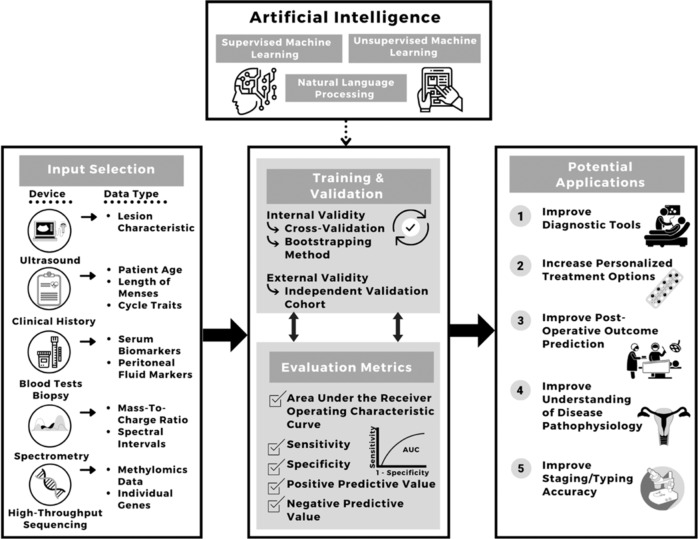
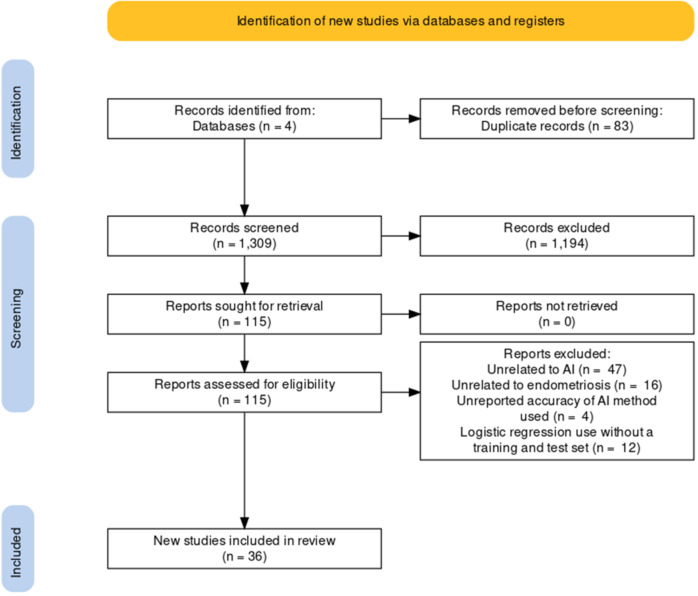
Endometriosis is a chronic, debilitating, gynecologic condition with a non-specific clinical presentation. Globally, patients can experience diagnostic delays of ~6 to 12 years, which significantly hinders adequate management and places a significant financial burden on patients and the healthcare system. Through artificial intelligence (AI), it is possible to create models that can extract data patterns to act as inputs for developing interventions with predictive and diagnostic accuracies that are superior to conventional methods and current tools used in standards of care. This literature review explored the use of AI methods to address different clinical problems in endometriosis. Approximately 1309 unique records were found across four databases; among those, 36 studies met the inclusion criteria. Studies were eligible if they involved an AI approach or model to explore endometriosis pathology, diagnostics, prediction, or management and if they reported evaluation metrics (sensitivity and specificity) after validating their models. Only articles accessible in English were included in this review. Logistic regression was the most popular machine learning method, followed by decision tree algorithms, random forest, and support vector machines. Approximately 44.4% (n = 16) of the studies analyzed the predictive capabilities of AI approaches in patients with endometriosis, while 47.2% (n = 17) explored diagnostic capabilities, and 8.33% (n = 3) used AI to improve disease understanding. Models were built using different data types, including biomarkers, clinical variables, metabolite spectra, genetic variables, imaging data, mixed methods, and lesion characteristics. Regardless of the AI-based endometriosis application (either diagnostic or predictive), pooled sensitivities ranged from 81.7 to 96.7%, and pooled specificities ranged between 70.7 and 91.6%. Overall, AI models displayed good diagnostic and predictive capacity in detecting endometriosis using simple classification scenarios (i.e., differentiating between cases and controls), showing promising directions for AI in assessing endometriosis in the near future. This timely review highlighted an emerging area of interest in endometriosis and AI. It also provided recommendations for future research in this field to improve the reproducibility of results and comparability between models, and further test the capacity of these models to enhance diagnosis, prediction, and management in endometriosis patients.
子宫内膜异位症是一种慢性、使人衰弱的妇科疾病,临床表现不具有特异性。在全球范围内,患者可能会经历约6至12年的诊断延迟,这严重阻碍了适当的治疗,并给患者和医疗系统带来了巨大的经济负担。通过人工智能(AI),可以创建能够提取数据模式的模型,作为开发干预措施的输入,其预测和诊断准确性优于传统方法以及当前护理标准中使用的工具。这篇文献综述探讨了使用AI方法解决子宫内膜异位症中的不同临床问题。在四个数据库中总共发现了约1309条独特记录;其中,36项研究符合纳入标准。如果研究涉及使用AI方法或模型来探索子宫内膜异位症的病理学、诊断、预测或管理,并且在验证模型后报告了评估指标(敏感性和特异性),则这些研究具有入选资格。本综述仅纳入了英文可获取的文章。逻辑回归是最常用的机器学习方法,其次是决策树算法、随机森林和支持向量机。约44.4%(n = 16)的研究分析了AI方法对子宫内膜异位症患者的预测能力,47.2%(n = 17)探索了诊断能力,8.33%(n = 3)使用AI来增进对疾病的了解。模型使用不同的数据类型构建,包括生物标志物、临床变量、代谢物光谱、基因变量、影像数据、混合方法和病变特征。无论基于AI的子宫内膜异位症应用是诊断性还是预测性的,合并敏感性范围为81.7%至96.7%,合并特异性范围为70.7%至91.6%。总体而言,AI模型在使用简单分类方案(即区分病例和对照)检测子宫内膜异位症方面显示出良好的诊断和预测能力,为AI在不久的将来评估子宫内膜异位症指明了有前景的方向。这篇及时的综述突出了子宫内膜异位症和AI这一新兴的研究领域。它还为该领域未来的研究提供了建议,以提高结果的可重复性和模型之间的可比性,并进一步测试这些模型增强子宫内膜异位症患者诊断、预测和管理的能力。