Hilton Ryan S, Hauschildt Katrina, Shah Milan, Kowalkowski Marc, Taylor Stephanie
Wake Forest University School of Medicine, Winston-Salem, NC.
Center for Clinical Management and Research, VA Ann Arbor Health Care System, Ann Arbor, MI.
Crit Care Explor. 2022 Jul 29;4(8):e0722. doi: 10.1097/CCE.0000000000000722. eCollection 2022 Aug.
To summarize knowledge and identify gaps in evidence about the relationship between social determinants of health (SDH) and postsepsis outcomes.
We conducted a comprehensive search of PubMed/Medical Literature Analysis and Retrieval System Online, Excerpta Medica database, and the Cochrane Library.
We identified articles that evaluated SDH as risk factors for mortality or readmission after sepsis hospitalization. Two authors independently screened and selected articles for inclusion.
We dual-extracted study characteristics with specific focus on measurement, reporting, and interpretation of SDH variables.
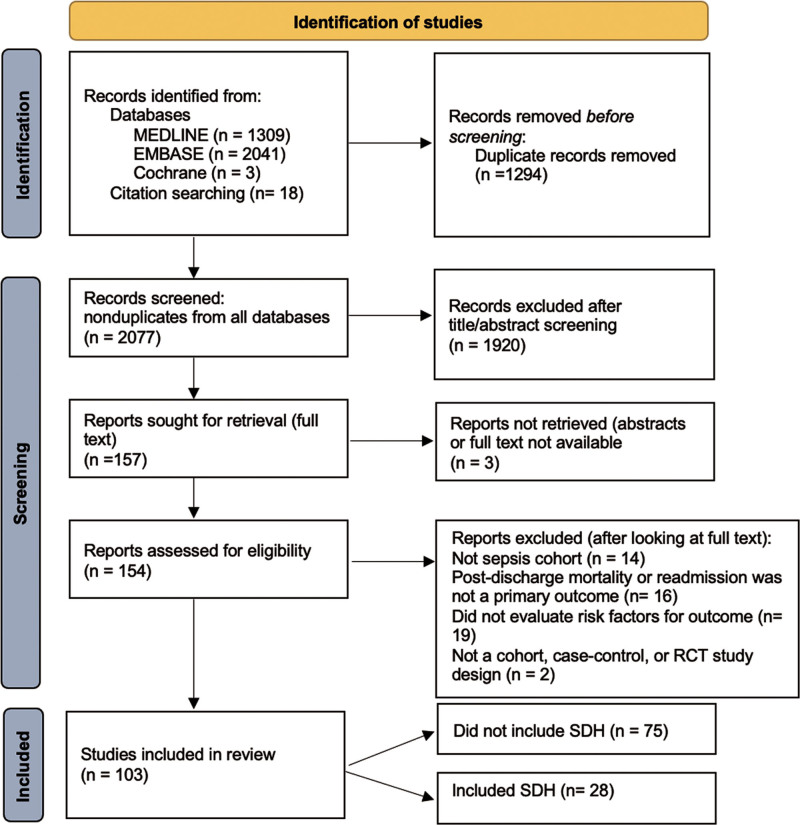
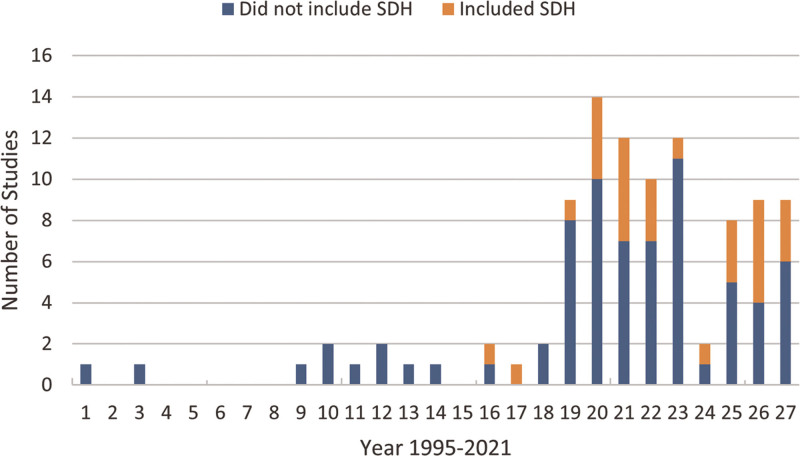
Of 2,077 articles screened, 103 articles assessed risk factors for postsepsis mortality or readmission. Of these, 28 (27%) included at least one SDH variable. Inclusion of SDH in studies assessing postsepsis adverse outcomes increased over time. The most common SDH evaluated was race/ethnicity ( = 21, 75%), followed by payer type ( = 10, 36%), and income/wealth ( = 9, 32%). Of the studies including race/ethnicity, nine (32%) evaluated no other SDH. Only one study including race/ethnicity discussed the use of this variable as a surrogate for social disadvantage, and none specifically discussed structural racism. None of the studies specifically addressed methods to validate the accuracy of SDH or handling of missing data. Eight (29%) studies included a general statement that missing data were infrequent. Several studies reported independent associations between SDH and outcomes after sepsis discharge; however, these findings were mixed across studies.
Our review suggests that SDH data are underutilized and of uncertain quality in studies evaluating postsepsis adverse events. Transparent and explicit ontogenesis and data models for SDH data are urgently needed to support research and clinical applications with specific attention to advancing our understanding of the role racism and racial health inequities in postsepsis outcomes.
总结关于健康的社会决定因素(SDH)与脓毒症后结局之间关系的知识,并找出证据中的差距。
我们对PubMed/医学文献分析与在线检索系统、医学文摘数据库和考克兰图书馆进行了全面检索。
我们确定了评估SDH作为脓毒症住院后死亡或再入院风险因素的文章。两位作者独立筛选并选择纳入的文章。
我们对研究特征进行了双重提取,特别关注SDH变量的测量、报告和解释。
在筛选的2077篇文章中,103篇文章评估了脓毒症后死亡或再入院的风险因素。其中,28篇(27%)纳入了至少一个SDH变量。在评估脓毒症后不良结局的研究中,SDH的纳入随着时间的推移有所增加。评估最多的SDH是种族/族裔(n = 21,75%),其次是付款人类型(n = 10,36%)和收入/财富(n = 9,32%)。在纳入种族/族裔的研究中,九篇(32%)未评估其他SDH。只有一篇纳入种族/族裔的研究讨论了将该变量用作社会劣势替代指标的情况,且没有研究专门讨论结构性种族主义。没有研究专门探讨验证SDH准确性或处理缺失数据的方法。八篇(29%)研究包含缺失数据不常见的一般性陈述。几项研究报告了SDH与脓毒症出院后结局之间的独立关联;然而,这些研究结果参差不齐。
我们的综述表明,在评估脓毒症后不良事件的研究中,SDH数据未得到充分利用且质量不确定。迫切需要用于SDH数据的透明且明确的本体论和数据模型,以支持研究和临床应用,尤其要关注增进我们对种族主义和种族健康不平等在脓毒症后结局中作用的理解。