• 文献检索
  • 文档翻译
  • 深度研究
  • 学术资讯
  • Suppr Zotero 插件Zotero 插件
  • 邀请有礼
  • 套餐&价格
  • 历史记录
应用&插件
Suppr Zotero 插件Zotero 插件浏览器插件Mac 客户端Windows 客户端微信小程序
定价
高级版会员购买积分包购买API积分包
服务
文献检索文档翻译深度研究API 文档MCP 服务
关于我们
关于 Suppr公司介绍联系我们用户协议隐私条款
关注我们

Suppr 超能文献

核心技术专利:CN118964589B侵权必究
粤ICP备2023148730 号-1Suppr @ 2026

文献检索

告别复杂PubMed语法,用中文像聊天一样搜索,搜遍4000万医学文献。AI智能推荐,让科研检索更轻松。

立即免费搜索

文件翻译

保留排版,准确专业,支持PDF/Word/PPT等文件格式,支持 12+语言互译。

免费翻译文档

深度研究

AI帮你快速写综述,25分钟生成高质量综述,智能提取关键信息,辅助科研写作。

立即免费体验

RECOVERY 是否应该使用反应适应性随机化?来自模拟研究的证据。

Should RECOVERY have used response adaptive randomisation? Evidence from a simulation study.

机构信息

University of Exeter College of Medicine and Health, Exeter, UK.

NIHR ARC South West Peninsula (PenARC), College of Medicine and Health, University of Exeter, Exeter, England.

出版信息

BMC Med Res Methodol. 2022 Aug 6;22(1):216. doi: 10.1186/s12874-022-01691-w.

DOI:10.1186/s12874-022-01691-w
PMID:35933340
原文链接:https://pmc.ncbi.nlm.nih.gov/articles/PMC9356442/
Abstract

BACKGROUND

The Randomised Evaluation of COVID-19 Therapy (RECOVERY) trial is aimed at addressing the urgent need to find effective treatments for patients hospitalised with suspected or confirmed COVID-19. The trial has had many successes, including discovering that dexamethasone is effective at reducing COVID-19 mortality, the first treatment to reach this milestone in a randomised controlled trial. Despite this, it continues to use standard or 'fixed' randomisation to allocate patients to treatments. We assessed the impact of implementing response adaptive randomisation within RECOVERY using an array of performance measures, to learn if it could be beneficial going forward. This design feature has recently been implemented within the REMAP-CAP platform trial.

METHODS

Trial data was simulated to closely match the data for patients allocated to standard care, dexamethasone, hydroxychloroquine, or lopinavir-ritonavir in the RECOVERY trial from March-June 2020, representing four out of five arms tested throughout this period. Trials were simulated in both a two-arm trial setting using standard care and dexamethasone, and a four-arm trial setting utilising all above treatments. Two forms of fixed randomisation and two forms of response-adaptive randomisation were tested. In the two-arm setting, response-adaptive randomisation was implemented across both trial arms, whereas in the four-arm setting it was implemented in the three non-standard care arms only. In the two-arm trial, randomisation strategies were performed at the whole trial level as well as within three pre-specified patient subgroups defined by patients' respiratory support level.

RESULTS

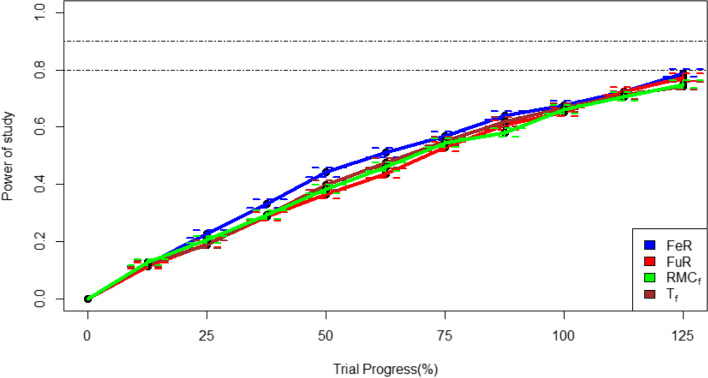
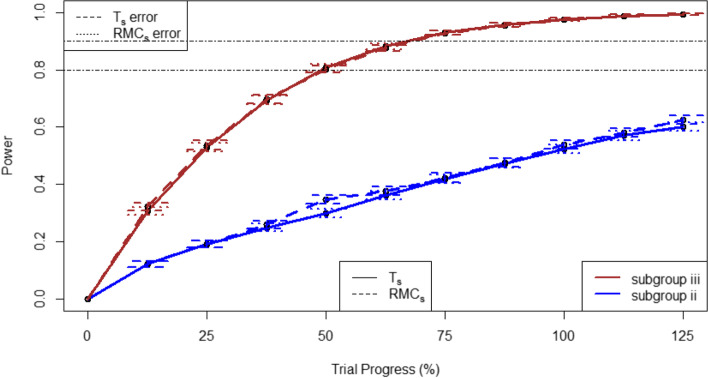
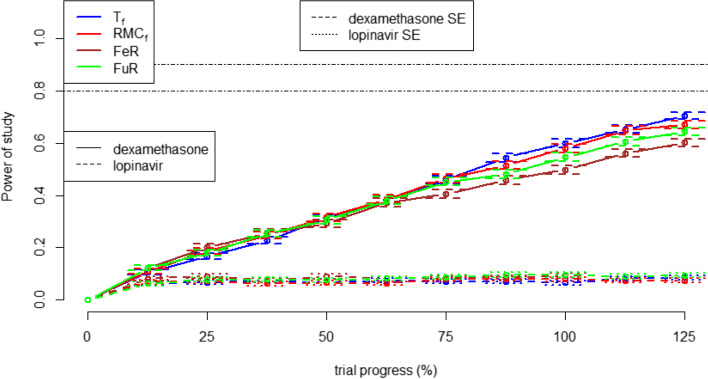
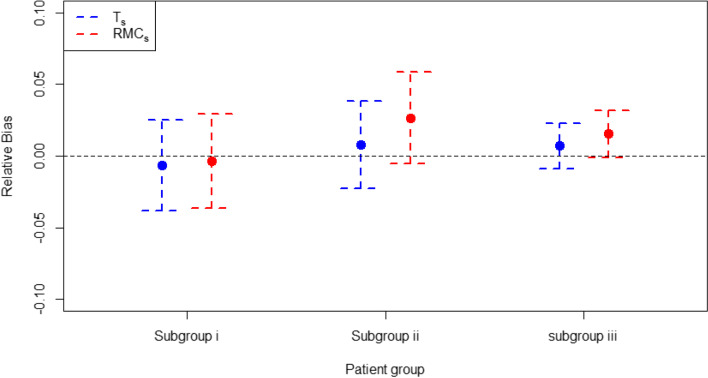
All response-adaptive randomisation strategies led to more patients being given dexamethasone and a lower mortality rate in the trial. Subgroup specific response-adaptive randomisation reduced mortality rates even further. In the two-arm trial, response-adaptive randomisation reduced statistical power compared to FR, with subgroup level adaptive randomisation exhibiting the largest power reduction. In the four-arm trial, response-adaptive randomisation increased statistical power in the dexamethasone arm but reduced statistical power in the lopinavir arm. Response-adaptive randomisation did not induce any meaningful bias in treatment effect estimates nor did it cause any inflation in the type 1 error rate.

CONCLUSIONS

Using response-adaptive randomisation within RECOVERY could have increased the number of patients receiving the optimal COVID-19 treatment during the trial, while reducing the number of patients needed to attain the same study power as the original study. This would likely have reduced patient deaths during the trial and lead to dexamethasone being declared effective sooner. Deciding how to balance the needs of patients within a trial and future patients who have yet to fall ill is an important ethical question for the trials community to address. Response-adaptive randomisation deserves to be considered as a design feature in future trials of COVID-19 and other diseases.
https://cdn.ncbi.nlm.nih.gov/pmc/blobs/3f21/9356442/46bab7cc017b/12874_2022_1691_Fig14_HTML.jpg
https://cdn.ncbi.nlm.nih.gov/pmc/blobs/3f21/9356442/50c92cd262b9/12874_2022_1691_Fig2_HTML.jpg
https://cdn.ncbi.nlm.nih.gov/pmc/blobs/3f21/9356442/c3286227ee36/12874_2022_1691_Fig5_HTML.jpg
https://cdn.ncbi.nlm.nih.gov/pmc/blobs/3f21/9356442/f02b8aa45c72/12874_2022_1691_Fig6_HTML.jpg
https://cdn.ncbi.nlm.nih.gov/pmc/blobs/3f21/9356442/1b625de0cade/12874_2022_1691_Fig7_HTML.jpg
https://cdn.ncbi.nlm.nih.gov/pmc/blobs/3f21/9356442/6e0d97bd96c2/12874_2022_1691_Fig8_HTML.jpg
https://cdn.ncbi.nlm.nih.gov/pmc/blobs/3f21/9356442/f363ced3bd70/12874_2022_1691_Fig9_HTML.jpg
https://cdn.ncbi.nlm.nih.gov/pmc/blobs/3f21/9356442/32b84ba0ffc8/12874_2022_1691_Fig10_HTML.jpg
https://cdn.ncbi.nlm.nih.gov/pmc/blobs/3f21/9356442/c75ac659c026/12874_2022_1691_Fig11_HTML.jpg
https://cdn.ncbi.nlm.nih.gov/pmc/blobs/3f21/9356442/52030fcd6de7/12874_2022_1691_Fig12_HTML.jpg
https://cdn.ncbi.nlm.nih.gov/pmc/blobs/3f21/9356442/7225881f5a71/12874_2022_1691_Fig13_HTML.jpg
https://cdn.ncbi.nlm.nih.gov/pmc/blobs/3f21/9356442/46bab7cc017b/12874_2022_1691_Fig14_HTML.jpg
https://cdn.ncbi.nlm.nih.gov/pmc/blobs/3f21/9356442/50c92cd262b9/12874_2022_1691_Fig2_HTML.jpg
https://cdn.ncbi.nlm.nih.gov/pmc/blobs/3f21/9356442/c3286227ee36/12874_2022_1691_Fig5_HTML.jpg
https://cdn.ncbi.nlm.nih.gov/pmc/blobs/3f21/9356442/f02b8aa45c72/12874_2022_1691_Fig6_HTML.jpg
https://cdn.ncbi.nlm.nih.gov/pmc/blobs/3f21/9356442/1b625de0cade/12874_2022_1691_Fig7_HTML.jpg
https://cdn.ncbi.nlm.nih.gov/pmc/blobs/3f21/9356442/6e0d97bd96c2/12874_2022_1691_Fig8_HTML.jpg
https://cdn.ncbi.nlm.nih.gov/pmc/blobs/3f21/9356442/f363ced3bd70/12874_2022_1691_Fig9_HTML.jpg
https://cdn.ncbi.nlm.nih.gov/pmc/blobs/3f21/9356442/32b84ba0ffc8/12874_2022_1691_Fig10_HTML.jpg
https://cdn.ncbi.nlm.nih.gov/pmc/blobs/3f21/9356442/c75ac659c026/12874_2022_1691_Fig11_HTML.jpg
https://cdn.ncbi.nlm.nih.gov/pmc/blobs/3f21/9356442/52030fcd6de7/12874_2022_1691_Fig12_HTML.jpg
https://cdn.ncbi.nlm.nih.gov/pmc/blobs/3f21/9356442/7225881f5a71/12874_2022_1691_Fig13_HTML.jpg
https://cdn.ncbi.nlm.nih.gov/pmc/blobs/3f21/9356442/46bab7cc017b/12874_2022_1691_Fig14_HTML.jpg
摘要

背景

随机评估 COVID-19 治疗试验(RECOVERY)旨在满足寻找有效治疗疑似或确诊 COVID-19 住院患者的迫切需求。该试验取得了许多成功,包括发现地塞米松可有效降低 COVID-19 死亡率,这是首个在随机对照试验中达到这一里程碑的治疗方法。尽管如此,它仍继续使用标准或“固定”随机化来分配患者接受治疗。我们使用一系列性能指标评估了在 RECOVERY 中实施适应性随机化的影响,以了解其是否具有前瞻性益处。这一设计特点最近已在 REMAP-CAP 平台试验中实施。

方法

试验数据被模拟,以尽可能匹配 2020 年 3 月至 6 月期间 RECOVERY 试验中接受标准治疗、地塞米松、羟氯喹或洛匹那韦-利托那韦治疗的患者数据,这代表了在此期间测试的五个治疗臂中的四个。在标准治疗和地塞米松的二臂试验设置和使用所有上述治疗的四臂试验设置中模拟了试验。测试了两种固定随机化和两种适应性随机化形式。在二臂试验中,适应性随机化在两个试验臂中实施,而在四臂试验中仅在三个非标准治疗臂中实施。在二臂试验中,随机化策略在整个试验层面以及在三个预先指定的患者亚组中进行,这些亚组根据患者的呼吸支持水平定义。

结果

所有适应性随机化策略都导致试验中接受地塞米松治疗的患者更多,死亡率更低。亚组特异性适应性随机化进一步降低了死亡率。在二臂试验中,与 FR 相比,适应性随机化降低了统计效力,亚组水平适应性随机化显示出最大的效力降低。在四臂试验中,适应性随机化增加了地塞米松臂的统计效力,但降低了洛匹那韦臂的统计效力。适应性随机化没有导致治疗效果估计的任何有意义的偏差,也没有导致 I 型错误率的膨胀。

结论

在 RECOVERY 中使用适应性随机化可以在试验期间增加接受最佳 COVID-19 治疗的患者数量,同时减少达到与原始研究相同研究效力所需的患者数量。这可能会减少试验期间的患者死亡,并导致更早地宣布地塞米松有效。对于试验界来说,决定如何平衡试验中的患者需求和尚未患病的未来患者的需求是一个重要的伦理问题。适应性随机化值得作为 COVID-19 和其他疾病未来试验的设计特点加以考虑。

相似文献

1
Should RECOVERY have used response adaptive randomisation? Evidence from a simulation study.RECOVERY 是否应该使用反应适应性随机化?来自模拟研究的证据。
BMC Med Res Methodol. 2022 Aug 6;22(1):216. doi: 10.1186/s12874-022-01691-w.
2
The Australasian COVID-19 Trial (ASCOT) to assess clinical outcomes in hospitalised patients with SARS-CoV-2 infection (COVID-19) treated with lopinavir/ritonavir and/or hydroxychloroquine compared to standard of care: A structured summary of a study protocol for a randomised controlled trial.澳大利亚 COVID-19 试验(ASCOT)评估了洛匹那韦/利托那韦和/或羟氯喹治疗与标准治疗相比住院的 SARS-CoV-2 感染(COVID-19)患者的临床结局:一项随机对照试验研究方案的结构化总结。
Trials. 2020 Jul 14;21(1):646. doi: 10.1186/s13063-020-04576-9.
3
Early antiviral treatment in outpatients with COVID-19 (FLARE): a structured summary of a study protocol for a randomised controlled trial.COVID-19 门诊患者的早期抗病毒治疗(FLARE):一项随机对照试验研究方案的结构化总结。
Trials. 2021 Mar 8;22(1):193. doi: 10.1186/s13063-021-05139-2.
4
Safety and efficacy of antiviral combination therapy in symptomatic patients of Covid-19 infection - a randomised controlled trial (SEV-COVID Trial): A structured summary of a study protocol for a randomized controlled trial.抗病毒联合治疗在新冠病毒感染有症状患者中的安全性和有效性 - 一项随机对照试验(SEV-COVID 试验):一项随机对照试验研究方案的结构化总结。
Trials. 2020 Oct 20;21(1):866. doi: 10.1186/s13063-020-04774-5.
5
Norwegian Coronavirus Disease 2019 (NO COVID-19) Pragmatic Open label Study to assess early use of hydroxychloroquine sulphate in moderately severe hospitalised patients with coronavirus disease 2019: A structured summary of a study protocol for a randomised controlled trial.挪威 2019 年冠状病毒病(NO COVID-19)实用开放性标签研究,评估硫酸羟氯喹在 2019 年冠状病毒病中度重症住院患者中的早期使用:一项随机对照试验研究方案的结构化总结。
Trials. 2020 Jun 5;21(1):485. doi: 10.1186/s13063-020-04420-0.
6
A Phase I/II Clinical Trial to evaluate the efficacy of baricitinib to prevent respiratory insufficiency progression in onco-hematological patients affected with COVID19: A structured summary of a study protocol for a randomised controlled trial.一项评估巴瑞替尼预防 COVID19 相关血液肿瘤患者呼吸功能不全进展的疗效的 I/II 期临床试验:一项随机对照试验研究方案的结构化总结。
Trials. 2021 Feb 5;22(1):116. doi: 10.1186/s13063-021-05072-4.
7
Effect of dexamethasone in patients with ARDS and COVID-19 - prospective, multi-centre, open-label, parallel-group, randomised controlled trial (REMED trial): A structured summary of a study protocol for a randomised controlled trial.地塞米松治疗 ARDS 合并 COVID-19 患者的效果 - 一项前瞻性、多中心、开放标签、平行组、随机对照试验(REMED 试验):一项随机对照试验研究方案的结构化总结。
Trials. 2021 Mar 1;22(1):172. doi: 10.1186/s13063-021-05116-9.
8
Protocol for the DisCoVeRy trial: multicentre, adaptive, randomised trial of the safety and efficacy of treatments for COVID-19 in hospitalised adults.DisCoVeRy试验方案:住院成人COVID-19治疗安全性和有效性的多中心、适应性、随机试验
BMJ Open. 2020 Sep 21;10(9):e041437. doi: 10.1136/bmjopen-2020-041437.
9
ACCORD: A Multicentre, Seamless, Phase 2 Adaptive Randomisation Platform Study to Assess the Efficacy and Safety of Multiple Candidate Agents for the Treatment of COVID-19 in Hospitalised Patients: A structured summary of a study protocol for a randomised controlled trial.ACCORD:一项多中心、无缝隙、2 期适应性随机化平台研究,旨在评估多种候选药物治疗住院 COVID-19 患者的疗效和安全性:一项随机对照试验研究方案的结构化总结。
Trials. 2020 Jul 31;21(1):691. doi: 10.1186/s13063-020-04584-9.
10
Testing the efficacy and safety of BIO101, for the prevention of respiratory deterioration, in patients with COVID-19 pneumonia (COVA study): a structured summary of a study protocol for a randomised controlled trial.评估 BIO101 预防 COVID-19 肺炎患者呼吸恶化的疗效和安全性(COVA 研究):一项随机对照试验研究方案的结构化总结。
Trials. 2021 Jan 11;22(1):42. doi: 10.1186/s13063-020-04998-5.

引用本文的文献

1
Operating characteristics of unequal allocation ratios in platform trials with the staggered addition of drugs using binary endpoints.在使用二元终点指标且药物逐步添加的平台试验中,不等分配比的操作特征。
Contemp Clin Trials Commun. 2025 Feb 17;44:101450. doi: 10.1016/j.conctc.2025.101450. eCollection 2025 Apr.
2
Adaptive clinical trials in surgery: A scoping review of methodological and reporting quality.手术中的适应性临床试验:方法学和报告质量的范围综述。
PLoS One. 2024 May 28;19(5):e0299494. doi: 10.1371/journal.pone.0299494. eCollection 2024.
3
Clinical Trial Design Innovations for Precision Medicine in Asthma.

本文引用的文献

1
Tocilizumab in patients admitted to hospital with COVID-19 (RECOVERY): a randomised, controlled, open-label, platform trial.托珠单抗治疗 COVID-19 住院患者的疗效(RECOVERY):一项随机、对照、开放标签、平台试验。
Lancet. 2021 May 1;397(10285):1637-1645. doi: 10.1016/S0140-6736(21)00676-0.
2
COVID-19 and cancer: 1 year on.新冠疫情与癌症:一年之后
Lancet Oncol. 2021 Apr;22(4):411. doi: 10.1016/S1470-2045(21)00148-0.
3
Interleukin-6 Receptor Antagonists in Critically Ill Patients with Covid-19.COVID-19 重症患者的白细胞介素 6 受体拮抗剂。
哮喘精准医学的临床试验设计创新。
Adv Exp Med Biol. 2023;1426:395-412. doi: 10.1007/978-3-031-32259-4_17.
N Engl J Med. 2021 Apr 22;384(16):1491-1502. doi: 10.1056/NEJMoa2100433. Epub 2021 Feb 25.
4
Genetic Variants of SARS-CoV-2-What Do They Mean?新型冠状病毒2019(SARS-CoV-2)的基因变异——它们意味着什么?
JAMA. 2021 Feb 9;325(6):529-531. doi: 10.1001/jama.2020.27124.
5
Covid-19: NHS is placed on highest alert level as intensive care beds fill up.新冠疫情:随着重症监护病床告急,英国国民医疗服务体系(NHS)进入最高警戒级别。
BMJ. 2020 Nov 5;371:m4296. doi: 10.1136/bmj.m4296.
6
The changing demographics of COVID-19.新冠病毒病不断变化的人口统计学特征。
Lancet Respir Med. 2020 Dec;8(12):e95. doi: 10.1016/S2213-2600(20)30461-6. Epub 2020 Oct 6.
7
Lopinavir-ritonavir in patients admitted to hospital with COVID-19 (RECOVERY): a randomised, controlled, open-label, platform trial.洛匹那韦利托那韦在因 COVID-19 住院的患者中的应用(RECOVERY):一项随机、对照、开放标签、平台试验。
Lancet. 2020 Oct 24;396(10259):1345-1352. doi: 10.1016/S0140-6736(20)32013-4. Epub 2020 Oct 5.
8
Effect of Hydroxychloroquine in Hospitalized Patients with Covid-19.羟氯喹治疗 COVID-19 住院患者的疗效。
N Engl J Med. 2020 Nov 19;383(21):2030-2040. doi: 10.1056/NEJMoa2022926. Epub 2020 Oct 8.
9
Long covid: How to define it and how to manage it.长期新冠:如何定义及如何应对。
BMJ. 2020 Sep 7;370:m3489. doi: 10.1136/bmj.m3489.
10
Dexamethasone in Hospitalized Patients with Covid-19.地塞米松在 COVID-19 住院患者中的应用。
N Engl J Med. 2021 Feb 25;384(8):693-704. doi: 10.1056/NEJMoa2021436. Epub 2020 Jul 17.