Wolfson Centre for Mathematical Biology, Mathematical Institute, University of Oxford, Oxford, UK.
Kennedy Institute of Rheumatology, University of Oxford, Oxford, UK.
J Pharmacokinet Pharmacodyn. 2022 Oct;49(5):539-556. doi: 10.1007/s10928-022-09819-7. Epub 2022 Aug 6.
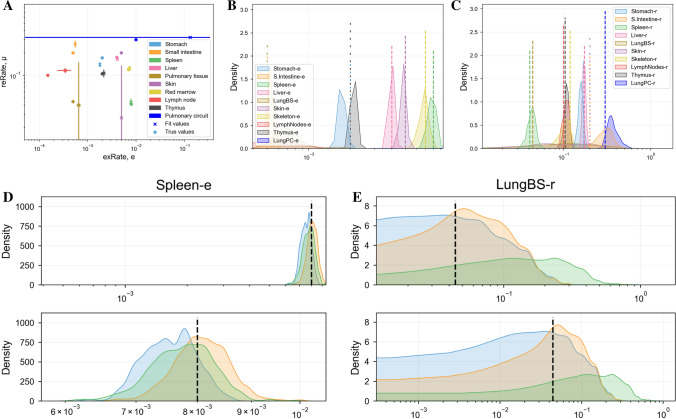
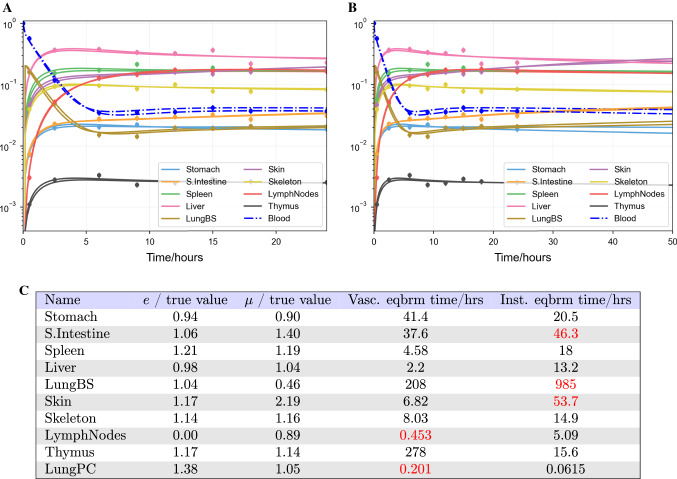
Physiologically-based pharmacokinetic and cellular kinetic models are used extensively to predict concentration profiles of drugs or adoptively transferred cells in patients and laboratory animals. Models are fit to data by the numerical optimisation of appropriate parameter values. When quantities such as the area under the curve are all that is desired, only a close qualitative fit to data is required. When the biological interpretation of the model that produced the fit is important, an assessment of uncertainties is often also warranted. Often, a goal of fitting PBPK models to data is to estimate parameter values, which can then be used to assess characteristics of the fit system or applied to inform new modelling efforts and extrapolation, to inform a prediction under new conditions. However, the parameters that yield a particular model output may not necessarily be unique, in which case the parameters are said to be unidentifiable. We show that the parameters in three published physiologically-based pharmacokinetic models are practically (deterministically) unidentifiable and that it is challenging to assess the associated parameter uncertainty with simple curve fitting techniques. This result could affect many physiologically-based pharmacokinetic models, and we advocate more widespread use of thorough techniques and analyses to address these issues, such as established Markov Chain Monte Carlo and Bayesian methodologies. Greater handling and reporting of uncertainty and identifiability of fit parameters would directly and positively impact interpretation and translation for physiologically-based model applications, enhancing their capacity to inform new model development efforts and extrapolation in support of future clinical decision-making.
生理药代动力学和细胞动力学模型被广泛用于预测药物或过继转移细胞在患者和实验动物中的浓度曲线。模型通过对适当参数值的数值优化来拟合数据。当所需的仅是曲线下面积等数量时,只需对数据进行紧密的定性拟合即可。当产生拟合的模型的生物学解释很重要时,通常也需要评估不确定性。通常,拟合 PBPK 模型以获取数据的目的是估计参数值,然后可以使用这些参数值来评估拟合系统的特征或应用于为新的建模工作和外推提供信息,以根据新条件进行预测。然而,产生特定模型输出的参数不一定是唯一的,在这种情况下,参数称为不可识别的。我们表明,三个已发表的生理药代动力学模型中的参数在实践上(确定性)是不可识别的,并且使用简单的曲线拟合技术评估相关参数不确定性具有挑战性。这一结果可能会影响许多生理药代动力学模型,我们主张更广泛地使用彻底的技术和分析来解决这些问题,例如已建立的马尔可夫链蒙特卡罗和贝叶斯方法。更好地处理和报告不确定性以及拟合参数的可识别性将直接且积极地影响生理模型应用的解释和转化,增强其为新模型开发工作和外推提供信息的能力,以支持未来的临床决策。