Bone Physiopathology Laboratory, Applied Molecular Medicine Institute (IMMA), Universidad San Pablo-CEU, CEU Universities, Campus Monteprincipe, Alcorcón, Spain.
Department of Basic Medical Sciences, School of Medicine, Universidad San Pablo-CEU, CEU Universities, Campus Monteprincipe, Alcorcón, Madrid, Spain.
J Cell Physiol. 2022 Oct;237(10):3927-3943. doi: 10.1002/jcp.30849. Epub 2022 Aug 7.
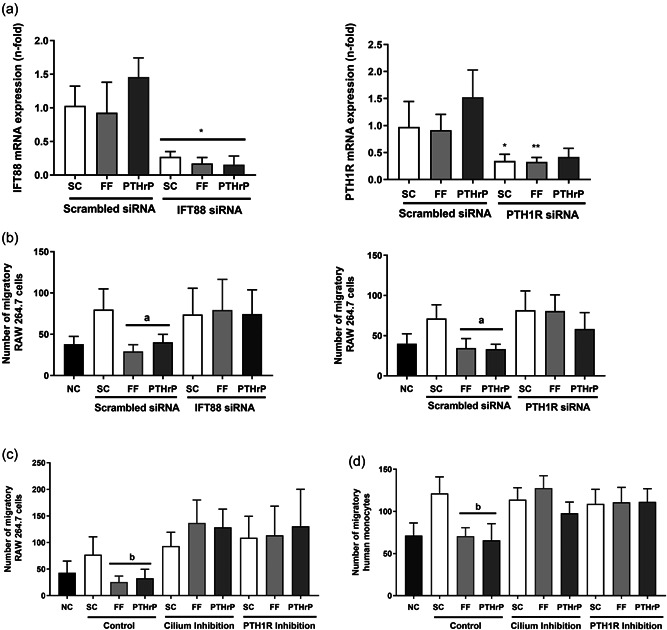
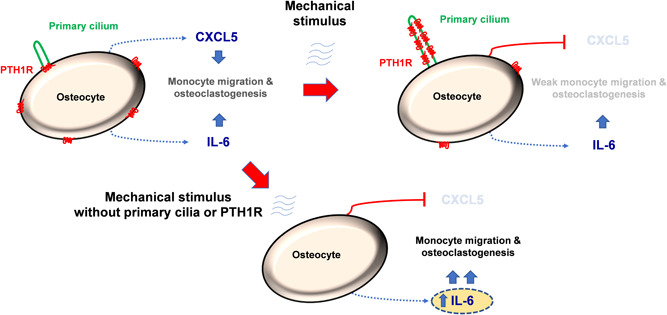
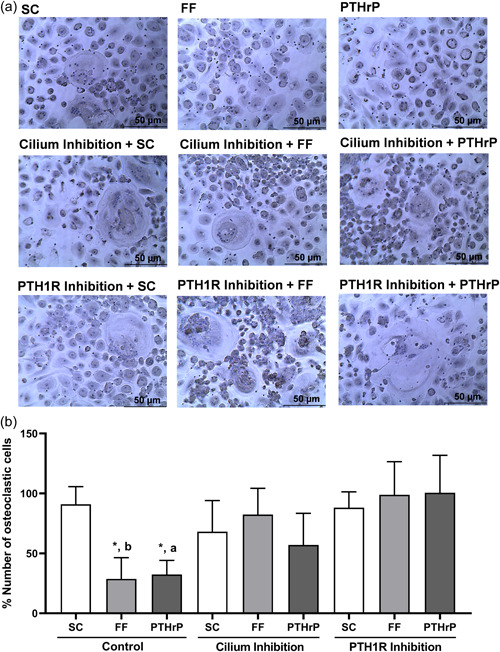
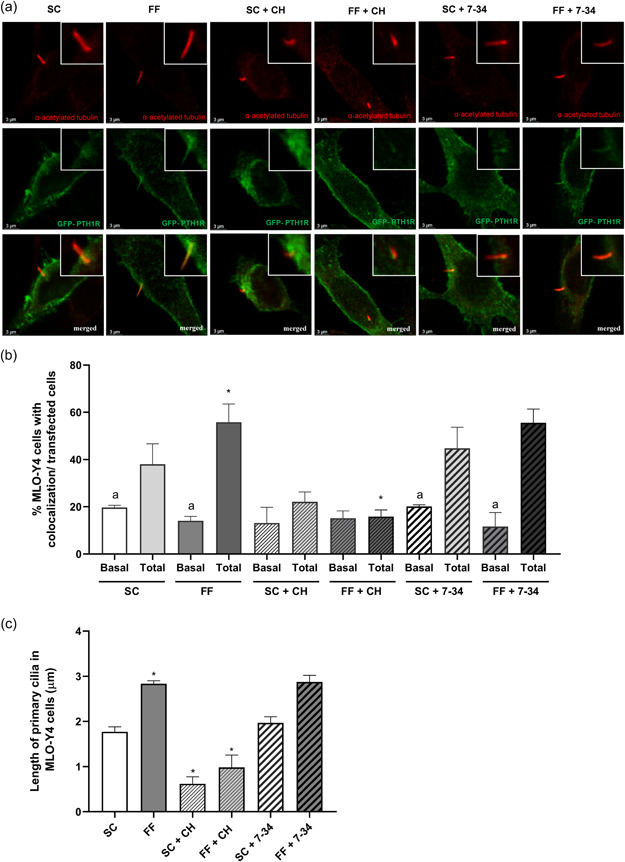
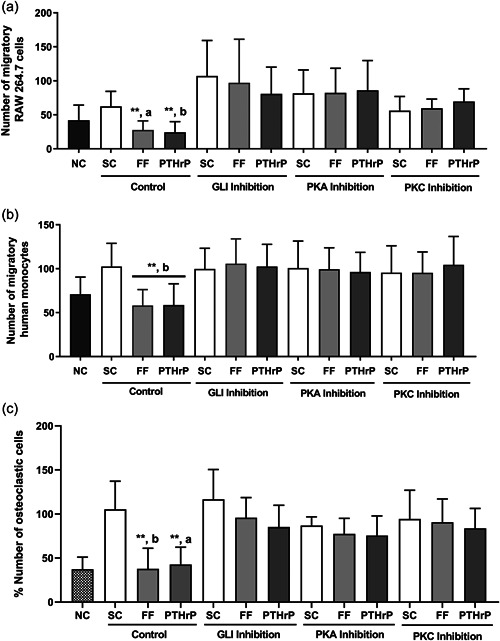
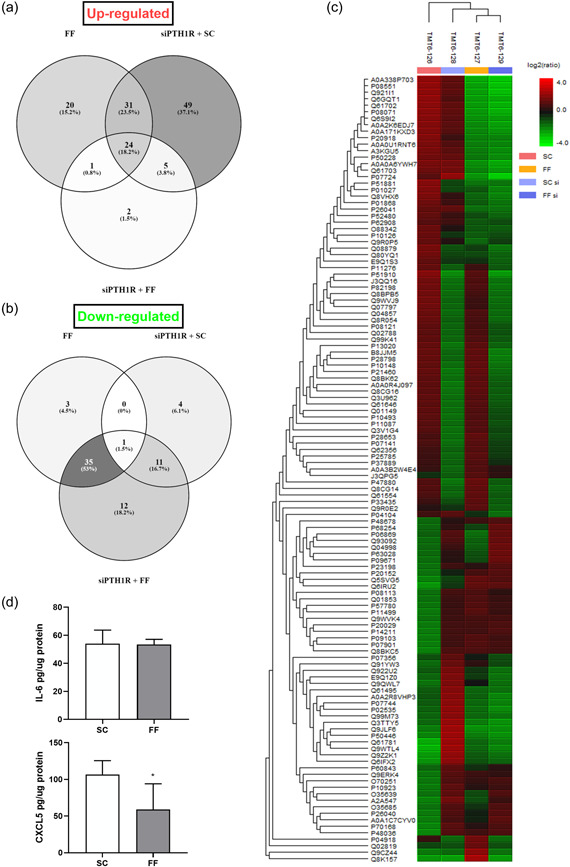
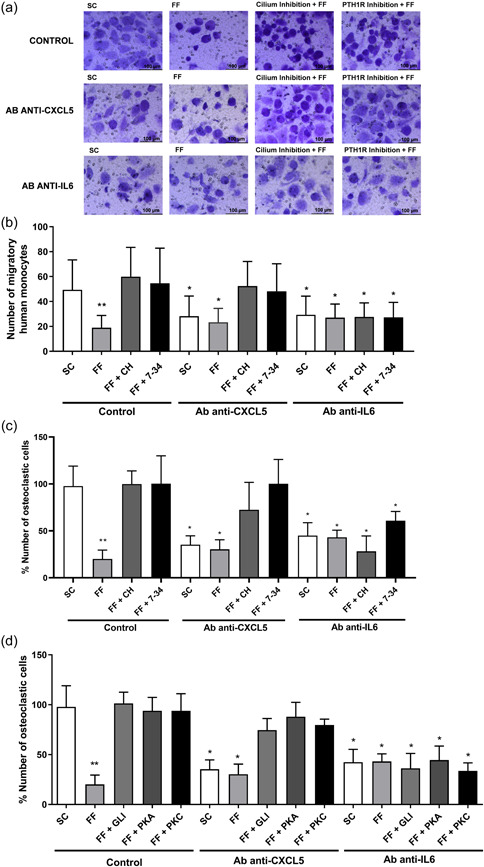
Osteocytes respond to mechanical forces controlling osteoblast and osteoclast function. Mechanical stimulation decreases osteocyte apoptosis and promotes bone formation. Primary cilia have been described as potential mechanosensors in bone cells. Certain osteogenic responses induced by fluid flow (FF) in vitro are decreased by primary cilia inhibition in MLO-Y4 osteocytes. The parathyroid hormone (PTH) receptor type 1 (PTH1R) modulates osteoblast, osteoclast, and osteocyte effects upon activation by PTH or PTH-related protein (PTHrP) in osteoblastic cells. Moreover, some actions of PTH1R seem to be triggered directly by mechanical stimulation. We hypothesize that PTH1R forms a signaling complex in the primary cilium that is essential for mechanotransduction in osteocytes and affects osteocyte-osteoclast communication. MLO-Y4 osteocytes were stimulated by FF or PTHrP (1-37). PTH1R and primary cilia signaling were abrogated using PTH1R or primary cilia specific siRNAs or inhibitors, respectively. Conditioned media obtained from mechanically- or PTHrP-stimulated MLO-Y4 cells inhibited the migration of preosteoclastic cells and osteoclast differentiation. Redistribution of PTH1R along the entire cilium was observed in mechanically stimulated MLO-Y4 osteocytic cells. Preincubation of MLO-Y4 cells with the Gli-1 antagonist, the adenylate cyclase inhibitor (SQ22536), or with the phospholipase C inhibitor (U73122), affected the migration of osteoclast precursors and osteoclastogenesis. Proteomic analysis and neutralizing experiments showed that FF and PTH1R activation control osteoclast function through the modulation of C-X-C Motif Chemokine Ligand 5 (CXCL5) and interleukin-6 (IL-6) secretion in osteocytes. These novel findings indicate that both primary cilium and PTH1R are necessary in osteocytes for proper communication with osteoclasts and show that mechanical stimulation inhibits osteoclast recruitment and differentiation through CXCL5, while PTH1R activation regulate these processes via IL-6.
成骨细胞对控制成骨细胞和破骨细胞功能的机械力作出响应。机械刺激可减少成骨细胞凋亡并促进骨形成。初级纤毛已被描述为骨细胞中潜在的机械感受器。在体外,流体流动(FF)引起的某些成骨反应会因 MLO-Y4 成骨细胞中初级纤毛的抑制而降低。甲状旁腺激素(PTH)受体 1(PTH1R)在成骨细胞中通过 PTH 或甲状旁腺激素相关蛋白(PTHrP)的激活来调节成骨细胞、破骨细胞和成骨细胞的作用。此外,PTH1R 的一些作用似乎是直接由机械刺激触发的。我们假设 PTH1R 在初级纤毛中形成一个信号复合物,对于成骨细胞中的机械转导是必不可少的,并影响成骨细胞与破骨细胞的通讯。用 FF 或 PTHrP(1-37)刺激 MLO-Y4 成骨细胞。分别使用 PTH1R 或初级纤毛特异性 siRNA 或抑制剂阻断 PTH1R 和初级纤毛信号。从机械刺激或 PTHrP 刺激的 MLO-Y4 细胞获得的条件培养基抑制破骨前体细胞的迁移和破骨细胞分化。在机械刺激的 MLO-Y4 成骨细胞中观察到 PTH1R 沿着整个纤毛重新分布。MLO-Y4 细胞用 Gli-1 拮抗剂、腺苷酸环化酶抑制剂(SQ22536)或磷脂酶 C 抑制剂(U73122)预孵育会影响破骨前体细胞的迁移和破骨细胞的形成。蛋白质组学分析和中和实验表明,FF 和 PTH1R 激活通过调节成骨细胞中 C-X-C 基序趋化因子配体 5(CXCL5)和白细胞介素 6(IL-6)的分泌来控制破骨细胞的功能。这些新发现表明,初级纤毛和 PTH1R 在成骨细胞中对于与破骨细胞的适当通讯都是必需的,并表明机械刺激通过 CXCL5 抑制破骨细胞募集和分化,而 PTH1R 激活通过 IL-6 调节这些过程。