Forensic Child and Youth Care Sciences, University of Amsterdam, Amsterdam, The Netherlands.
Counseling Psychology and Human Services Department, University of Oregon, Eugene, Oregon.
J Adolesc Health. 2022 Nov;71(5):579-586. doi: 10.1016/j.jadohealth.2022.06.007. Epub 2022 Aug 5.
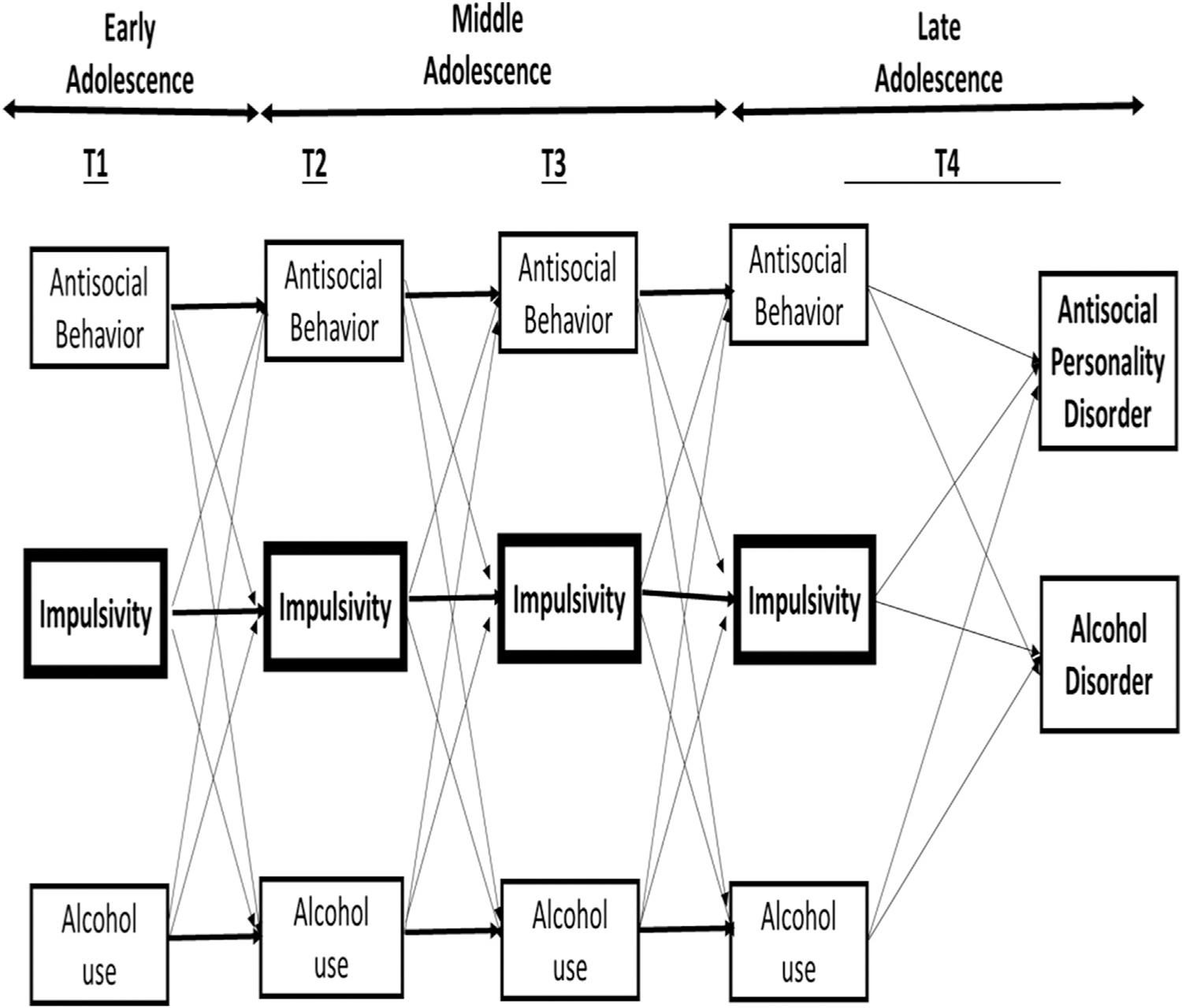
The behavioral disinhibition model (BDM) posits that a liability toward impulsivity evident by early adolescence underlies the coemergence of antisocial behavior and alcohol use (i.e., problem behaviors) in early-adolescence to mid-adolescence, but that the subsequent development of these problem behaviors (rather than impulsivity itself) predicts the emergence of antisocial personality disorder (APD) and alcohol use disorder (AUD) in late adolescence. The present study was designed to test these predictions of the BDM from early to late adolescence.
We used five-year longitudinal self-report data from the Philadelphia Trajectory Study that was collected from 2006-2012. Mediational analyses were performed using the Random Intercept Cross-lagged Panel Model, which enables the detection of within-person predictions of changes in problem behaviors during adolescence. The sample was ethnically and socioeconomically diverse, including 364 urban US community youth (at baseline: M = 13.51(.95); 49.1% female).
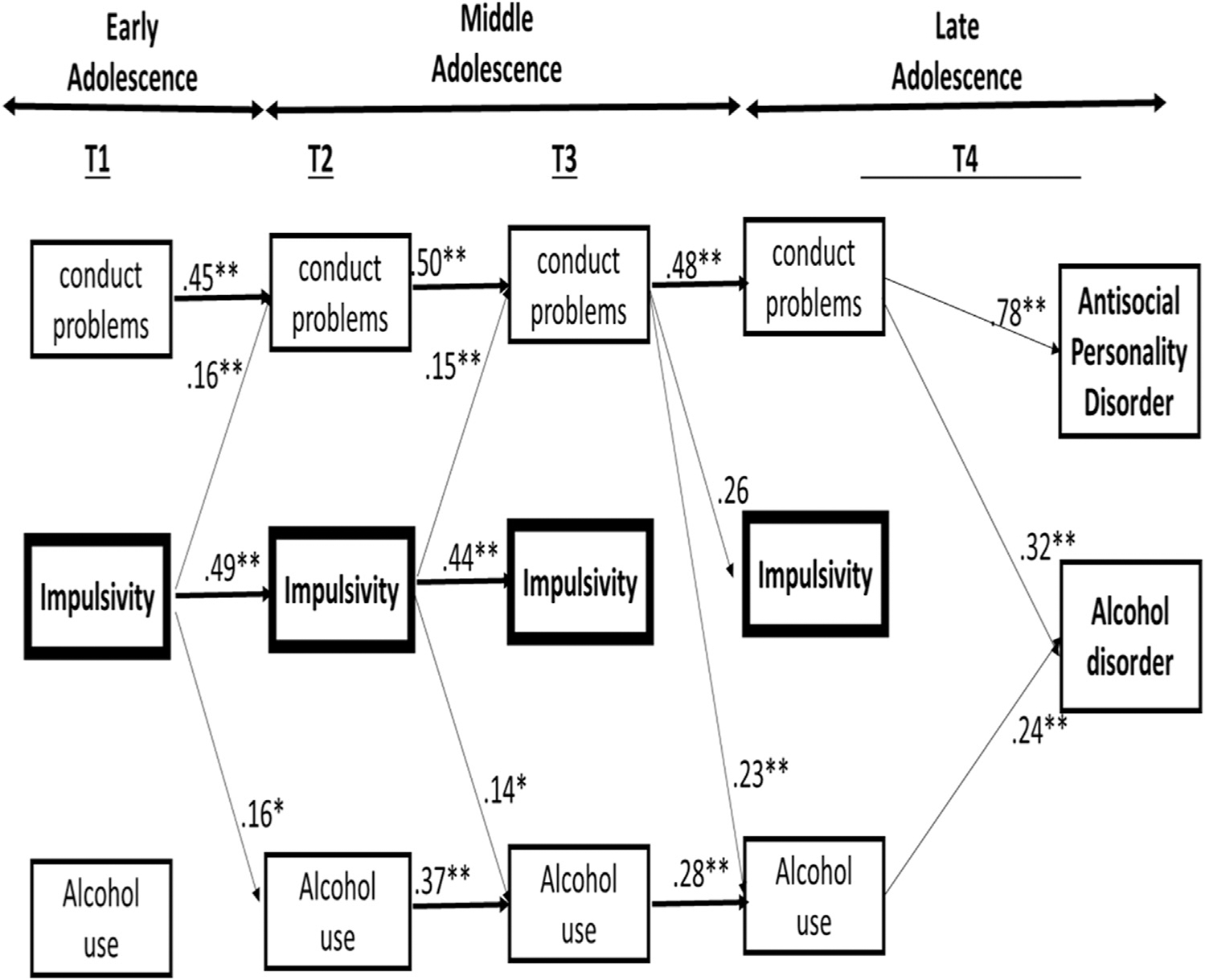
Consistent with the BDM, mediational analyses revealed that changes in early adolescent impulsivity predicted late adolescent APD and AUD criteria, mediated by changes in mid-adolescent alcohol use and conduct problems.
Interventions targeting impulsivity in early adolescence could potentially halt the cascading chain of events leading to both late adolescent APD and AUD by decelerating growth in antisocial behavior and alcohol use during early-adolescence to mid-adolescence. From mid-adolescence to late-adolescence, the consequences of early impulsivity, especially involvement in antisocial behaviors, become a more relevant predictor of both APD and AUD rather than impulsivity itself.
行为抑制障碍模型(BDM)认为,青少年早期表现出的冲动倾向与反社会行为和酒精使用(即问题行为)在青少年早期到中期同时出现有关,但这些问题行为的后续发展(而不是冲动本身)预测了反社会人格障碍(APD)和酒精使用障碍(AUD)在青春期晚期的出现。本研究旨在从青少年早期到晚期测试 BDM 的这些预测。
我们使用了 2006 年至 2012 年期间从费城轨迹研究中收集的五年纵向自我报告数据。中介分析使用随机截距交叉滞后面板模型进行,该模型能够检测到青少年时期问题行为变化的个体内预测。该样本在种族和社会经济方面具有多样性,包括 364 名美国城市社区青年(基线时:M=13.51(.95);49.1%为女性)。
与 BDM 一致,中介分析显示,青少年早期冲动性的变化预测了青少年晚期 APD 和 AUD 标准,这是由青少年中期酒精使用和行为问题的变化介导的。
针对青少年早期冲动性的干预措施,通过减缓青少年早期到中期反社会行为和酒精使用的增长,有可能阻止导致青少年晚期 APD 和 AUD 的连锁事件的发生。从中期到晚期,早期冲动的后果,特别是参与反社会行为,成为 APD 和 AUD 的更相关预测因素,而不是冲动本身。