Jiang Yihong, Cai Yuting, Hu Jiateng, Zhang Xing, Lei Jiahao, Peng Zhaoxi, Huang Qun, Xu Zhijue, Li Bo, Qin Jinbao, Li Weimin, Sun Dazhi, Ye Kaichuang, Lu Xinwu
Department of Vascular Surgery, Shanghai Ninth People's Hospital, Shanghai Jiao Tong University School of Medicine, Shanghai, China.
Department of Chemical and Biological Engineering, William Mong Institute of Nano Science and Technology, The Hong Kong University of Science and Technology, Kowloon, Hong Kong SAR, China.
Front Bioeng Biotechnol. 2022 Jul 22;10:944435. doi: 10.3389/fbioe.2022.944435. eCollection 2022.
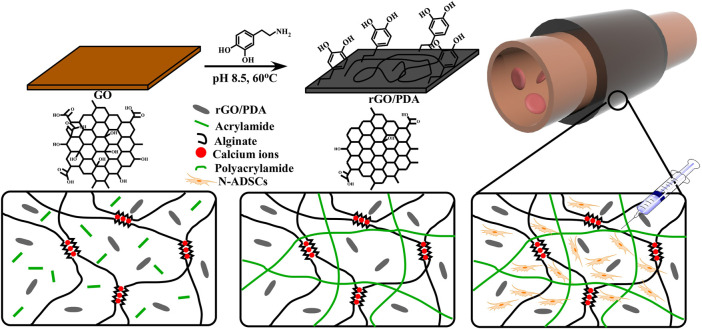
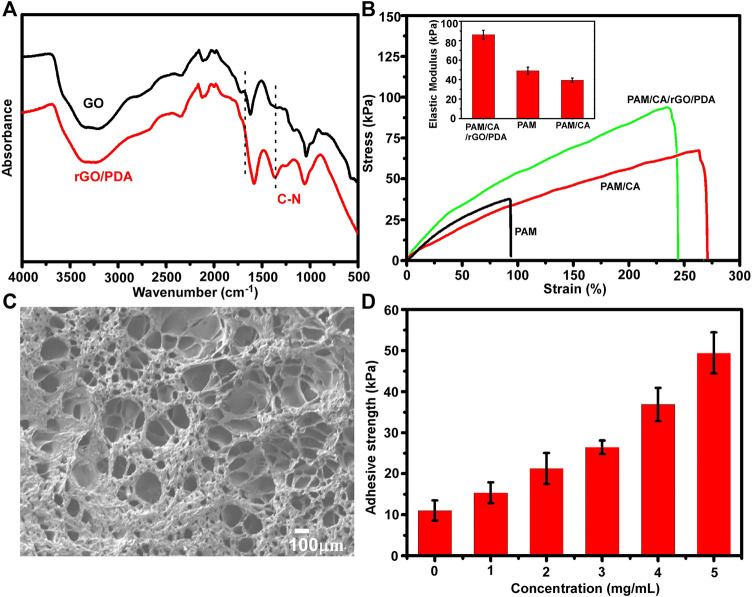
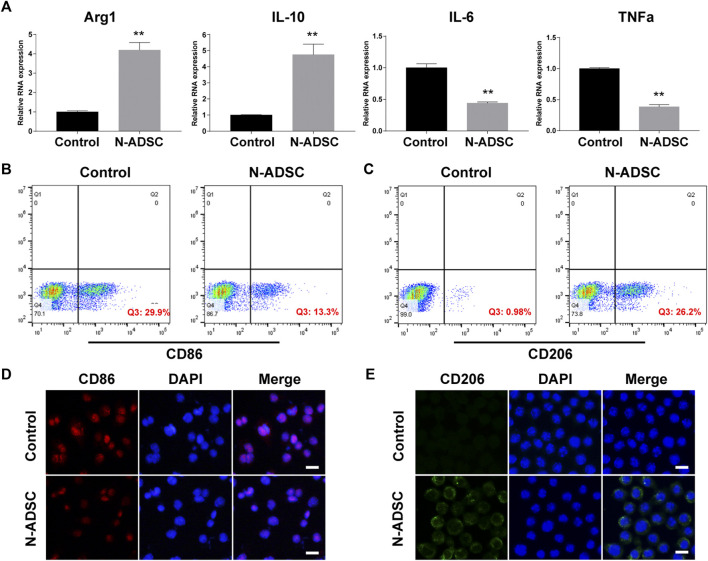
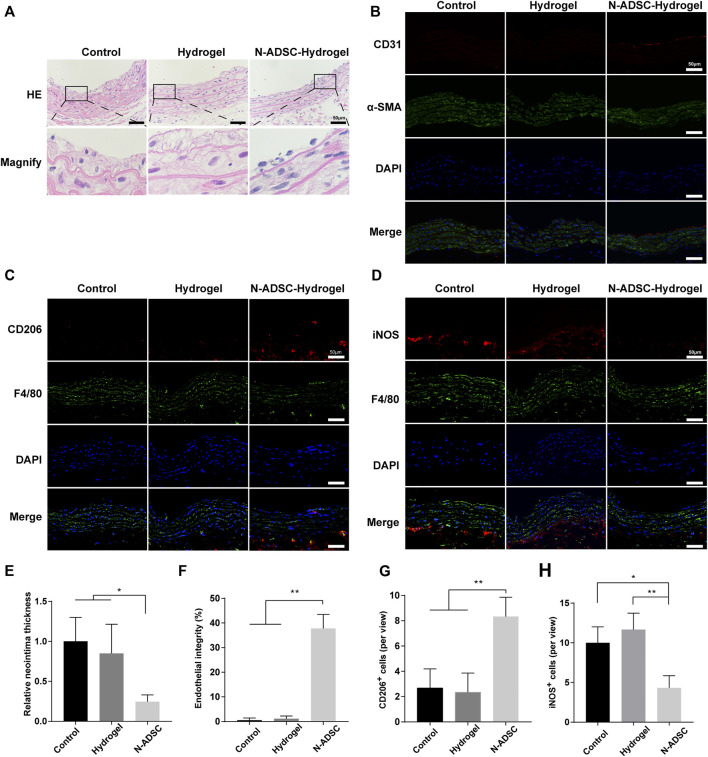
Endovascular interventions, such as balloon dilation and stent implantation, are currently recommended as the primary treatment for patients with peripheral artery disease (PAD), greatly improving patient prognosis. However, the consequent lumen restenosis that occurs after endovascular interventions has become an important clinical problem. Inflammation has been proven to be crucial to postoperative restenosis. In previous studies we have identified that Netrin-1-modified adipose-derived stem cells (N-ADSCs) transplantation is an effective anti-inflammatory strategy to repair vascular damage. Nevertheless, it remained to be explored how one could constantly deliver N-ADSCs onto damaged arteries. Therefore, we developed an adhesive double network (DN) hydrogel wrap loaded with N-ADSCs for sustained perivascular delivery. Inspired by the adhesion mechanism of mussels, we developed an adhesive and tough polyacrylamide/calcium-alginate/reduced graphene oxide/polydopamine (PAM/CA/rGO/PDA) hydrogel. Dopamine was attached to graphene sheets and limitedly oxidized to generate free catechol groups. The hydrogel could wrap damaged arteries and induce anti-inflammatory effects through N-ADSCs. experiments demonstrated that N-ADSCs significantly promoted the M2 polarization of macrophages to anti-inflammatory phenotypes and reduced the expression of inflammatory factors. experiments in a rat carotid artery guidewire injury model showed that the adhesive hydrogel wrap loaded with N-ADSCs could significantly reduce arterial inflammation, inhibit intimal hyperplasia and improve re-endothelialization. Altogether, this newly developed N-ADSCs-loaded hydrogel wrap provides an effective slow-releasing system, which may be a promising way to prevent and treat restenosis after endovascular interventions.
血管内介入治疗,如球囊扩张和支架植入,目前被推荐作为外周动脉疾病(PAD)患者的主要治疗方法,极大地改善了患者的预后。然而,血管内介入治疗后随之发生的管腔再狭窄已成为一个重要的临床问题。炎症已被证明对术后再狭窄至关重要。在先前的研究中,我们已经确定Netrin-1修饰的脂肪来源干细胞(N-ADSCs)移植是一种修复血管损伤的有效抗炎策略。然而,如何将N-ADSCs持续递送至受损动脉仍有待探索。因此,我们开发了一种负载N-ADSCs的粘性双网络(DN)水凝胶包裹物,用于血管周围的持续递送。受贻贝粘附机制的启发,我们开发了一种粘性且坚韧的聚丙烯酰胺/海藻酸钙/还原氧化石墨烯/聚多巴胺(PAM/CA/rGO/PDA)水凝胶。多巴胺附着在石墨烯片上并有限地氧化以产生游离的儿茶酚基团。该水凝胶可以包裹受损动脉并通过N-ADSCs诱导抗炎作用。实验表明,N-ADSCs显著促进巨噬细胞向抗炎表型的M2极化并降低炎症因子的表达。在大鼠颈动脉导丝损伤模型中的实验表明,负载N-ADSCs的粘性水凝胶包裹物可以显著减轻动脉炎症,抑制内膜增生并改善再内皮化。总之,这种新开发的负载N-ADSCs的水凝胶包裹物提供了一种有效的缓释系统,这可能是预防和治疗血管内介入治疗后再狭窄的一种有前途的方法。