Fan Shipei, Shi Xingyu, Chen Zhen, Li Xia, Yu Songping, Li Jun
Department of Ophthalmology, Lishui Municipal Central Hospital, The Fifth Affiliated Hospital of Wenzhou Medical University, Lishui, China.
Department of Nephrology, Lishui Municipal Central Hospital, The Fifth Affiliated Hospital of Wenzhou Medical University, Lishui, China.
Front Med (Lausanne). 2022 Jul 22;9:911990. doi: 10.3389/fmed.2022.911990. eCollection 2022.
We performed a systematic review and meta-analysis to examine the microvascular alterations in non-ocular Behcet's disease (BD) using optical coherence tomography angiography (OCTA).
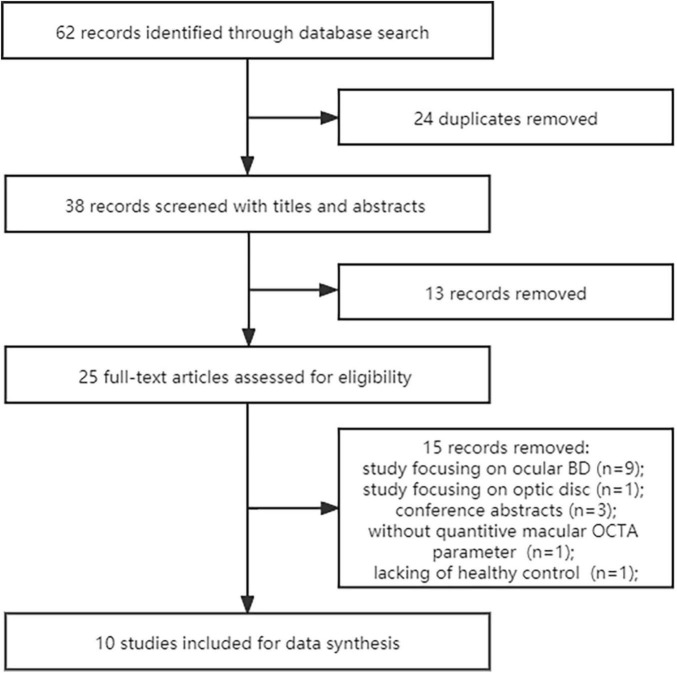
A comprehensive search was performed in Pubmed, Embase and Cochrane databases for eligible studies from inception to February 2022. Detailed clinical demographics were extracted from each study by two independent reviewers. The weighted mean difference (WMD) and 95% confidence intervals (CI) were used to compare the OCTA parameters between non-ocular BD and healthy controls. Stata 12.0 was adopted to conduct statistical analyses.
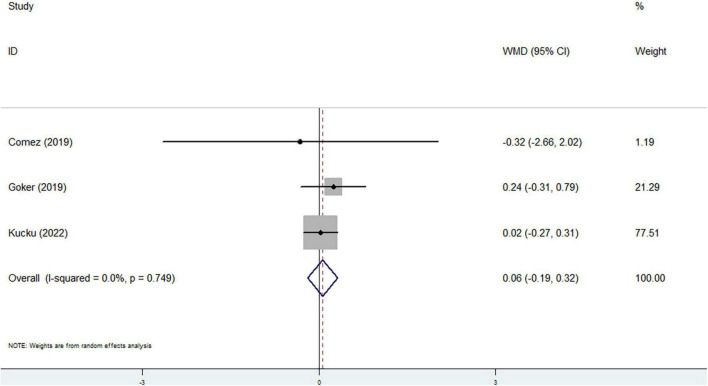
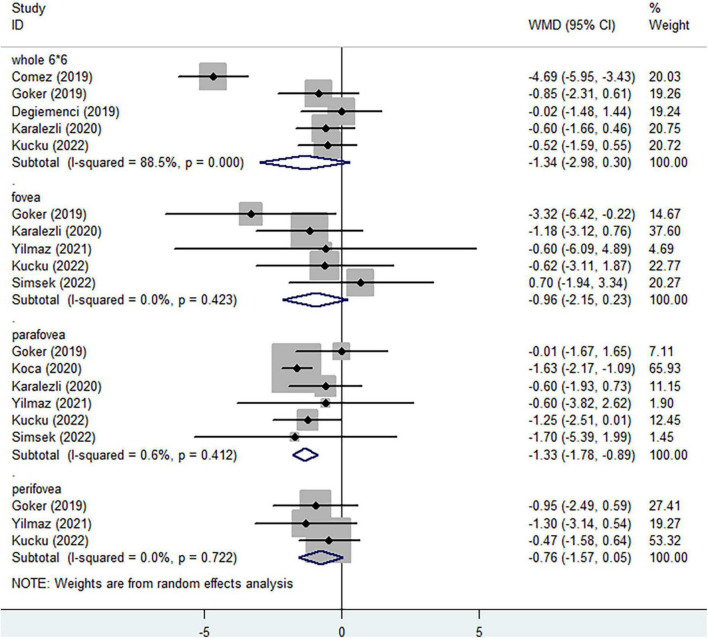
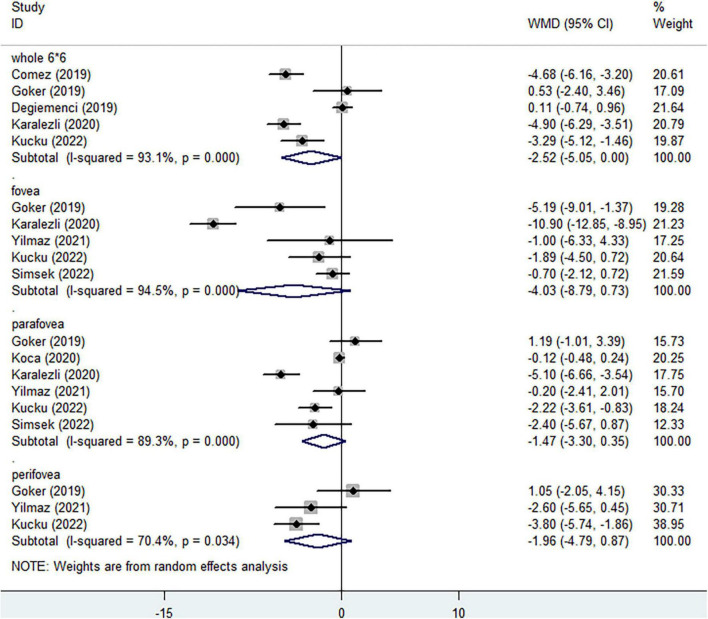
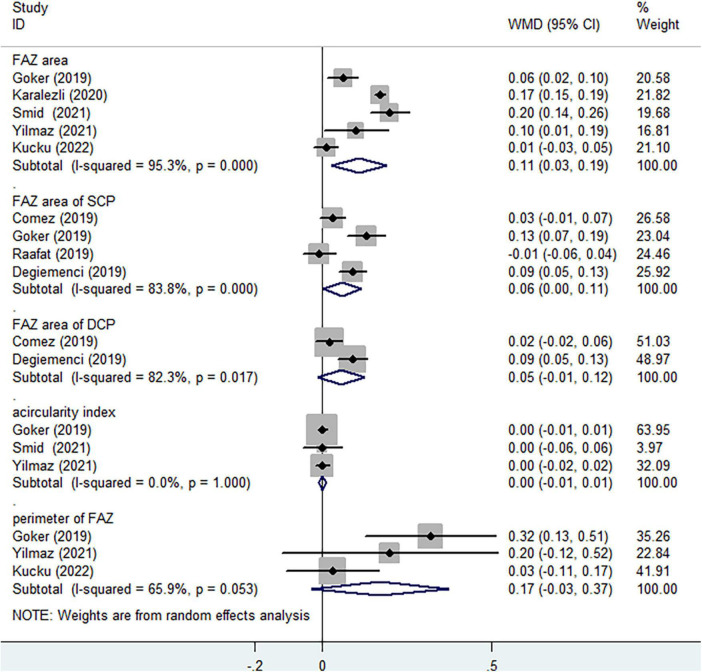
Ten cross-sectional studies involving 386 eyes in non-ocular BD and 418 eyes in healthy volunteers were ultimately included in the present analysis. When considering superficial capillary plexus (SCP) and deep capillary plexus (DCP), no significant differences of vessel densities in the whole enface image, fovea and perifovea were evaluated between two groups. Significantly reduced parafoveal vessel density of SCP was observed in non-ocular BD in comparison with healthy group (WMD = -1.33, 95%CI: -1.78, -0.89; = 0.6%), while slightly decreased parafoveal vessel density was assessed in DCP (WMD = -1.47, 95%CI: -3.30, 0.35; = 89.3%). Significantly increasing foveal avascular zone (FAZ) area was observed in non-ocular BD when compared to healthy controls (WMD = 0.11, 95%CI: 0.03, 0.19; = 95.3%). There was no significant difference in flow area of choriocapillaris between non-ocular BD and control group (WMD = 0.06, 95%CI: -0.19, 0.32; = 0%).
Based on current analysis, our results demonstrated significantly lower parafoveal vessel density of SCP and lager FAZ area in full vasculature in non-ocular BD. The retinal microvascular alterations appear before the emergence of ocular manifestations.
[https://www.crd.york.ac.uk/PROSPERO/], identifier [CRD42021244856].
我们进行了一项系统评价和荟萃分析,以使用光学相干断层扫描血管造影(OCTA)检查非眼部白塞病(BD)的微血管改变。
在Pubmed、Embase和Cochrane数据库中进行全面检索,以查找从开始到2022年2月的符合条件的研究。由两名独立审阅者从每项研究中提取详细的临床人口统计学数据。加权平均差(WMD)和95%置信区间(CI)用于比较非眼部BD与健康对照之间的OCTA参数。采用Stata 12.0进行统计分析。
本分析最终纳入了10项横断面研究,涉及非眼部BD的386只眼和健康志愿者的418只眼。在考虑浅表毛细血管丛(SCP)和深部毛细血管丛(DCP)时,两组在整个表面图像、黄斑中心凹和黄斑旁区域的血管密度没有显著差异。与健康组相比,非眼部BD患者的SCP黄斑旁血管密度显著降低(WMD = -1.33,95%CI:-1.78,-0.89;P = 0.6%),而DCP的黄斑旁血管密度略有降低(WMD = -1.47,95%CI:-3.30,0.35;P = 89.3%)。与健康对照相比,非眼部BD患者的黄斑无血管区(FAZ)面积显著增加(WMD = 0.11,95%CI:0.03,0.19;P = 95.3%)。非眼部BD与对照组之间的脉络膜毛细血管血流面积没有显著差异(WMD = 0.06,95%CI:-0.19,0.32;P = 0%)。
基于目前的分析,我们的结果表明,非眼部BD患者的SCP黄斑旁血管密度显著降低,全视网膜血管系统的FAZ面积更大。视网膜微血管改变出现在眼部表现出现之前。