Fasola Foluke A, Fowotade Adeola A, Faneye Adedayo O, Adeleke Adeyeni
Department of Haematology, College of Medicine, University of Ibadan, Ibadan, Nigeria.
Department of Haematology, University College Hospital, Ibadan, Nigeria.
Afr J Lab Med. 2022 Jul 26;11(1):1434. doi: 10.4102/ajlm.v11i1.1434. eCollection 2022.
Anti-hepatitis B core antibody (anti-HBc) testing improves transfusion safety by detecting past and current hepatitis B virus (HBV) infection while detecting hepatitis B surface antigen (HBsAg) in serology-negative HBV infection. However, occult HBV infection (OBI) (serum or liver HBV DNA-positive but HBsAg-negative) remains unaddressed among replacement blood donors - family members or friends who donate to replace blood transfused to a relative.
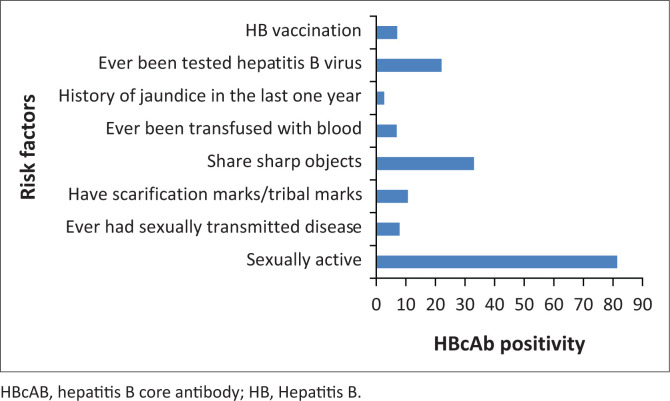
This study assessed risk factors for a positive anti-HBc test among donors with OBI and determined the anti-HBc-positive status of replacement donors.
The study was conducted at the University College Hospital Blood Bank, Ibadan, Nigeria, using blood samples collected from blood donors between April 2019 and May 2019. Donors were screened for HBsAg by rapid diagnostic test (RDT) and enzyme-linked immunosorbent assay (ELISA) and anti-HBc by ELISA, while HBV DNA was detected using a semi-nested polymerase chain reaction.
Of the 274 participants, 15 (5.5%) were HBsAg-positive by RDT and 36 (13.1%) by ELISA, while 133 (48.5%) were anti-HBc positive. Out of 232 HBsAg-negative donors, 107 (46.1%) were anti-HBc positive. Of the 107 HBsAg-negative but anti-HBc-positive samples, only one (0.93%) was HBV DNA-positive. The HBV DNA-positive donor was HBsAg-negative by both RDT and ELISA tests.
This study establishes a potential risk for HBV transmission from isolated anti-HBc-positive donors to blood recipients. HBc immunoglobulin (antibody) M testing to identify blood units requiring further screening with polymerase chain reaction to detect OBI can prevent HBV transmission through blood transfusion.
抗乙型肝炎核心抗体(抗-HBc)检测可通过检测过去和当前的乙型肝炎病毒(HBV)感染来提高输血安全性,同时在血清学阴性的HBV感染中检测乙型肝炎表面抗原(HBsAg)。然而,在替代献血者(为亲属输血而献血的家庭成员或朋友)中,隐匿性HBV感染(OBI)(血清或肝脏HBV DNA阳性但HBsAg阴性)仍未得到解决。
本研究评估了OBI献血者抗-HBc检测呈阳性的危险因素,并确定了替代献血者抗-HBc阳性状态。
该研究在尼日利亚伊巴丹大学学院医院血库进行,使用2019年4月至2019年5月期间从献血者采集的血样。通过快速诊断试验(RDT)和酶联免疫吸附测定(ELISA)筛查献血者的HBsAg,通过ELISA筛查抗-HBc,同时使用半巢式聚合酶链反应检测HBV DNA。
在274名参与者中,RDT检测出15名(5.5%)HBsAg阳性,ELISA检测出36名(13.1%)阳性,而133名(48.5%)抗-HBc阳性。在232名HBsAg阴性的献血者中,107名(46.1%)抗-HBc阳性。在107份HBsAg阴性但抗-HBc阳性的样本中,只有一份(0.93%)HBV DNA阳性。该HBV DNA阳性的献血者RDT和ELISA检测均为HBsAg阴性。
本研究确定了孤立的抗-HBc阳性献血者向受血者传播HBV的潜在风险。进行抗-HBc免疫球蛋白(抗体)M检测以识别需要进一步用聚合酶链反应筛查以检测OBI的血液单位,可以预防HBV通过输血传播。