Saini Fedal, Dell'Acqua Flavio, Strydom Andre
Department of Forensic and Neurodevelopmental Sciences, Institute of Psychiatry, Psychology and Neuroscience, King's College London, London, United Kingdom.
Department of Neuroimaging, Institute of Psychiatry, Psychology and Neuroscience, King's College London, London, United Kingdom.
Front Neurosci. 2022 Jul 22;16:908413. doi: 10.3389/fnins.2022.908413. eCollection 2022.
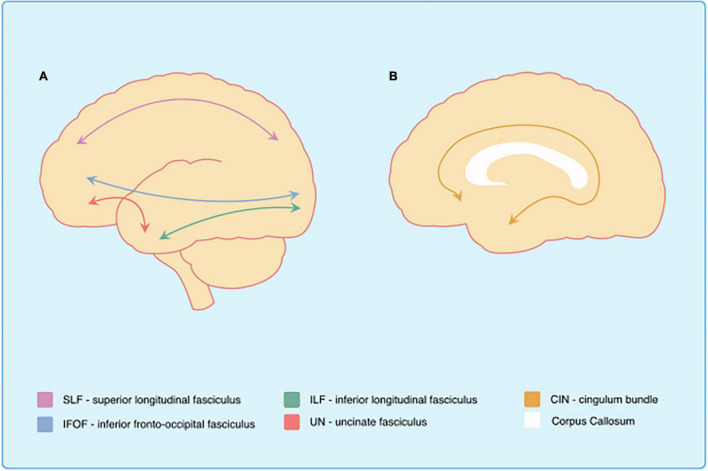
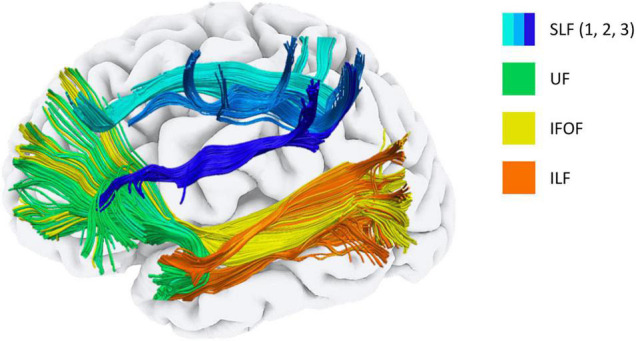
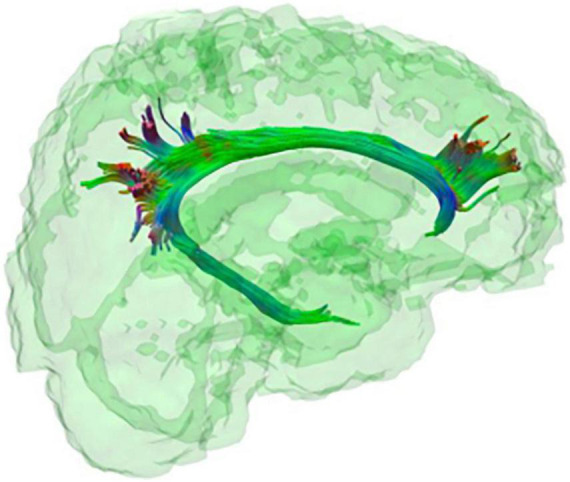
Down syndrome (DS) arises from the triplication of chromosome 21, which leads to an atypical neurodevelopment and the overproduction of the amyloid precursor protein, predisposing to early Alzheimer's disease (AD). Not surprisingly, trisomy 21 is widely considered a model to study predementia stages of AD. After decades, in which neural loss was the main focus, research in AD is now moving toward understanding the neurodegenerative aspects affecting white matter. Motivated by the development of magnetic resonance imaging (MRI)-based diffusion techniques, this shift in focus has led to several exploratory studies on both young and older individuals with DS. In this review, we synthesise the initial efforts made by researchers in characterising structural connectivity in DS, together with the AD footprint on top of such pre-existing connectivity related to atypical brain development. The white matter structures found to be affected in DS are the corpus callosum and all the main long-association fibres, namely the inferior fronto-occipital fasciculus, the inferior and superior longitudinal fasciculus, the uncinate fasciculus and the cingulum bundle. Furthermore, the cingulum bundle and the corpus callosum appear to be particularly sensitive to early AD changes in this population. Findings are discussed in terms of their functional significance, alongside methodological considerations and implications for future research.
唐氏综合征(DS)源于21号染色体三体性,这会导致非典型神经发育以及淀粉样前体蛋白的过量产生,从而易患早发性阿尔茨海默病(AD)。毫不奇怪,21号染色体三体性被广泛认为是研究AD痴呆前期阶段的一个模型。在几十年里,神经细胞损失一直是主要研究重点,如今AD研究正朝着理解影响白质的神经退行性方面发展。受基于磁共振成像(MRI)的扩散技术发展的推动,这种研究重点的转变促使人们对年轻和年长的DS个体进行了多项探索性研究。在这篇综述中,我们综合了研究人员在表征DS结构连通性方面所做的初步努力,以及与非典型脑发育相关的这种预先存在的连通性之上的AD特征。在DS中发现受影响的白质结构包括胼胝体和所有主要的长联合纤维,即额枕下束、上纵束和下纵束、钩束和扣带束。此外,扣带束和胼胝体在该人群中似乎对早期AD变化特别敏感。我们将结合方法学考量以及对未来研究的启示,从功能意义的角度对研究结果进行讨论。