Department of Physiology and Pathophysiology, Rady Faculty of Health Sciences, Institute of Cardiovascular Sciences, St. Boniface Hospital Albrechtsen Research Centre, University of Manitoba, Winnipeg, Manitoba, Canada.
Department of Medical Laboratory Sciences, The Hashemite University, Zarqa, Jordan.
Physiol Rep. 2022 Aug;10(15):e15379. doi: 10.14814/phy2.15379.
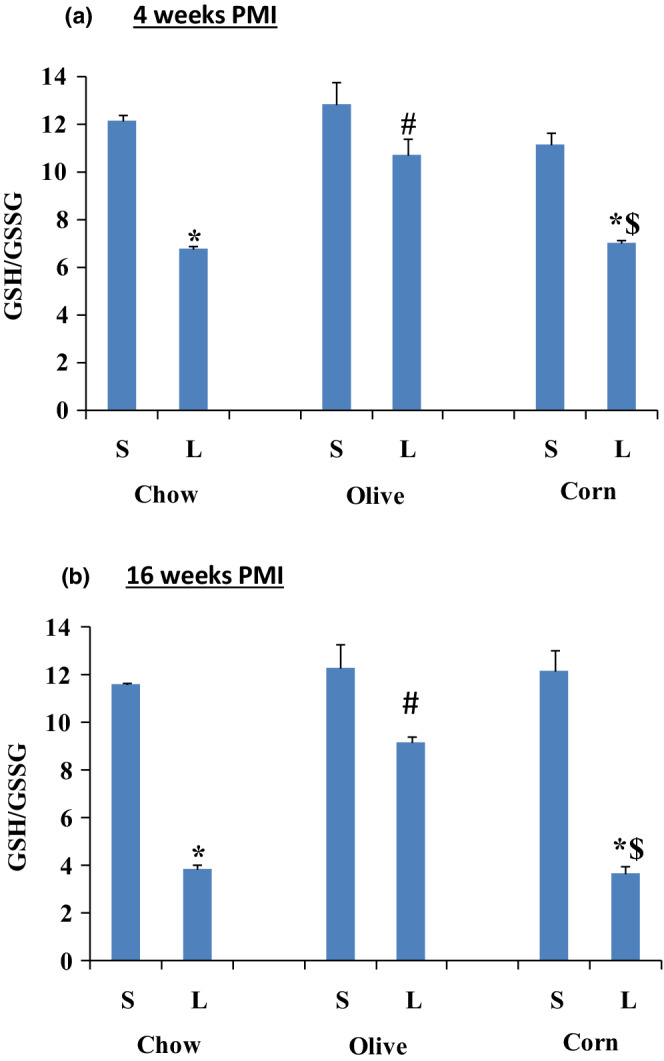
We examined the beneficial effects of olive oil against heart failure post-myocardial infarction (PMI), induced by coronary artery ligation in rats. Animals were divided into sham and ligated groups and fed either regular chow, olive oil (10% wt/wt), or corn oil (10% wt/wt) and were followed up to 16 weeks. On the echocardiography at 3 days (PMI), in the ligated regular chow (LRC), ligated olive oil (LOO), and ligated corn oil (LCO) left ventricular ejection fraction (LVEF) decrease was 12.14%, 16.42%, and 17.53% from the baseline, respectively. However, only LOO group improved LVEF significantly at 16 weeks PMI and became comparable with all sham groups. Both scar formation and collagen deposition at 16 weeks PMI were less pronounced in the LOO group. Myocardial TNF-α level at 4 weeks of PMI increased by 176%, 11%, and 181% in the LRC, LOO, and LCO groups, respectively. Plasma TNF-α levels in LOO were significantly lower than LRC group after 4 weeks of PMI. Myocardial redox ratio (reduced glutathione/oxidized glutathione) decreased at 4 weeks PMI by 44.4%, 16.4%, and 36.9% in the LRC, LOO, and LCO groups, respectively, compared to the baseline. These changes in the redox ratio at 16 weeks PMI were further exacerbated in the LRC and LCO groups. Lipid hydroperoxides formation increased at 4 weeks PMI by 137.4%, 14.6%, and 97.1% in the LRC, LOO, and LCO groups, respectively. Since coronary artery ligation decreased left ventricular ejection fraction, increased myocardial TNF-α and oxidative stress, and since olive oil was able to inhibit these effects, it is proposed that dietary olive oil modulates cardiac remodeling and heart failure subsequent to myocardial infarction.
我们研究了橄榄油对冠状动脉结扎诱导的心肌梗死后心力衰竭(PMI)的有益作用。动物分为假手术组和结扎组,分别给予常规饲料、橄榄油(10%wt/wt)或玉米油(10%wt/wt),并随访至 16 周。在 3 天(PMI)的超声心动图检查中,结扎常规饲料(LRC)、结扎橄榄油(LOO)和结扎玉米油(LCO)组左心室射血分数(LVEF)分别从基线下降 12.14%、16.42%和 17.53%。然而,只有 LOO 组在 16 周 PMI 时显著改善 LVEF,且与所有假手术组相当。在 16 周 PMI 时,LOO 组的疤痕形成和胶原沉积也较少。在 4 周 PMI 时,心肌 TNF-α水平在 LRC、LOO 和 LCO 组分别增加了 176%、11%和 181%。在 4 周 PMI 后,LOO 组的血浆 TNF-α水平明显低于 LRC 组。在 4 周 PMI 时,心肌氧化还原比(还原型谷胱甘肽/氧化型谷胱甘肽)在 LRC、LOO 和 LCO 组分别下降了 44.4%、16.4%和 36.9%,与基线相比。在 16 周 PMI 时,这些氧化还原比的变化在 LRC 和 LCO 组进一步恶化。在 4 周 PMI 时,脂质氢过氧化物的形成在 LRC、LOO 和 LCO 组分别增加了 137.4%、14.6%和 97.1%。由于冠状动脉结扎降低了左心室射血分数,增加了心肌 TNF-α和氧化应激,而橄榄油能够抑制这些作用,因此可以认为饮食橄榄油调节心肌梗死后的心脏重构和心力衰竭。