Population Research Unit, Faculty of Social Sciences, University of Helsinki, Helsinki, Finland.
Center for Twin Research, Osaka University Graduate School of Medicine, Osaka, Japan.
Int J Obes (Lond). 2022 Oct;46(10):1901-1909. doi: 10.1038/s41366-022-01202-3. Epub 2022 Aug 9.
Body mass index (BMI) shows strong continuity over childhood and adolescence and high childhood BMI is the strongest predictor of adult obesity. Genetic factors strongly contribute to this continuity, but it is still poorly known how their contribution changes over childhood and adolescence. Thus, we used the genetic twin design to estimate the genetic correlations of BMI from infancy to adulthood and compared them to the genetic correlations of height.
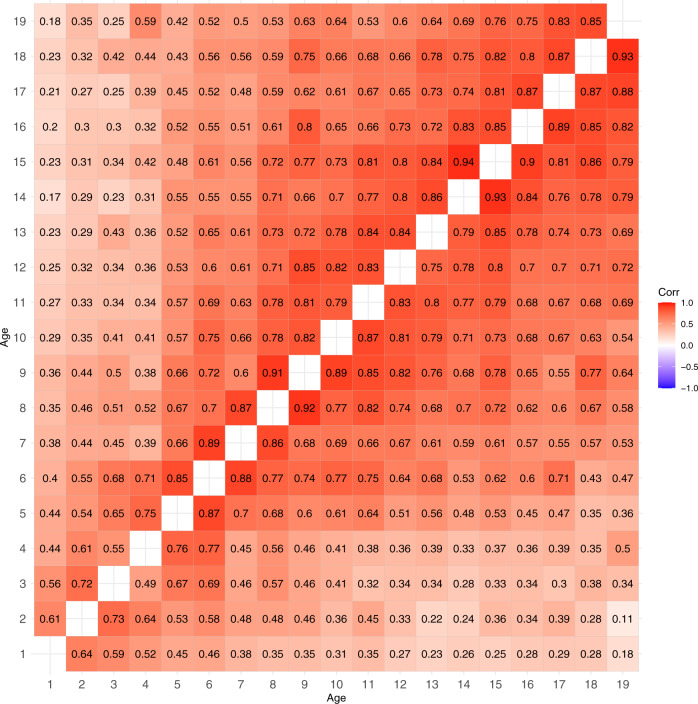
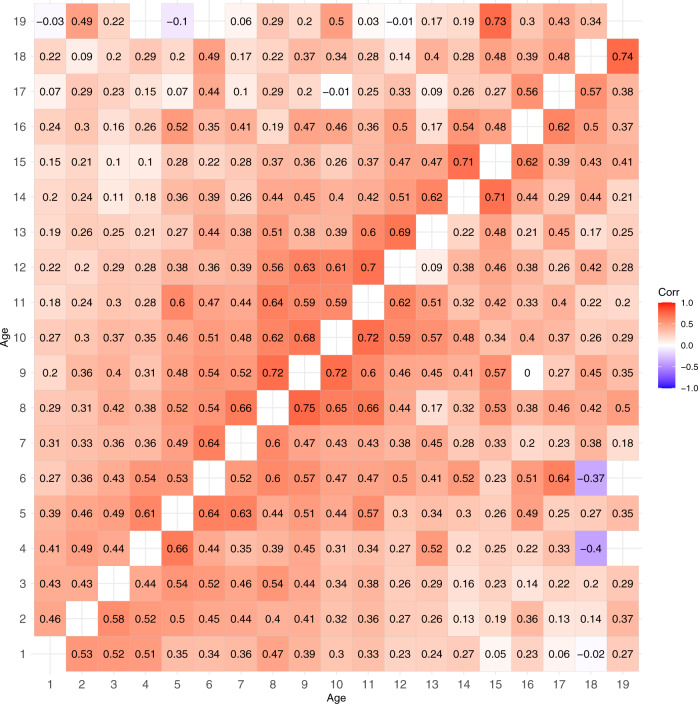
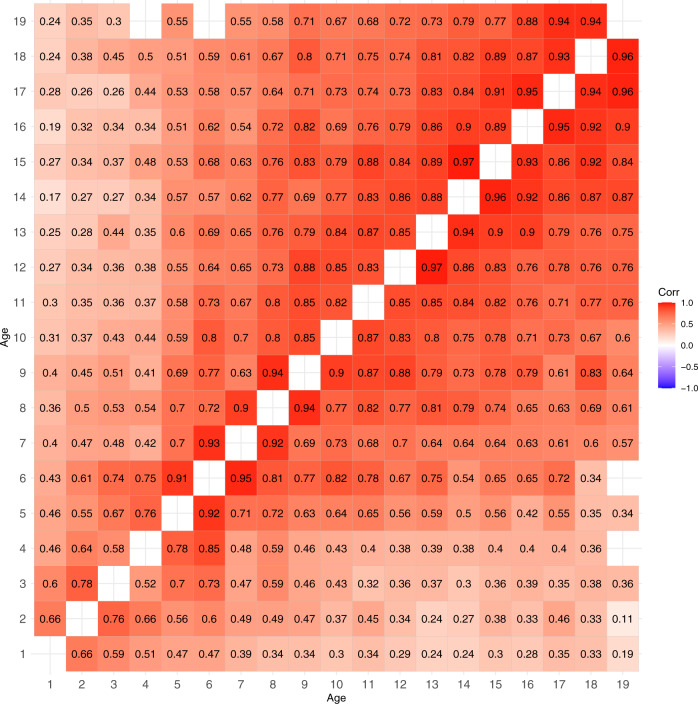
We pooled individual level data from 25 longitudinal twin cohorts including 38,530 complete twin pairs and having 283,766 longitudinal height and weight measures. The data were analyzed using Cholesky decomposition offering genetic and environmental correlations of BMI and height between all age combinations from 1 to 19 years of age.
The genetic correlations of BMI and height were stronger than the trait correlations. For BMI, we found that genetic correlations decreased as the age between the assessments increased, a trend that was especially visible from early to middle childhood. In contrast, for height, the genetic correlations were strong between all ages. Age-to-age correlations between environmental factors shared by co-twins were found for BMI in early childhood but disappeared altogether by middle childhood. For height, shared environmental correlations persisted from infancy to adulthood.
Our results suggest that the genes affecting BMI change over childhood and adolescence leading to decreasing age-to-age genetic correlations. This change is especially visible from early to middle childhood indicating that new genetic factors start to affect BMI in middle childhood. Identifying mediating pathways of these genetic factors can open possibilities for interventions, especially for those children with high genetic predisposition to adult obesity.
体重指数(BMI)在儿童期和青春期表现出很强的连续性,儿童时期的 BMI 较高是成年肥胖的最强预测因素。遗传因素对此连续性有很大贡献,但遗传因素的贡献如何随儿童期和青春期而变化仍知之甚少。因此,我们使用遗传双胞胎设计来估计从婴儿期到成年期 BMI 的遗传相关性,并将其与身高的遗传相关性进行比较。
我们汇集了 25 个纵向双胞胎队列的个体水平数据,包括 38530 对完整的双胞胎和 283766 次纵向身高和体重测量。使用 Cholesky 分解法分析数据,提供了 1 至 19 岁所有年龄组合的 BMI 和身高的遗传和环境相关性。
BMI 和身高的遗传相关性强于表型相关性。对于 BMI,我们发现遗传相关性随着评估之间的年龄增加而降低,这种趋势在儿童早期到中期尤为明显。相比之下,对于身高,所有年龄段的遗传相关性都很强。在儿童早期发现了 BMI 双胞胎间共享环境因素的年龄间相关性,但到了儿童中期完全消失。对于身高,从婴儿期到成年期,共享环境相关性持续存在。
我们的研究结果表明,影响 BMI 的基因在儿童期和青春期发生变化,导致年龄间遗传相关性降低。这种变化在儿童早期到中期尤为明显,表明新的遗传因素开始在儿童中期影响 BMI。确定这些遗传因素的中介途径可以为干预提供可能性,特别是对于那些有成年肥胖高遗传倾向的儿童。