Kachhara Rajneesh, Nigam Pulak, Nair Suresh
Department of Neurosurgery, Institute of Neurosciences, Medanta Multi-Speciality Hospital, Indore, Madhya Pradesh, India.
Department of Neurosurgery, Sree Chitra Tirunal Institute of Medical Sciences and Technology, Trivandrum, Kerala, India.
J Neurosci Rural Pract. 2022 Jun 8;13(3):431-440. doi: 10.1055/s-0042-1745817. eCollection 2022 Jul.
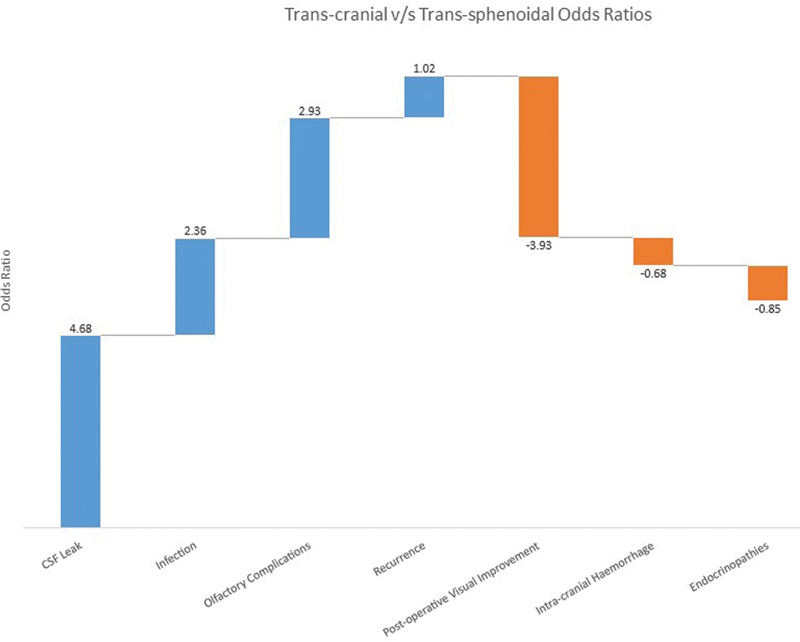
Tuberculum sella meningioma form a distinct surgical entity with significant morbidity for the patient due to early and profound visual involvement. Surgical treatment of tuberculum sella meningioma is challenging in view of the proximity of vital neuro-vasculature. These lesions may be approached via a high-route (trans-cranial) or a low-route (trans-sphenoidal). The authors present a consecutive series of 36 patients, operated by the first author from 1996 onward, with an analysis of clinical presentation (emphasizing visual deterioration), imaging features, operative approaches, and outcome with postoperative visual status. There were 36 patients (72 eyes) in the series, 75% females and 25% males. The mean age of patients was 48.05 ± 10.02 years. In all, 88.89% had visual diminution, 50% had headache, 5.56% had behavioral changes, and 2.78% had seizures. The mean tumor size was 4.01 ± 1.01 cm. The frontotemporal approach was employed in 66.67% of patients, and all patients underwent a right-sided approach. There was no significant difference between improvement in the vision between the right eye and left eye, despite the fact that right-sided approach was employed in nearly cases. While tuberculum sella meningioma have profound morbidity in terms of visual deterioration, timely surgical intervention may help patients gain serviceable vision postoperatively. We advocate the trans-cranial approach and find no difference in visual outcomes on employing right-sided approach, regardless of the side with worse vision.
鞍结节脑膜瘤是一种独特的外科疾病,由于早期且严重的视力受累,会给患者带来显著的发病率。鉴于重要神经血管结构的临近,鞍结节脑膜瘤的外科治疗具有挑战性。这些病变可通过高路径(经颅)或低路径(经蝶窦)进行处理。作者呈现了一系列连续的36例患者,由第一作者从1996年起进行手术,并对临床表现(着重于视力减退)、影像学特征、手术入路以及术后视力状况的结果进行了分析。该系列中有36例患者(72只眼),女性占75%,男性占25%。患者的平均年龄为48.05±10.02岁。总体而言,88.89%的患者有视力减退,50%的患者有头痛,5.56%的患者有行为改变,2.78%的患者有癫痫发作。肿瘤的平均大小为4.01±1.01厘米。66.67%的患者采用了额颞入路,所有患者均采用右侧入路。尽管几乎所有病例都采用了右侧入路,但右眼和左眼视力改善之间没有显著差异。虽然鞍结节脑膜瘤在视力减退方面有严重的发病率,但及时的外科干预可能有助于患者术后获得可用的视力。我们提倡经颅入路,并且发现采用右侧入路在视力结果上没有差异,无论视力较差的是哪一侧。