Department of Computer Science, University of Verona, Verona 37134, Italy.
Department of Molecular Biotechnology and Health Sciences, University of Turin, Turin 10126, Italy.
Gigascience. 2022 Aug 10;11. doi: 10.1093/gigascience/giac075.
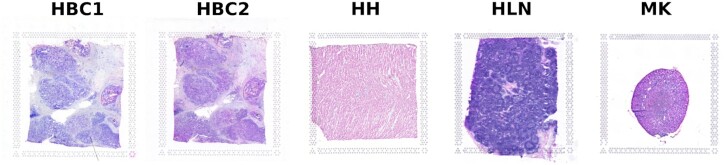
Spatial transcriptomics (ST) combines stained tissue images with spatially resolved high-throughput RNA sequencing. The spatial transcriptomic analysis includes challenging tasks like clustering, where a partition among data points (spots) is defined by means of a similarity measure. Improving clustering results is a key factor as clustering affects subsequent downstream analysis. State-of-the-art approaches group data by taking into account transcriptional similarity and some by exploiting spatial information as well. However, it is not yet clear how much the spatial information combined with transcriptomics improves the clustering result.
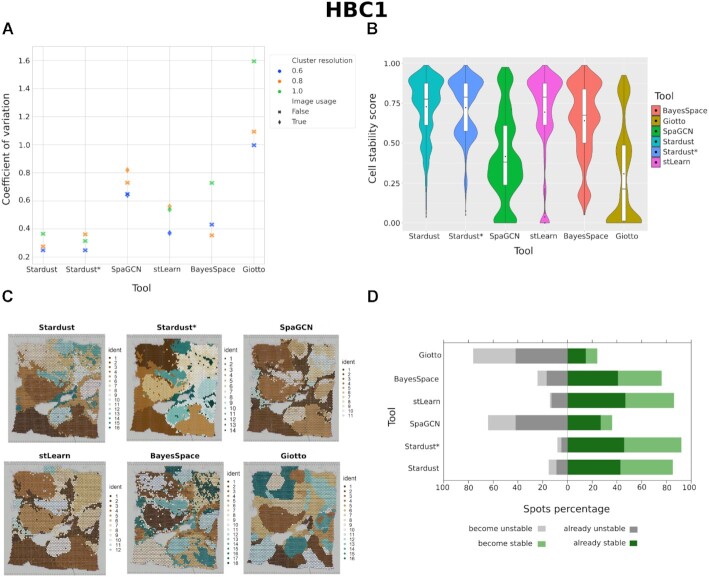
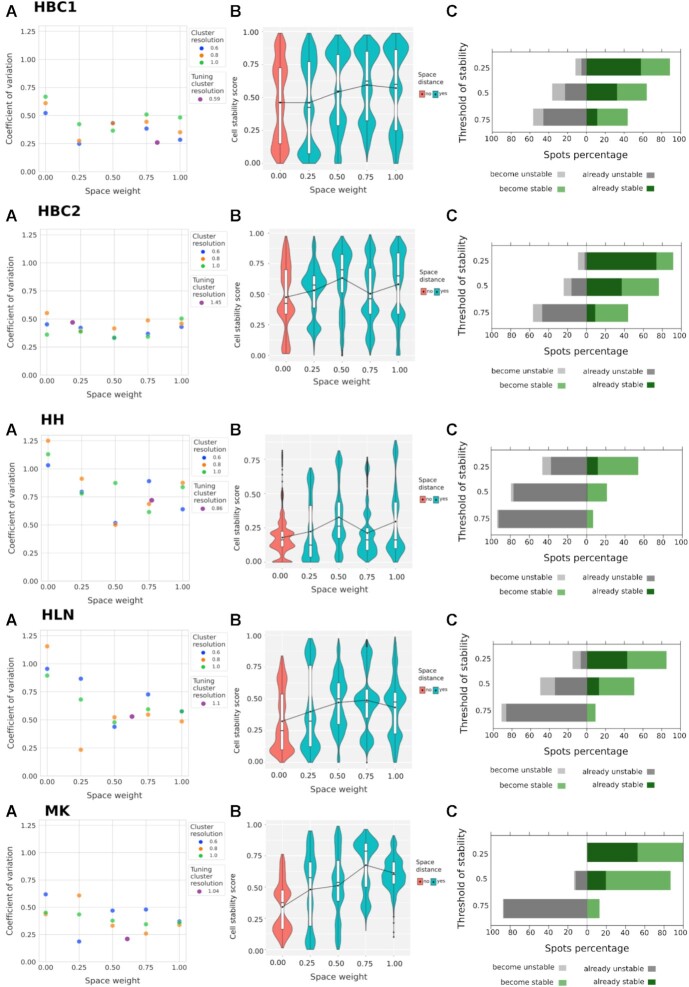
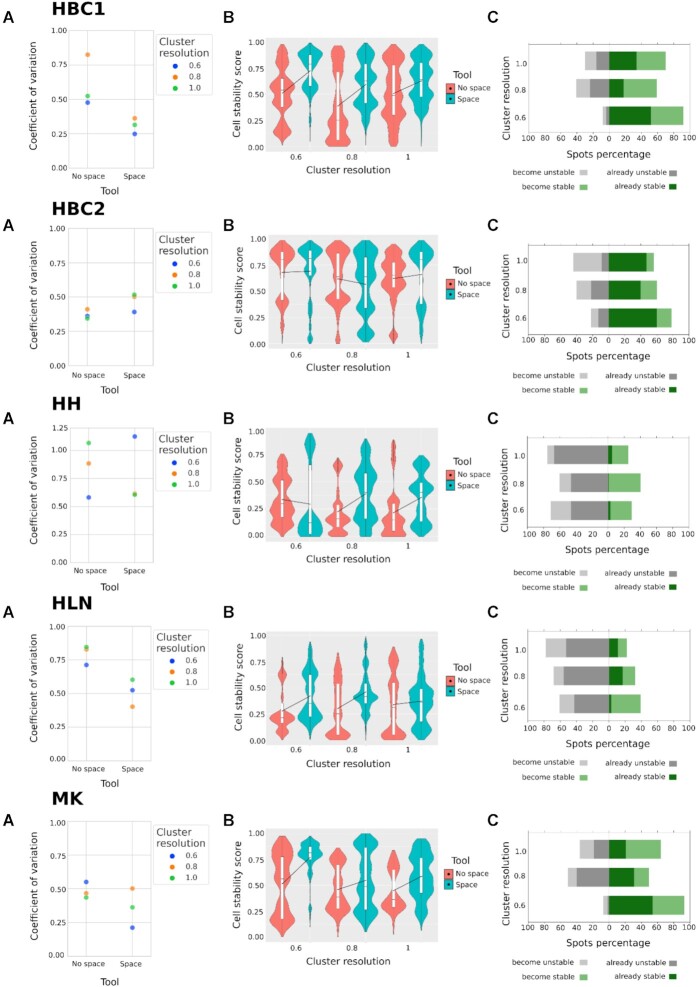
We propose a new clustering method, Stardust, that easily exploits the combination of space and transcriptomic information in the clustering procedure through a manual or fully automatic tuning of algorithm parameters. Moreover, a parameter-free version of the method is also provided where the spatial contribution depends dynamically on the expression distances distribution in the space. We evaluated the proposed methods results by analyzing ST data sets available on the 10x Genomics website and comparing clustering performances with state-of-the-art approaches by measuring the spots' stability in the clusters and their biological coherence. Stability is defined by the tendency of each point to remain clustered with the same neighbors when perturbations are applied.
Stardust is an easy-to-use methodology allowing to define how much spatial information should influence clustering on different tissues and achieving more stable results than state-of-the-art approaches.
空间转录组学(ST)将染色组织图像与空间分辨的高通量 RNA 测序相结合。空间转录组分析包括聚类等具有挑战性的任务,其中通过相似性度量来定义数据点(斑点)之间的分区。提高聚类结果是一个关键因素,因为聚类会影响后续的下游分析。最先进的方法通过考虑转录相似性和一些通过利用空间信息来对数据进行分组。然而,目前尚不清楚将空间信息与转录组学结合起来能在多大程度上改善聚类结果。
我们提出了一种新的聚类方法 Stardust,它可以通过手动或自动调整算法参数轻松地在聚类过程中利用空间和转录组信息的组合。此外,还提供了一种无参数版本的方法,其中空间贡献取决于空间中表达距离分布的动态变化。我们通过分析 10x Genomics 网站上提供的 ST 数据集来评估所提出方法的结果,并通过测量聚类中斑点的稳定性和它们的生物学一致性来比较聚类性能与最先进的方法。稳定性是指每个点在应用扰动时保持与相同邻居聚类的趋势。
Stardust 是一种易于使用的方法,可以定义在不同组织上应该有多少空间信息来影响聚类,并实现比最先进的方法更稳定的结果。