Division of Virology, Institute of Medical Science, University of Tokyo, Tokyo, Japan.
Center for Global Viral Diseases, National Center for Global Health and Medicine, Tokyo, Japan.
mSphere. 2022 Aug 31;7(4):e0008622. doi: 10.1128/msphere.00086-22. Epub 2022 Aug 10.
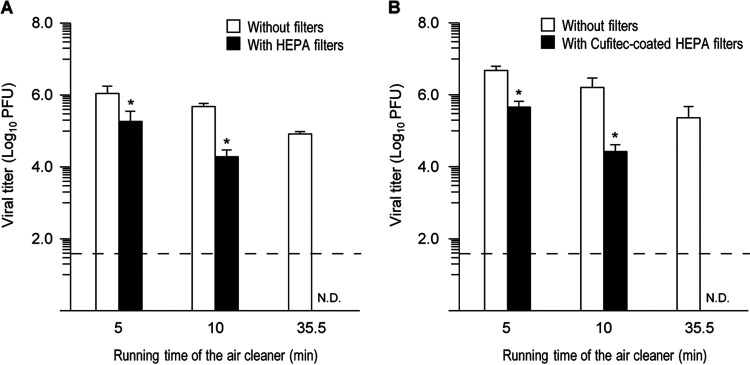
Coronavirus disease 2019 (COVID-19) spreads by airborne transmission; therefore, the development and functional evaluation of air-cleaning technologies are essential for infection control. Air filtration using high-efficiency particulate air (HEPA) filters may be effective; however, no quantitative assessment of the effectiveness of these filters in the removal of infectious severe acute respiratory syndrome coronavirus 2 (SARS-CoV-2) from the air has been reported. To evaluate the removal effect of HEPA filtration on airborne SARS-CoV-2, here, we disseminated infectious SARS-CoV-2 aerosols in a test chamber in a biosafety level 3 facility and filtered the air with a HEPA-filtered air cleaner in the chamber. The air cleaner with the HEPA filter continuously removed the infectious SARS-CoV-2 from the air in a running-time-dependent manner, and the virus capture ratios were 85.38%, 96.03%, and >99.97% at 1, 2, and 7.1 ventilation volumes, respectively. The air-cleaning performance of a HEPA filter coated with an antiviral agent consisting mainly of a monovalent copper compound was also evaluated, and the capture ratio was found to be comparable to that of the conventional HEPA filter. This study provides insights into the proper use and performance of HEPA-filtered air cleaners to prevent the spread of COVID-19. Air filtration simulation experiments quantitatively showed that an air cleaner equipped with a HEPA filter can continuously remove SARS-CoV-2 from the air. The capture ratios for SARS-CoV-2 in the air when the air cleaner was equipped with an antiviral-agent-coated HEPA filter were comparable to those with the conventional HEPA filter, and there was little effect on SARS-CoV-2 in the air that passed through the antiviral-reagent-coated HEPA filter.
新型冠状病毒病(COVID-19)通过空气传播;因此,开发和功能评估空气净化技术对于感染控制至关重要。使用高效空气(HEPA)过滤器进行空气过滤可能是有效的;然而,尚未报道这些过滤器在去除空气中传染性严重急性呼吸综合征冠状病毒 2(SARS-CoV-2)方面的有效性的定量评估。为了评估 HEPA 过滤对空气中 SARS-CoV-2 的去除效果,在这里,我们在生物安全 3 级设施的测试室中传播传染性 SARS-CoV-2 气溶胶,并在室内使用 HEPA 过滤空气净化器过滤空气。带有 HEPA 过滤器的空气净化器以运行时间依赖的方式连续从空气中去除传染性 SARS-CoV-2,在 1、2 和 7.1 通风量下,病毒捕获率分别为 85.38%、96.03%和>99.97%。还评估了主要由单价铜化合物组成的抗病毒剂涂覆的 HEPA 过滤器的空气净化性能,发现捕获率与常规 HEPA 过滤器相当。本研究为正确使用和评估 HEPA 过滤空气净化器以预防 COVID-19 的传播提供了依据。空气过滤模拟实验定量表明,配备 HEPA 过滤器的空气净化器可以从空气中连续去除 SARS-CoV-2。配备涂有抗病毒剂的 HEPA 过滤器的空气净化器对空气中 SARS-CoV-2 的捕获率与常规 HEPA 过滤器相当,并且通过涂有抗病毒剂的 HEPA 过滤器过滤后的空气中 SARS-CoV-2 几乎没有影响。