Austere Environments Consortium for Enhanced Sepsis Outcomes, Henry M. Jackson Foundation for the Advancement of Military Medicine Inc., Bethesda, Maryland, United States of America.
Department of Pathology, School of Medicine, Uniformed Services University, Bethesda, Maryland, United States of America.
PLoS One. 2022 Aug 10;17(8):e0272572. doi: 10.1371/journal.pone.0272572. eCollection 2022.
Venous phlebotomy performed by trained personnel is critical for patient diagnosis and monitoring of chronic disease, but has limitations in resource-constrained settings, and represents an infection control challenge during outbreaks. Self-collection devices have the potential to shift phlebotomy closer to the point of care, supporting telemedicine strategies and virtual clinical trials. Here we assess a capillary blood micro-sampling device, the Tasso Serum Separator Tube (SST), for measuring blood protein levels in healthy subjects and non-hospitalized COVID-19 patients.
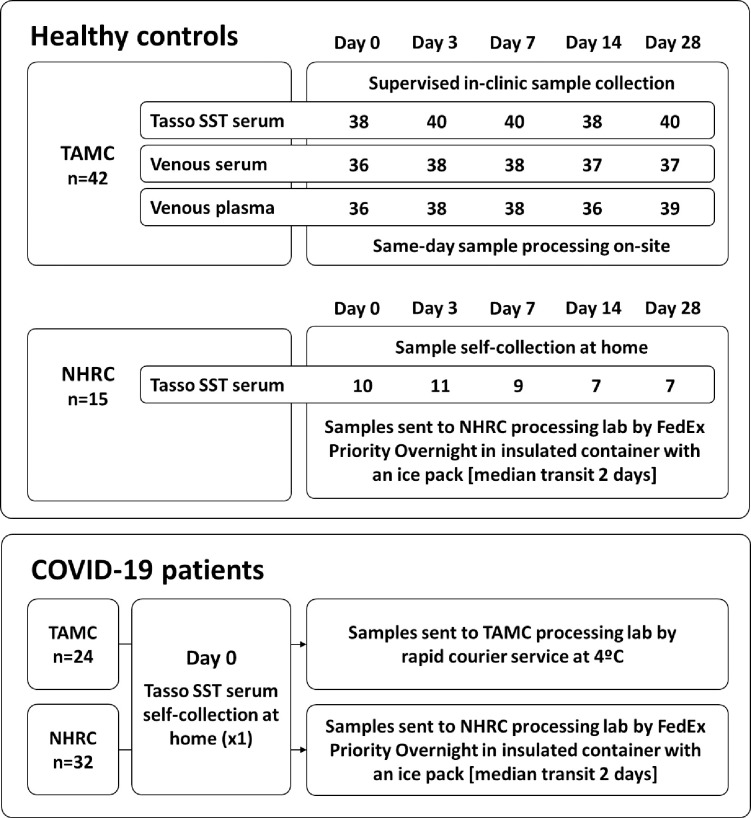
57 healthy controls and 56 participants with mild/moderate COVID-19 were recruited at two U.S. military healthcare facilities. Healthy controls donated Tasso SST capillary serum, venous plasma and venous serum samples at multiple time points, while COVID-19 patients donated a single Tasso SST serum sample at enrolment. Concentrations of 17 protein inflammatory biomarkers were measured in all biospecimens by Ella multi-analyte immune-assay.
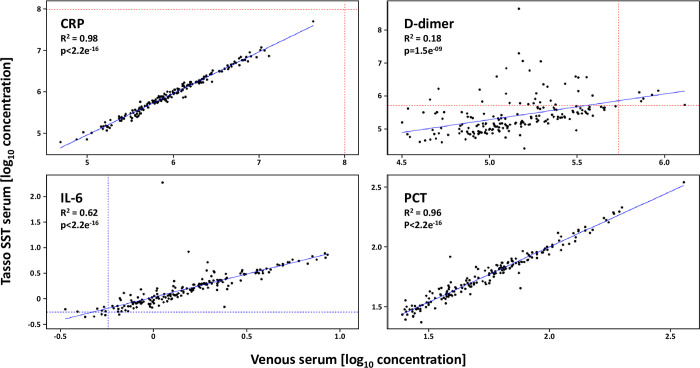
Tasso SST serum protein measurements in healthy control subjects were highly reproducible, but their agreements with matched venous samples varied. Most of the selected proteins, including CRP, Ferritin, IL-6 and PCT, were well-correlated between Tasso SST and venous serum with little sample type bias, but concentrations of D-dimer, IL-1B and IL-1Ra were not. Self-collection at home with delayed sample processing was associated with significant concentrations differences for several analytes compared to supervised, in-clinic collection with rapid processing. Finally, Tasso SST serum protein concentrations were significantly elevated in in non-hospitalized COVID-19 patients compared with healthy controls.
Self-collection of capillary blood with micro-sampling devices provides an attractive alternative to routine phlebotomy. However, concentrations of certain analytes may differ significantly from those in venous samples, and factors including user proficiency, temperature control and time lags between specimen collection and processing need to be considered for their effect on sample quality and reproducibility.
经过培训的人员进行静脉采血对于患者诊断和慢性病监测至关重要,但在资源有限的环境下存在局限性,并且在疫情爆发期间存在感染控制挑战。自采设备有可能将采血更接近护理点,支持远程医疗策略和虚拟临床试验。在这里,我们评估了一种毛细血管血微量采样装置,即 Tasso 血清分离管(SST),用于测量健康受试者和非住院 COVID-19 患者的血液蛋白水平。
在美国的两家军事医疗保健机构招募了 57 名健康对照者和 56 名轻度/中度 COVID-19 参与者。健康对照者在多个时间点捐献了 Tasso SST 毛细血管血清、静脉血浆和静脉血清样本,而 COVID-19 患者在入组时捐献了单一的 Tasso SST 血清样本。所有生物样本中的 17 种蛋白质炎症生物标志物浓度均通过 Ella 多分析物免疫测定法进行测量。
健康对照者的 Tasso SST 血清蛋白测量结果高度可重复,但与匹配的静脉样本的一致性存在差异。大多数选定的蛋白质,包括 CRP、铁蛋白、IL-6 和 PCT,在 Tasso SST 和静脉血清之间具有很好的相关性,几乎没有样本类型偏差,但 D-二聚体、IL-1β 和 IL-1Ra 的浓度则不然。与监督、快速处理的门诊采集相比,在家中自行采集并延迟处理的样本中,几种分析物的浓度差异显著。最后,与健康对照者相比,非住院 COVID-19 患者的 Tasso SST 血清蛋白浓度显著升高。
使用微量采样装置进行毛细血管血自采提供了一种有吸引力的常规采血替代方法。然而,某些分析物的浓度可能与静脉样本有很大差异,并且包括用户熟练程度、温度控制和标本采集与处理之间的时间滞后在内的因素,都需要考虑其对样本质量和可重复性的影响。