Department of Chemistry, University of Toronto, Toronto, Ontario M5S 3H6, Canada.
Acceleration Consortium, University of Toronto, Toronto, Ontario M5S 3H6, Canada.
Acc Chem Res. 2022 Sep 6;55(17):2454-2466. doi: 10.1021/acs.accounts.2c00220. Epub 2022 Aug 10.
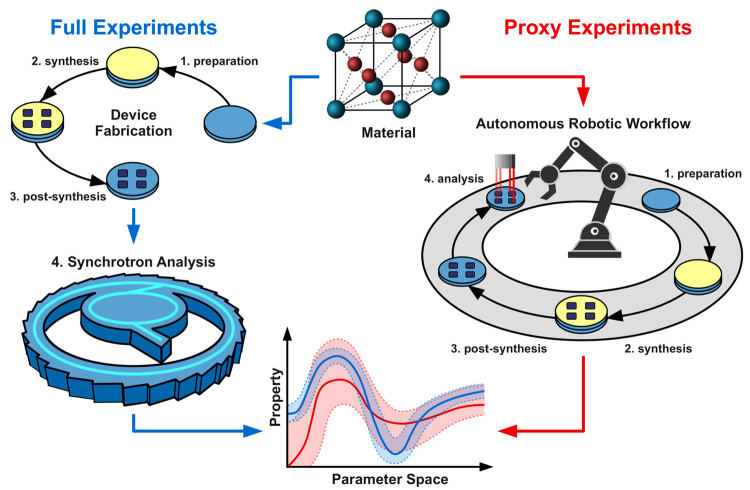
We must accelerate the pace at which we make technological advancements to address climate change and disease risks worldwide. This swifter pace of discovery requires faster research and development cycles enabled by better integration between hypothesis generation, design, experimentation, and data analysis. Typical research cycles take months to years. However, data-driven automated laboratories, or self-driving laboratories, can significantly accelerate molecular and materials discovery. Recently, substantial advancements have been made in the areas of machine learning and optimization algorithms that have allowed researchers to extract valuable knowledge from multidimensional data sets. Machine learning models can be trained on large data sets from the literature or databases, but their performance can often be hampered by a lack of negative results or metadata. In contrast, data generated by self-driving laboratories can be information-rich, containing precise details of the experimental conditions and metadata. Consequently, much larger amounts of high-quality data are gathered in self-driving laboratories. When placed in open repositories, this data can be used by the research community to reproduce experiments, for more in-depth analysis, or as the basis for further investigation. Accordingly, high-quality open data sets will increase the accessibility and reproducibility of science, which is sorely needed.In this Account, we describe our efforts to build a self-driving lab for the development of a new class of materials: organic semiconductor lasers (OSLs). Since they have only recently been demonstrated, little is known about the molecular and material design rules for thin-film, electrically-pumped OSL devices as compared to other technologies such as organic light-emitting diodes or organic photovoltaics. To realize high-performing OSL materials, we are developing a flexible system for automated synthesis via iterative Suzuki-Miyaura cross-coupling reactions. This automated synthesis platform is directly coupled to the analysis and purification capabilities. Subsequently, the molecules of interest can be transferred to an optical characterization setup. We are currently limited to optical measurements of the OSL molecules in solution. However, material properties are ultimately most important in the solid state (e.g., as a thin-film device). To that end and for a different scientific goal, we are developing a self-driving lab for inorganic thin-film materials focused on the oxygen evolution reaction.While the future of self-driving laboratories is very promising, numerous challenges still need to be overcome. These challenges can be split into cognition and motor function. Generally, the cognitive challenges are related to optimization with constraints or unexpected outcomes for which general algorithmic solutions have yet to be developed. A more practical challenge that could be resolved in the near future is that of software control and integration because few instrument manufacturers design their products with self-driving laboratories in mind. Challenges in motor function are largely related to handling heterogeneous systems, such as dispensing solids or performing extractions. As a result, it is critical to understand that adapting experimental procedures that were designed for human experimenters is not as simple as transferring those same actions to an automated system, and there may be more efficient ways to achieve the same goal in an automated fashion. Accordingly, for self-driving laboratories, we need to carefully rethink the translation of manual experimental protocols.
我们必须加快步伐,在全球范围内利用技术进步应对气候变化和疾病风险。这种更快的发现步伐需要更快的研究和开发周期,这需要更好地整合假设生成、设计、实验和数据分析。典型的研究周期需要数月至数年。然而,数据驱动的自动化实验室或自动驾驶实验室可以显著加速分子和材料的发现。最近,机器学习和优化算法领域取得了重大进展,使研究人员能够从多维数据集提取有价值的知识。机器学习模型可以在文献或数据库中的大型数据集上进行训练,但由于缺乏负面结果或元数据,其性能往往会受到影响。相比之下,自动驾驶实验室生成的数据信息丰富,包含实验条件和元数据的精确细节。因此,自动驾驶实验室收集了大量高质量的数据。将这些数据放入开放存储库中,研究社区可以使用这些数据来复制实验、进行更深入的分析,或作为进一步研究的基础。因此,高质量的开放数据集将提高科学的可访问性和可重复性,这是非常需要的。在本报告中,我们描述了构建用于开发一类新型材料的自动驾驶实验室的努力:有机半导体激光器(OSL)。由于它们最近才被证明,与其他技术(如有机发光二极管或有机光伏)相比,薄 膜、电泵浦 OSL 器件的分子和材料设计规则知之甚少。为了实现高性能 OSL 材料,我们正在开发一种通过迭代 Suzuki-Miyaura 交叉偶联反应进行自动化合成的灵活系统。该自动化合成平台直接与分析和净化功能相结合。随后,可以将感兴趣的分子转移到光学特性测试设备中。我们目前仅限于对溶液中 OSL 分子的光学测量。然而,材料性能在固态中最终是最重要的(例如,作为薄膜器件)。为此,出于不同的科学目标,我们正在开发一个专注于氧析出反应的无机薄膜材料的自动驾驶实验室。尽管自动驾驶实验室的未来非常有前景,但仍有许多挑战需要克服。这些挑战可以分为认知和运动功能。一般来说,认知挑战与具有约束的优化或尚未开发出通用算法解决方案的意外结果有关。一个更实际的挑战可能会在不久的将来得到解决,那就是软件控制和集成,因为很少有仪器制造商在设计产品时考虑到自动驾驶实验室。运动功能方面的挑战主要与处理异构系统有关,例如分配固体或进行提取。因此,关键是要了解,将专为人类实验员设计的实验程序进行改编并不像将这些相同的操作直接转移到自动化系统那么简单,并且以自动化的方式实现相同目标可能有更有效的方法。因此,对于自动驾驶实验室,我们需要仔细重新思考手动实验方案的转化。