International Agency for Research on Cancer (IARC/WHO), Nutrition and Metabolism Branch, Lyon, France.
Centre for Population Health Research, National Institute of Public Health, Cuernavaca, Mexico.
BMC Cancer. 2022 Aug 11;22(1):877. doi: 10.1186/s12885-022-09975-6.
Breast cancer incidence is increasing rapidly in Latin America, with a higher proportion of cases among young women than in developed countries. Studies have linked inflammation to breast cancer development, but data is limited in premenopausal women, especially in Latin America.
We investigated the associations between serum biomarkers of chronic inflammation (interleukin (IL)-6, IL-8, IL-10, tumor necrosis factor-α (TNF-α), interferon-γ (IFN-γ), leptin, adiponectin) and risk of premenopausal breast cancer among 453 cases and 453 matched, population-based controls from Chile, Colombia, Costa Rica, and Mexico. Odds ratios (OR) were estimated using conditional logistic regression models. Analyses were stratified by size and hormonal receptor status of the tumors.
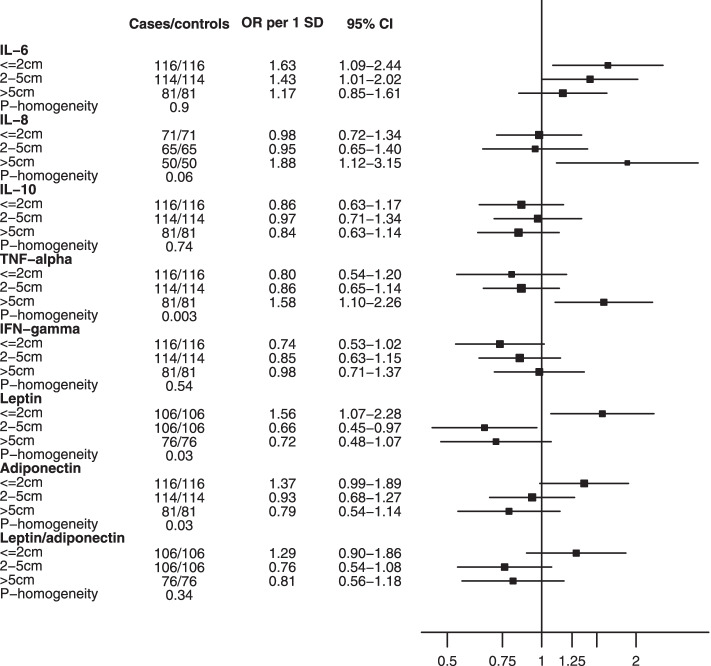
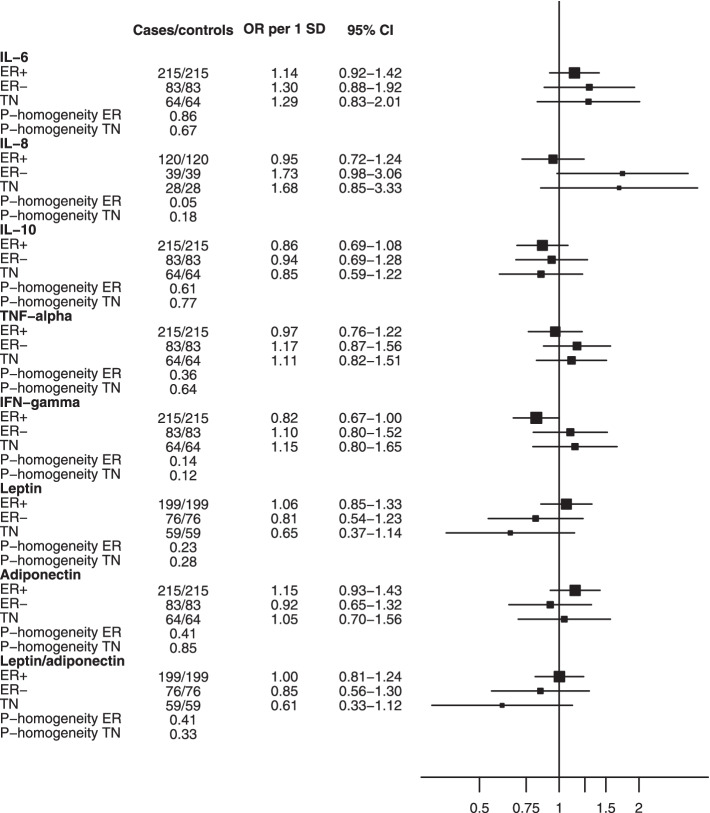
IL-6 (OR = 1.33 (1.11-1.60)) and TNF-α (OR = 1.32 (1.11-1.58)) were positively associated with breast cancer risk in fully adjusted models. Evidence of heterogeneity by estrogen receptor (ER) status was observed for IL-8 (P-homogeneity = 0.05), with a positive association in ER-negative tumors only. IL-8 (P-homogeneity = 0.06) and TNF-α (P-homogeneity = 0.003) were positively associated with risk in the largest tumors, while for leptin (P-homogeneity = 0.003) a positive association was observed for the smallest tumors only.
The results of this study support the implication of chronic inflammation in breast cancer risk in young women in Latin America. Largest studies of prospective design are needed to confirm these findings in premenopausal women.
乳腺癌在拉丁美洲的发病率迅速上升,年轻女性的病例比例高于发达国家。研究表明炎症与乳腺癌的发展有关,但在绝经前妇女中,特别是在拉丁美洲,相关数据有限。
我们研究了血清慢性炎症生物标志物(白细胞介素 (IL)-6、IL-8、IL-10、肿瘤坏死因子-α (TNF-α)、干扰素-γ (IFN-γ)、瘦素、脂联素)与来自智利、哥伦比亚、哥斯达黎加和墨西哥的 453 例病例和 453 例基于人群的对照者中绝经前乳腺癌风险之间的关联。使用条件逻辑回归模型估计比值比 (OR)。分析按肿瘤大小和激素受体状态进行分层。
在完全调整的模型中,IL-6(OR=1.33(1.11-1.60))和 TNF-α(OR=1.32(1.11-1.58))与乳腺癌风险呈正相关。IL-8(P 同质性=0.05)的雌激素受体 (ER) 状态存在异质性证据,仅在 ER 阴性肿瘤中呈正相关。IL-8(P 同质性=0.06)和 TNF-α(P 同质性=0.003)与最大肿瘤的风险呈正相关,而对于瘦素(P 同质性=0.003),仅在最小肿瘤中观察到正相关。
这项研究的结果支持慢性炎症在拉丁美洲年轻女性乳腺癌风险中的作用。需要进行最大规模的前瞻性研究来证实绝经前妇女的这些发现。