Department of Community Medicine, Institute of Medical Sciences and Sum Hospital, Siksha 'O' Anusandhan Deemed to be University, Bhubaneswar, India.
Indian Institute of Public Health, Public Health Foundation of India, Bhubaneswar, India.
BMC Public Health. 2022 Aug 10;22(1):1524. doi: 10.1186/s12889-022-13949-5.
Prevalence of hypertension increases with age, but there is a general perception in India that women are less affected at every stage of life, although empiric evidence hardly exists regarding gender difference in hypertension in Indians of different ages. Therefore, we aimed to examine the gender difference in hypertension among Indians across various age-groups; and the contribution of variation in body mass index (BMI) to this difference.
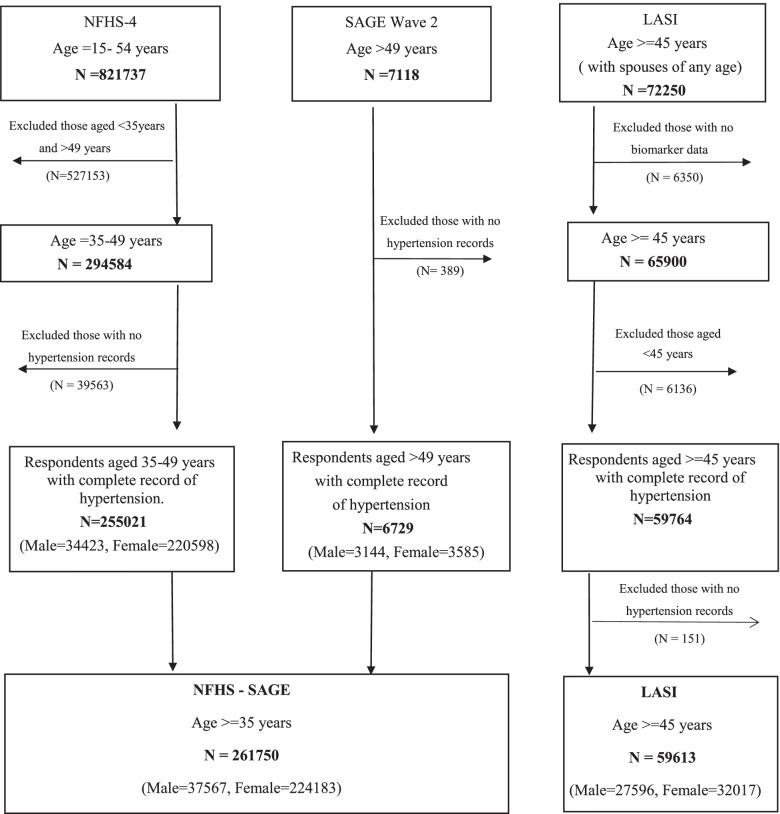
Data were analysed after combining National Family Health Survey 4 (n = 294,584 aged 35-49 years) and Study of Ageing and Health wave 2 (n = 7118 aged 50 + years) datasets (NFHS-SAGE). Longitudinal Ageing Study of India (LASI) dataset (n = 65,900 aged > 45years) was analysed to replicate the results. Hypertension was defined if systolic and diastolic blood pressure was > 89 and/or > 139 respectively and/or if there was a history of anti-hypertensive medication. Descriptive summaries were tabulated and plotted to examine the gender difference in hypertension in various age-groups (35-39,40-44, 45-49, 50-54, 55-59, 60-64, 65-69, ≥ 70). Odds Ratios (ORs) from logistic regression models estimated the age gradient of hypertension and their male-female difference, adjusted for Body Mass Index (BMI).
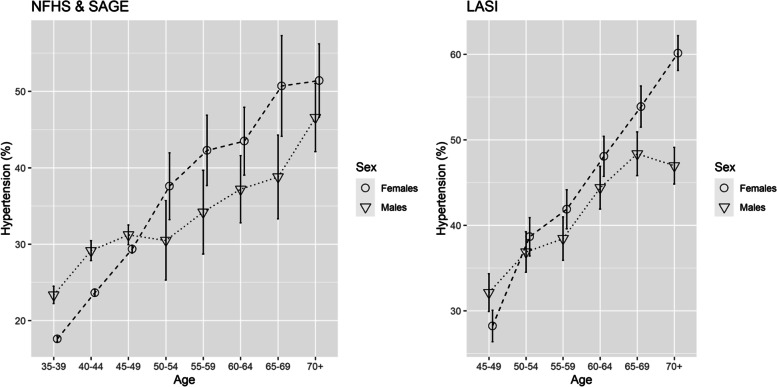
Males had a higher prevalence of hypertension up to 50 years; after that, females had higher rates. The estimates of age gradient, expressed as ORs, were 1.02 (1.02, 1.02) in males versus 1.05(1.05, 1.06) in females (p < 0.001) in NFHS-SAGE and 1.01(1.01, 1.02) in males versus 1.04(1.03, 1.04)in females (p < 0.001) in LASI;these differences marginally changed after adjustment with BMI.
This is perhaps the first study to comprehensively demonstrate that cardio-metabolic risk in Indian females surpasses males after 50 years of age, "busting the myth" that Indian females are always at much lower risk than males; and this evidence should inform the Indian healthcare system to prioritise older women for screening and treatment of hypertension.
高血压的患病率随着年龄的增长而增加,但印度普遍认为女性在生命的各个阶段受影响较小,尽管几乎没有经验证据表明不同年龄段的印度人中高血压存在性别差异。因此,我们旨在研究不同年龄段印度人高血压的性别差异;以及体重指数(BMI)变化对此差异的贡献。
我们分析了国家家庭健康调查 4 期(NFHS-4,年龄 35-49 岁,n=294584)和年龄与健康研究 2 期(n=7118,年龄 50 岁及以上)数据集的数据(NFHS-SAGE),以及印度纵向老龄化研究(LASI,年龄>45 岁,n=65900)的数据,以复制结果。高血压的定义为收缩压和舒张压分别>89mmHg 和/或>139mmHg,或有抗高血压药物治疗史。我们列出并绘制了描述性总结,以检查不同年龄段(35-39 岁、40-44 岁、45-49 岁、50-54 岁、55-59 岁、60-64 岁、65-69 岁、≥70 岁)高血压的性别差异。我们使用逻辑回归模型估计了高血压的年龄梯度及其男性与女性的差异,并根据体重指数(BMI)进行了调整。
男性在 50 岁之前高血压患病率较高;此后,女性的患病率较高。NFHS-SAGE 中男性的年龄梯度估计值表示为比值比(OR)为 1.02(1.02,1.02),女性为 1.05(1.05,1.06)(p<0.001);LASI 中男性为 1.01(1.01,1.02),女性为 1.04(1.03,1.04)(p<0.001)。在调整 BMI 后,这些差异略有变化。
这可能是第一项全面证明印度女性在 50 岁后心血管代谢风险超过男性的研究,“打破了印度女性的风险始终低于男性的神话”;这一证据应该为印度医疗保健系统提供信息,优先为老年女性进行高血压筛查和治疗。