Centre for Non-communicable Diseases and Nutrition, BRAC James P Grant School of Public Health, BRAC University, Dhaka, Bangladesh.
National Nutrition Services (NNS), Directorate General of Health Services, Government of Bangladesh, Dhaka, Bangladesh.
BMJ Open. 2021 Jan 21;11(1):e038326. doi: 10.1136/bmjopen-2020-038326.
We aimed to estimate the gender-specific prevalence and associated factors of hypertension among elderly people in Bangladesh.
We analysed data from the food security and nutrition surveillance round 2018-2019. The multistage cluster sampling method was used to select the study population. Hypertension was defined as systolic blood pressure ≥140 mm Hg and/or diastolic blood pressure ≥90 mm Hg and/or having a history of hypertension. We carried out the descriptive analysis, bivariate and multivariable logistic regression to report the weighted prevalence of hypertension as well as crude and adjusted ORs with 95% CI. A p value<0.05 was considered statistically significant.
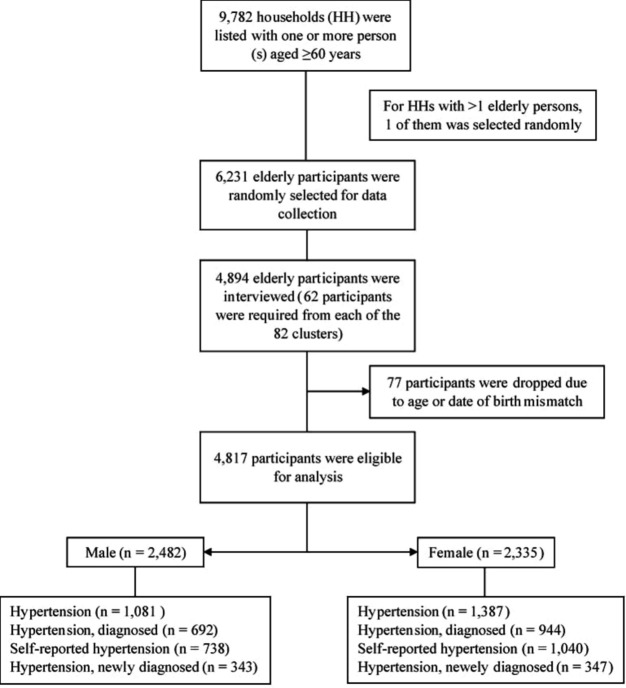
The study was conducted in 82 clusters (57 rural, 15 non-slum urban and 10 slums) in all eight administrative divisions of Bangladesh.
A total of 2482 males and 2335 females aged ≥60 years were included in this analysis.
The weighted prevalence of hypertension was 42% and 56% among males and females, respectively. The prevalence was higher among females across all sociodemographic, behavioural and clinical strata. Factors associated with higher odds of hypertension (adjusted OR (AOR) (95% CI) for males and females, respectively) were age ≥70 years (1.32 (1.09, 1.60) and 1.40 (1.15, 1.71)); insufficient physical activity (1.50 (1.25, 1.81) and 1.38 (1.15, 1.67)); higher waist circumference (2.76 (2.22, 3.43) and 2.20 (1.82, 2.67)); and self-reported diabetes (1.36 (1.02, 1.82) and 1.82 (1.35, 2.45)). Additionally, living in slums decreased (0.71 (0.52, 0.96)) and education >10 years increased odds of hypertension (1.83 (1.38, 2.44)) among males.
In Bangladesh, half of the elderly persons were hypertensive, with a higher prevalence in females. In both sexes, odds of hypertension was higher among persons with older age (≥70 years), insufficient physical activity, higher waist circumference and self-reported diabetes. The Ministry of Health of Bangladesh should consider these findings while designing and implementing health programmes for elderly population.
本研究旨在估计孟加拉国老年人中性别特异性高血压的患病率及其相关因素。
我们分析了 2018-2019 年食品保障和营养监测的第二轮数据。采用多阶段聚类抽样方法选择研究人群。高血压定义为收缩压≥140mmHg 和/或舒张压≥90mmHg 和/或有高血压病史。我们进行了描述性分析、双变量和多变量逻辑回归,以报告高血压的加权患病率以及粗比值比(OR)和调整后的比值比(OR)及其 95%置信区间。p 值<0.05 被认为具有统计学意义。
该研究在孟加拉国所有 8 个行政区的 82 个集群(57 个农村、15 个非贫民窟城市和 10 个贫民窟)中进行。
本分析共纳入 2482 名男性和 2335 名女性,年龄均≥60 岁。
男性和女性的高血压加权患病率分别为 42%和 56%。在所有社会人口统计学、行为和临床指标中,女性的患病率均较高。与高血压高风险相关的因素(男性和女性的调整比值比(AOR)(95%置信区间))分别为年龄≥70 岁(1.32(1.09,1.60)和 1.40(1.15,1.71));身体活动不足(1.50(1.25,1.81)和 1.38(1.15,1.67));腰围较大(2.76(2.22,3.43)和 2.20(1.82,2.67));以及自我报告的糖尿病(1.36(1.02,1.82)和 1.82(1.35,2.45))。此外,在男性中,居住在贫民窟(0.71(0.52,0.96))和教育程度>10 年(1.83(1.38,2.44))降低了高血压的风险。
在孟加拉国,一半的老年人患有高血压,女性的患病率更高。在男性和女性中,高血压的风险随着年龄(≥70 岁)的增加、身体活动不足、腰围增加和自我报告的糖尿病而增加。孟加拉国卫生部在制定和实施老年人健康计划时应考虑这些发现。