Ricciardi Luca, Pucci Resi, Piazza Amedeo, Lofrese Giorgio, Scerrati Alba, Montemurro Nicola, Raco Antonino, Miscusi Massimo, Ius Tamara, Zeppieri Marco
Division of Neurosurgery, AOU Sant'Andrea, Department of NESMOS, Sapienza University, Rome 00189, Italy.
Department of Oral and Maxillofacial Sciences, Sapienza University, Rome 00161, Italy.
World J Stem Cells. 2022 Jun 26;14(6):420-428. doi: 10.4252/wjsc.v14.i6.420.
Treatments involving stem cell (SC) usage represent novel and potentially interesting alternatives in facial nerve reanimation. Current literature includes the use of SC in animal model studies to promote graft survival by enhancing nerve fiber growth, spreading, myelinization, in addition to limiting fibrotic dege neration after surgery. However, the effectiveness of the clinical use of SC in facial nerve reanimation has not been clarified yet.
To investigate the histological, neurophysiological, and functional outcomes in facial reanimation using SC, compared to autograft.
Our study is a systematic review of the literature, consistently conducted according to the preferred reporting items for systematic reviews and meta-analyses statement guidelines. The review question was: In facial nerve reanimation on rats, has the use of stem cells revealed as effective when compared to autograft, in terms of histological, neurophysiological, and functional outcomes? Random-effect meta-analysis was conducted on histological and neurophysiological data from the included comparative studies.
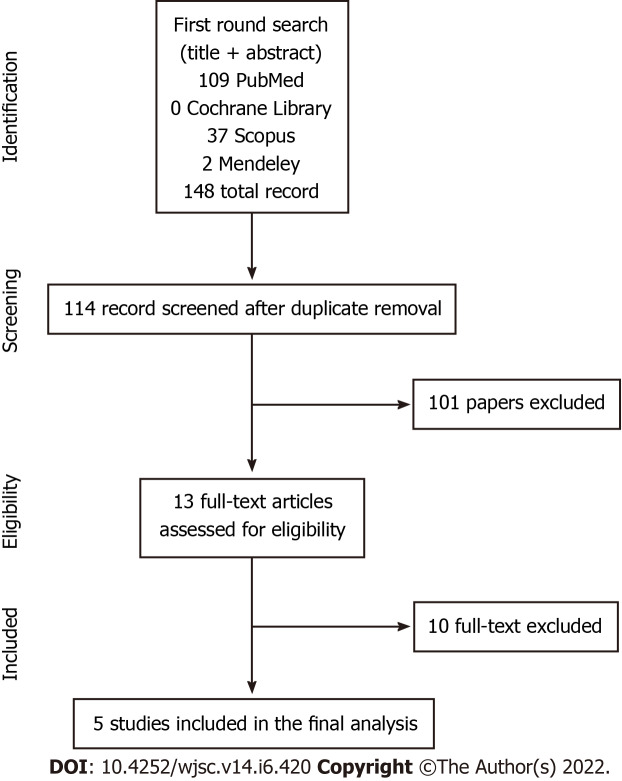
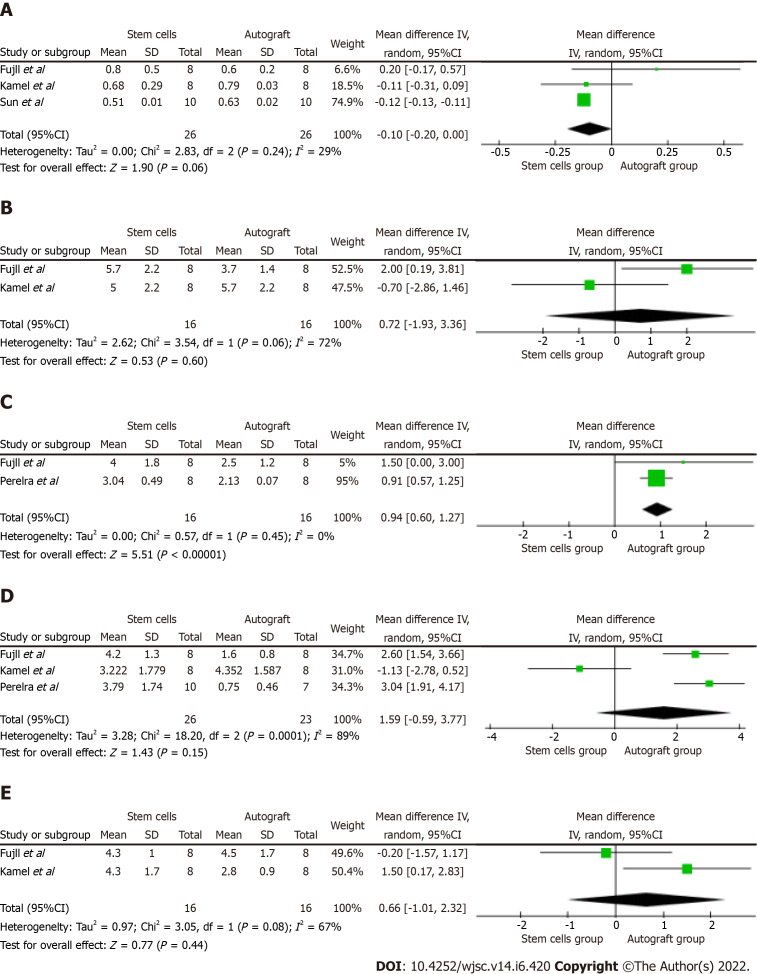
After screening 148 manuscript, five papers were included in our study. 43 subjects were included in the SC group, while 40 in the autograft group. The meta-analysis showed no significative differences between the two groups in terms of myelin thickness [CI: -0.10 (-0.20, 0.00); = 29%; = 0.06], nerve fibers diameter [CI: 0.72 (-0.93, 3.36); = 72%; = 0.6], compound muscle action potential amplitude [CI: 1.59 (0.59, 3.77); = 89%; = 0.15] and latency [CI: 0.66 (-1.01, 2.32); = 67%; = 0.44]. The mean axonal diameter was higher in the autograft group [CI: 0.94 (0.60, 1.27); = 0%; ≤ 0.001].
The role of stem cells in facial reanimation is still relatively poorly studied, in animal models, and available results should not discourage their use in future studies on human subjects.
涉及使用干细胞(SC)的治疗方法是面神经修复术中新颖且颇具潜力的替代方案。当前文献报道了在动物模型研究中使用干细胞,其可通过促进神经纤维生长、扩展、髓鞘形成,以及限制术后纤维化退变来提高移植成活率。然而,干细胞在面神经修复术中临床应用的有效性尚未明确。
对比自体移植,研究使用干细胞进行面部修复后的组织学、神经生理学及功能学结果。
本研究是一项文献系统综述,严格按照系统综述和Meta分析优先报告条目声明指南进行。综述问题为:在大鼠面神经修复术中,相较于自体移植,使用干细胞在组织学、神经生理学及功能学结果方面是否显示出有效性?对纳入的比较研究中的组织学和神经生理学数据进行随机效应Meta分析。
在筛选了148篇手稿后,本研究纳入了5篇论文。干细胞组纳入43例受试者,自体移植组纳入40例。Meta分析显示,两组在髓鞘厚度[可信区间:-0.10(-0.20,0.00);I² = 29%;P = 0.06]、神经纤维直径[可信区间:0.72(-0.93,3.36);I² = 72%;P = 0.6]、复合肌肉动作电位幅度[可信区间:1.59(0.59,3.77);I² = 89%;P = 0.15]和潜伏期[可信区间:0.66(-1.01,2.32);I² = 67%;P = 0.44]方面无显著差异。自体移植组的平均轴突直径更高[可信区间:0.94(0.60,1.27);I² = 0%;P≤0.001]。
在动物模型中,干细胞在面部修复中的作用仍研究较少,现有结果不应阻碍其在未来人体研究中的应用。