Boehringer Ingelheim Pharma GmbH & Co. KG, Biberach an der Riss, Germany.
Boehringer Ingelheim Pharmaceuticals Inc., Ridgefield, CT, USA.
Transl Psychiatry. 2022 Aug 11;12(1):329. doi: 10.1038/s41398-022-02096-5.
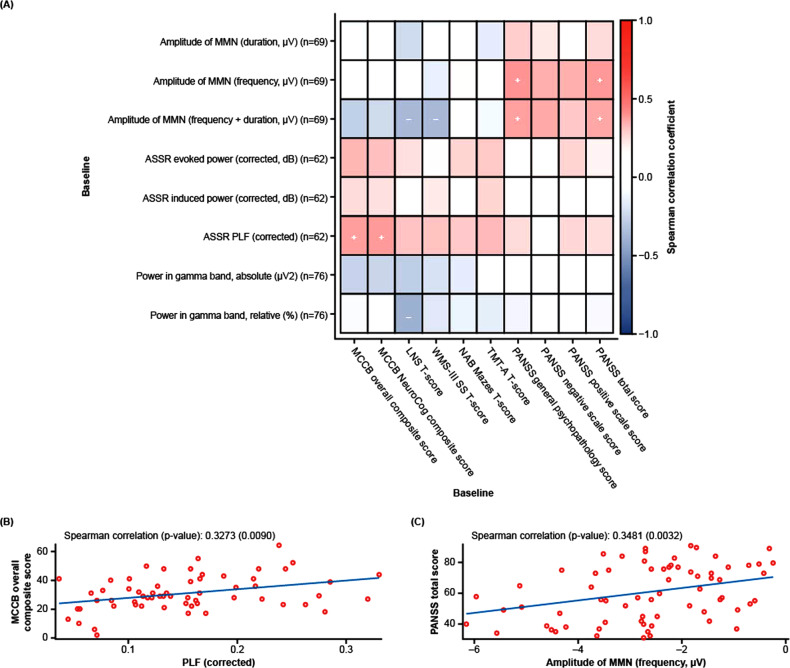
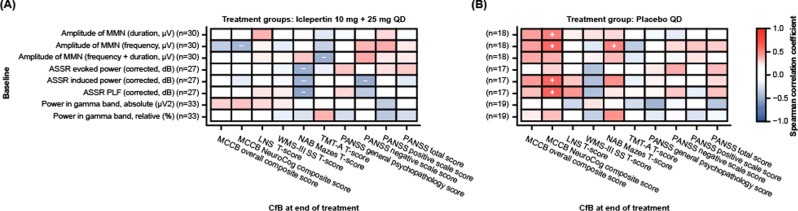
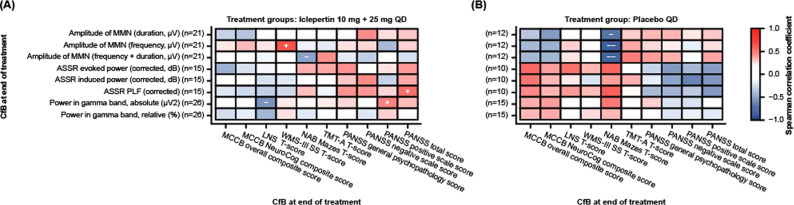
Patients with schizophrenia experience cognitive impairment related to neural network dysfunction and deficits in sensory processing. These deficits are thought to be caused by N-methyl-D-aspartate receptor hypofunction and can be assessed in patient populations using electroencephalography (EEG). This substudy from a Phase II, randomized, double-blind, placebo-controlled, parallel-group study investigating the safety and efficacy of the novel glycine transporter-1 inhibitor, iclepertin (BI 425809), assessed the potential of EEG parameters as clinically relevant biomarkers of schizophrenia and response to iclepertin treatment. Eligible patients were randomized to once-daily add-on iclepertin (2, 5, 10, or 25 mg), or placebo (1:1:1:1:2 ratio) for 12 weeks. EEG data were recorded from a subgroup of patients (n = 79) at baseline and end of treatment (EoT). EEG parameters of interest were mismatch negativity (MMN), auditory steady-state response (ASSR), and resting state gamma power, and their correlations with clinical assessments. At baseline, MMN and ASSR exhibited consistent correlations with clinical assessments, indicating their potential value as neurophysiological biomarkers of schizophrenia-related deficits. ASSR measures were positively correlated to the MATRICS Consensus Cognitive Battery overall and neurocognitive composite scores; MMN amplitude was positively correlated with Positive and Negative Syndrome Scale scores. However, correlations between change from baseline (CfB) at EoT in clinical assessments, and baseline or CfB at EoT for EEG parameters were modest and inconsistent between dose groups, which might indicate low potential of these EEG parameters as predictive and treatment response biomarkers. Further methodological refinement is needed to establish EEG parameters as useful drug development tools for schizophrenia.
精神分裂症患者存在神经网络功能障碍和感觉处理缺陷相关的认知障碍。这些缺陷被认为是由 N-甲基-D-天冬氨酸受体功能低下引起的,可以通过脑电图(EEG)在患者人群中进行评估。这项来自 II 期、随机、双盲、安慰剂对照、平行组研究的子研究,旨在评估新型甘氨酸转运体-1 抑制剂 iclepertin(BI 425809)的安全性和疗效,研究了 EEG 参数作为精神分裂症的临床相关生物标志物以及对 iclepertin 治疗反应的潜在可能性。符合条件的患者被随机分配至每日一次添加 iclepertin(2、5、10 或 25mg)或安慰剂(1:1:1:1:2 比例),治疗 12 周。从患者亚组(n=79)中记录基线和治疗结束时(EoT)的 EEG 数据。感兴趣的 EEG 参数包括失匹配负波(MMN)、听觉稳态反应(ASSR)和静息状态伽马功率,以及它们与临床评估的相关性。在基线时,MMN 和 ASSR 与临床评估一致相关,表明它们作为精神分裂症相关缺陷的神经生理学生物标志物具有潜在价值。ASSR 测量值与 MATRICS 共识认知电池的总体和神经认知综合评分呈正相关;MMN 幅度与阳性和阴性症状量表评分呈正相关。然而,EoT 时临床评估的基线至 EoT 变化(CfB)与 EEG 参数的基线或 CfB 之间的相关性在剂量组之间是适度且不一致的,这可能表明这些 EEG 参数作为预测和治疗反应生物标志物的潜力较低。需要进一步的方法学改进,以将 EEG 参数确立为精神分裂症的有用药物开发工具。