BrainPark, Turner Institute for Brain and Mental Health and School of Psychological Sciences, Monash University, Clayton, VIC 3168, Australia.
Monash Business School, Monash University, Caulfield, VIC 3145, Australia.
Int J Environ Res Public Health. 2022 Aug 4;19(15):9592. doi: 10.3390/ijerph19159592.
Problematic internet use is receiving increasing attention in the addiction field, yet the mechanisms driving such behaviours remain unclear. Previous research has shown that impulsivity- and compulsivity-related constructs may interactively contribute to a range of problematic behaviours. The current study examined whether distress-driven impulsivity and psychological flexibility may interactively contribute to problematic internet use, which has not been addressed in prior literature.
Two hundred and one participants completed an online survey. Bootstrapped moderation analysis was conducted to examine the collected data on distress-driven impulsivity, psychological flexibility, and their interaction in relation to problematic internet use.
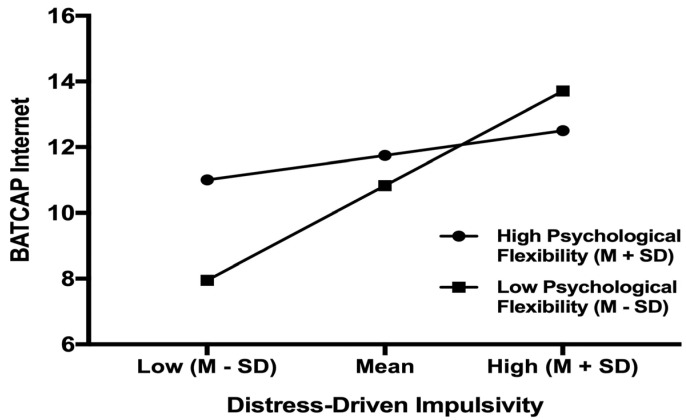
The interaction between distress-driven impulsivity and psychological flexibility was significantly related to problematic internet use. Simple slope tests confirmed that distress-driven impulsivity was associated with problematic internet use among individuals with low flexibility levels.
Our findings highlight the moderating role of psychological inflexibility in the association between distress-driven impulsivity and problematic internet use. Prevention and/or early interventions for problematic internet use should consider targeting psychological inflexibility and distress-driven impulsivity.
在成瘾领域,问题性互联网使用受到越来越多的关注,但驱动这些行为的机制仍不清楚。先前的研究表明,冲动性和强迫性相关结构可能会相互作用,导致一系列问题行为。本研究旨在探讨困扰驱动的冲动性和心理灵活性是否会相互作用,从而导致问题性互联网使用,这在先前的文献中尚未涉及。
201 名参与者完成了在线调查。采用 Bootstrap 调节分析方法,对困扰驱动的冲动性、心理灵活性及其与问题性互联网使用的交互作用进行了数据分析。
困扰驱动的冲动性和心理灵活性之间的交互作用与问题性互联网使用显著相关。简单斜率检验证实,在心理灵活性较低的个体中,困扰驱动的冲动性与问题性互联网使用相关。
我们的研究结果强调了心理不灵活性在困扰驱动的冲动性与问题性互联网使用之间的调节作用。针对问题性互联网使用的预防和/或早期干预措施应考虑针对心理不灵活性和困扰驱动的冲动性。