School of Medicine and Health Sciences, Universidad del Rosario, Bogotá, Colombia.
Biomedical Engineering, Universidad Antonio Nariño, Bogotá, Colombia.
Front Public Health. 2022 Jul 26;10:876949. doi: 10.3389/fpubh.2022.876949. eCollection 2022.
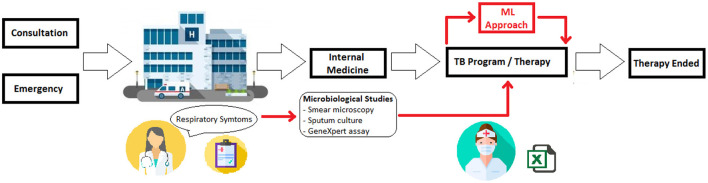
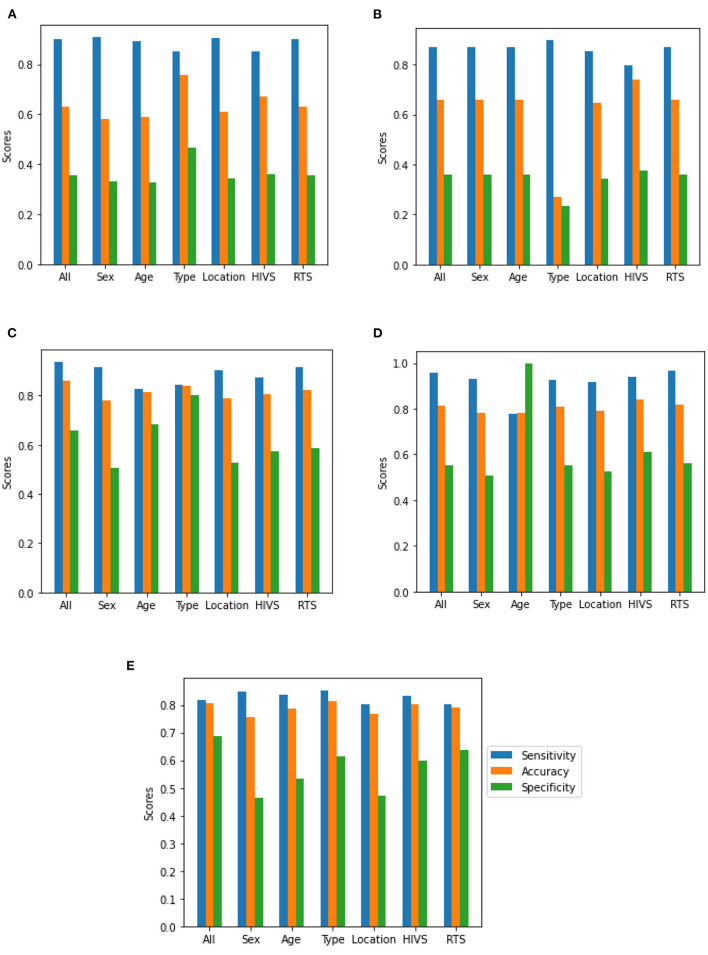
The use of machine learning (ML) for diagnosis support has advanced in the field of health. In the present paper, the results of studying ML techniques in a tuberculosis diagnosis loop in a scenario of limited resources are presented. Data are analyzed using a tuberculosis (TB) therapy program at a health institution in a main city of a developing country using five ML models. Logistic regression, classification trees, random forest, support vector machines, and artificial neural networks are trained under physician supervision following physicians' typical daily work. The models are trained on seven main variables collected when patients arrive at the facility. Additionally, the variables applied to train the models are analyzed, and the models' advantages and limitations are discussed in the context of the automated ML techniques. The results show that artificial neural networks obtain the best results in terms of accuracy, sensitivity, and area under the receiver operating curve. These results represent an improvement over smear microscopy, which is commonly used techniques to detect TB for special cases. Findings demonstrate that ML in the TB diagnosis loop can be reinforced with available data to serve as an alternative diagnosis tool based on data processing in places where the health infrastructure is limited.
机器学习(ML)在健康领域的诊断支持方面取得了进展。在本文中,介绍了在资源有限的情况下,在结核病诊断循环中研究 ML 技术的结果。使用发展中国家一个主要城市的一家医疗机构的结核病(TB)治疗计划,使用五个 ML 模型对数据进行了分析。逻辑回归、分类树、随机森林、支持向量机和人工神经网络是在医生监督下根据医生的典型日常工作进行训练的。这些模型是基于患者到达医疗机构时收集的七个主要变量进行训练的。此外,还分析了用于训练模型的变量,并在自动化 ML 技术的背景下讨论了模型的优势和局限性。结果表明,在准确性、敏感性和接收者操作曲线下面积方面,人工神经网络的结果最佳。这些结果优于常用于特殊情况下检测结核病的涂片显微镜检查,这是一种常用的技术。研究结果表明,ML 可以在结核病诊断循环中得到加强,利用现有的数据,在卫生基础设施有限的地方,作为一种基于数据处理的替代诊断工具。