Antoniou Faye, Ralli Asimina M, Mouzaki Angeliki, Diamanti Vassiliki, Papaioannou Sofia
Department of Educational Studies, National and Kapodistrian University of Athens, Athens, Greece.
Department of Psychology, National and Kapodistrian University of Athens, Athens, Greece.
Front Psychol. 2022 Jul 26;13:900600. doi: 10.3389/fpsyg.2022.900600. eCollection 2022.
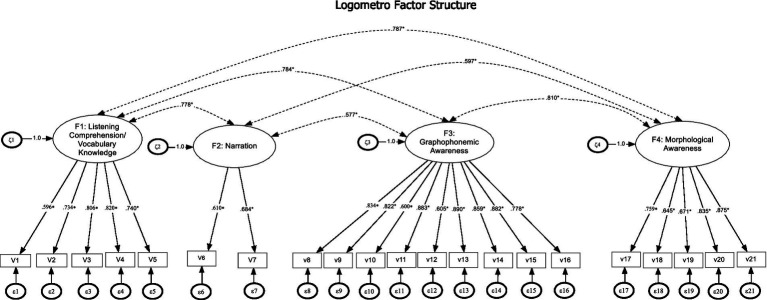
In educational and clinical settings, few norm-referenced tests have been utilized until now usually focusing on a single or a few language subcomponents, along with very few language rating scales for parents and educators. The need for a comprehensive language assessment tool for preschool and early school years children which could form the basis for valid and reliable screening and diagnostic decisions, led to the development of a new norm-referenced digital tool called Logometro®. The aim of the present study is to describe Logometro® as well as its psychometric characteristics. Logometro® evaluates an array of oral language skills across the different language domains such as phonological awareness, listening comprehension, vocabulary knowledge (receptive and expressive), narrative speech, morphological awareness, pragmatics, as well emergent literacy skills (letter sound knowledge and invented writing) in Greek-speaking 4-7 years old children. More specifically, Logometro® has been designed in order to: (a) map individual language development paths as well as difficulties, (b) provide a descriptive profile of children's oral language and emergent literacy skills, and (c) assist in the identification of children who are at risk for Developmental Language Disorder (DLD) or Specific Learning Disabilities (SLD). The sample consisted of 926 children aged from 4 to 7 years, which were recruited from diverse geographical provinces and represented a variety of socioeconomic backgrounds in Greece. Eight hundred participants were typically developing children ( = 384 and = 416), 126 children ( = 44 and = 82) represented children with Special Educational Needs, and 126 children were typically developing peers matched for gender and age with the clinical groups. The administration lasted 90 min, depending on the participant's age and competence. Validity (construct, criterion, convergent, discriminant, and predictive) as well as internal consistency and test-retest reliability were assessed. Results indicated that Logometro® is characterized by good psychometric properties and can constitute a norm-referenced battery of oral language and emergent literacy skills. It could be used to inform the professionals as well as the researchers about a child's language strengths and weaknesses and form the basis on which they can design an appropriate individualized intervention if needed.
在教育和临床环境中,到目前为止,很少使用常模参照测试,这些测试通常只关注单一或几个语言子成分,同时面向家长和教育工作者的语言评定量表也非常少。对于一种全面的语言评估工具的需求,这种工具可为学前和小学低年级儿童的有效且可靠的筛查和诊断决策提供依据,这促使了一种名为Logometro®的新的常模参照数字工具的开发。本研究的目的是描述Logometro®及其心理测量特征。Logometro®评估了不同语言领域的一系列口语技能,如语音意识、听力理解、词汇知识(接受性和表达性)、叙事性言语、形态意识、语用学,以及希腊语4至7岁儿童的早期读写技能(字母发音知识和自创书写)。更具体地说,Logometro®的设计目的是:(a)描绘个体语言发展路径以及困难,(b)提供儿童口语和早期读写技能的描述性概况,以及(c)协助识别有发展性语言障碍(DLD)或特定学习障碍(SLD)风险的儿童。样本包括926名4至7岁的儿童,他们来自希腊不同的地理省份,代表了各种社会经济背景。800名参与者为发育正常儿童(男孩 = 384名,女孩 = 416名),126名儿童(男孩 = 44名,女孩 = 82名)代表有特殊教育需求的儿童,还有126名发育正常的同龄人在性别和年龄上与临床组相匹配。测试时长为90分钟,具体取决于参与者的年龄和能力。评估了效度(结构效度、效标效度、聚合效度、区分效度和预测效度)以及内部一致性和重测信度。结果表明,Logometro®具有良好的心理测量特性,可构成一套常模参照的口语和早期读写技能测试。它可用于告知专业人员和研究人员儿童的语言优势和劣势,并在需要时为他们设计适当的个性化干预措施提供依据。