Loturco Irineu, Freitas Tomás T, Alcaraz Pedro E, Kobal Ronaldo, Hartmann Nunes Renan F, Weldon Anthony, Pereira Lucas A
NAR - Nucleus of High Performance in Sport, São Paulo, Brazil.
Department of Human Movement Science, Federal University of São Paulo, São Paulo, Brazil.
Biol Sport. 2022 Sep;39(3):779-791. doi: 10.5114/biolsport.2022.108703. Epub 2021 Oct 6.
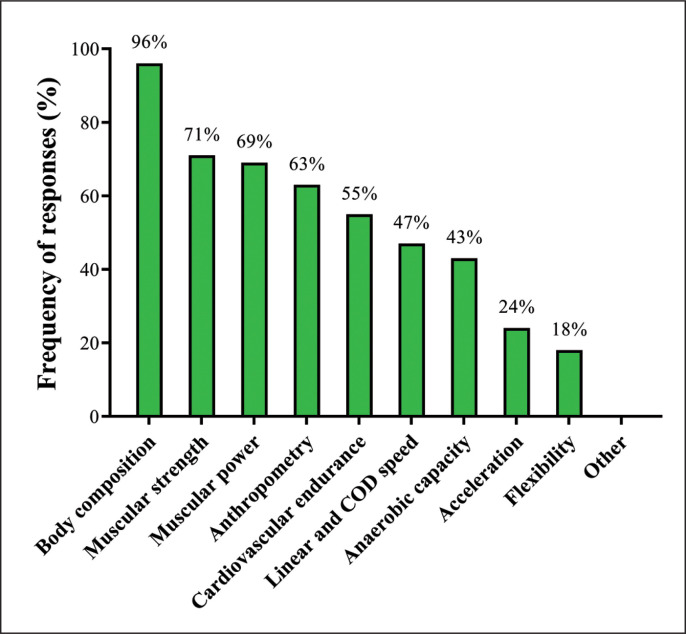
Brazil is the leading global exporter of soccer players, with approximately 2,000 international transfers to different clubs per year. Although Brazilian players compete in the most prestigious soccer leagues worldwide, the habitual training methods, strategies, and routines of Brazilian soccer strength and conditioning coaches (SCCs) are undocumented. This study used a standard online survey to collect and characterize the strength and conditioning practices of Brazilian soccer SCCs. Forty-nine SCCs (age: 40.4 ± 7.5 years; professional experience: 15.3 ± 7.5 years) working in Brazilian professional soccer teams participated in this study. The survey consisted of eight sections: 1) background information; 2) muscular strength-power development; 3) speed training; 4) plyometrics; 5) flexibility training; 6) physical testing; 7) technology use; and 8) programing. Results indicated that training and testing practices of Brazilian SCCs are strongly affected by the congested fixture schedules, extensive traveling distances, and socio-economic disparities between different regions of the country. We describe all these different strategies and methods in detail, providing a comprehensive view and a critical examination of Brazilian soccer strength and conditioning practices. Brazilian SCCs and professional soccer organizations can use the findings from this study to develop training strategies and customize education programs. Practitioners from other countries can use this information to design training programs closely tailored to the background of Brazilian athletes, which may support their adaptation to different competitive scenarios and game demands, such as those found in the most important soccer leagues worldwide.
巴西是全球足球运动员的主要出口国,每年约有2000名球员转会至不同俱乐部。尽管巴西球员在全球最负盛名的足球联赛中征战,但巴西足球体能教练的常规训练方法、策略和日常安排却尚无文献记载。本研究采用标准在线调查来收集并描述巴西足球体能教练的体能训练实践。49名在巴西职业足球队工作的体能教练(年龄:40.4±7.5岁;专业经验:15.3±7.5年)参与了本研究。该调查包括八个部分:1)背景信息;2)肌肉力量-功率发展;3)速度训练;4)增强式训练;5)柔韧性训练;6)体能测试;7)技术运用;8)训练计划制定。结果表明,巴西体能教练的训练和测试实践受到密集赛程、长途旅行以及该国不同地区社会经济差异的强烈影响。我们详细描述了所有这些不同的策略和方法,全面审视并批判性地分析了巴西足球的体能训练实践。巴西体能教练和职业足球组织可利用本研究结果制定训练策略并定制教育项目。其他国家的从业者可利用这些信息设计与巴西运动员背景紧密契合的训练计划,这可能有助于他们适应不同的竞争场景和比赛要求,比如在全球最重要的足球联赛中遇到的那些情况。