Heidelberg University Biochemistry Center (BZH), Heidelberg University, Heidelberg, Germany.
BioQuant, Heidelberg University, Heidelberg, Germany.
PLoS One. 2022 Aug 12;17(8):e0261543. doi: 10.1371/journal.pone.0261543. eCollection 2022.
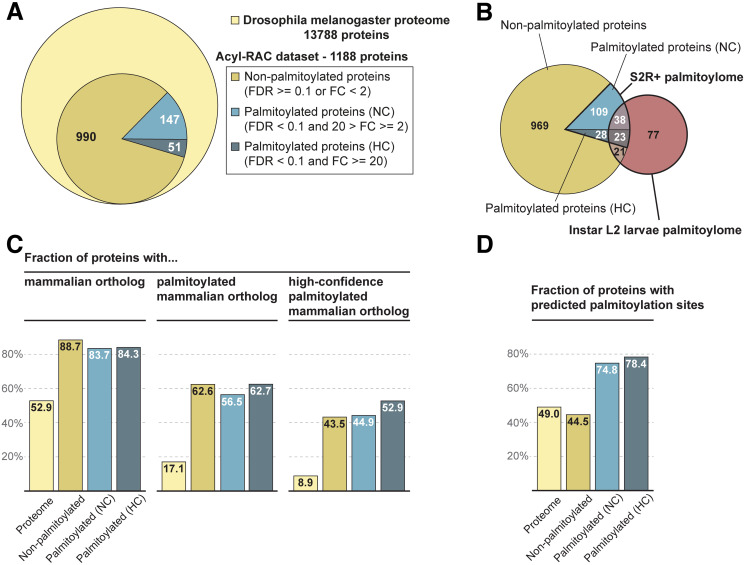
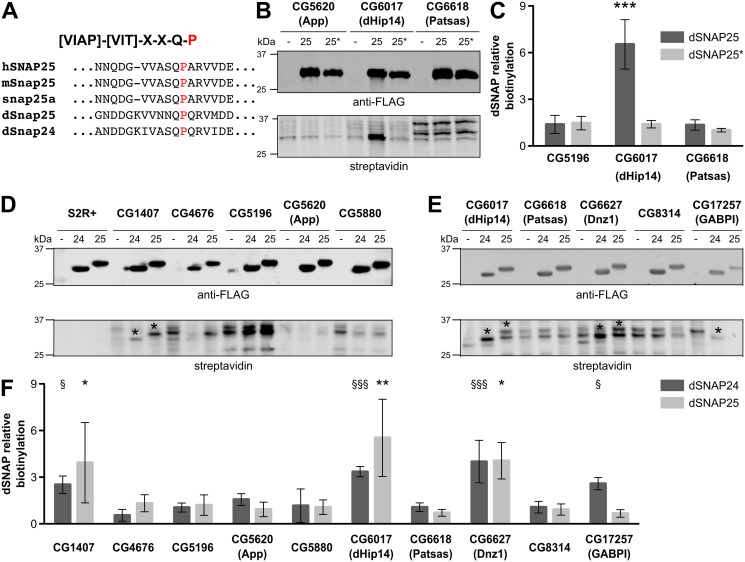
Protein S-palmitoylation, the addition of a long-chain fatty acid to target proteins, is among the most frequent reversible protein modifications in Metazoa, affecting subcellular protein localization, trafficking and protein-protein interactions. S-palmitoylated proteins are abundant in the neuronal system and are associated with neuronal diseases and cancer. Despite the importance of this post-translational modification, it has not been thoroughly studied in the model organism Drosophila melanogaster. Here we present the palmitoylome of Drosophila S2R+ cells, comprising 198 proteins, an estimated 3.5% of expressed genes in these cells. Comparison of orthologs between mammals and Drosophila suggests that S-palmitoylated proteins are more conserved between these distant phyla than non-S-palmitoylated proteins. To identify putative client proteins and interaction partners of the DHHC family of protein acyl-transferases (PATs) we established DHHC-BioID, a proximity biotinylation-based method. In S2R+ cells, ectopic expression of the DHHC-PAT dHip14-BioID in combination with Snap24 or an interaction-deficient Snap24-mutant as a negative control, resulted in biotinylation of Snap24 but not the Snap24-mutant. DHHC-BioID in S2R+ cells using 10 different DHHC-PATs as bait identified 520 putative DHHC-PAT interaction partners of which 48 were S-palmitoylated and are therefore putative DHHC-PAT client proteins. Comparison of putative client protein/DHHC-PAT combinations indicates that CG8314, CG5196, CG5880 and Patsas have a preference for transmembrane proteins, while S-palmitoylated proteins with the Hip14-interaction motif are most enriched by DHHC-BioID variants of approximated and dHip14. Finally, we show that BioID is active in larval and adult Drosophila and that dHip14-BioID rescues dHip14 mutant flies, indicating that DHHC-BioID is non-toxic. In summary we provide the first systematic analysis of a Drosophila palmitoylome. We show that DHHC-BioID is sensitive and specific enough to identify DHHC-PAT client proteins and provide DHHC-PAT assignment for ca. 25% of the S2R+ cell palmitoylome, providing a valuable resource. In addition, we establish DHHC-BioID as a useful concept for the identification of tissue-specific DHHC-PAT interactomes in Drosophila.
蛋白质 S-棕榈酰化,即向靶蛋白添加长链脂肪酸,是后生动物中最常见的可逆蛋白质修饰之一,影响亚细胞蛋白定位、运输和蛋白质-蛋白质相互作用。棕榈酰化蛋白在神经元系统中含量丰富,与神经元疾病和癌症有关。尽管这种翻译后修饰很重要,但在模式生物果蝇中并没有得到充分研究。在这里,我们展示了果蝇 S2R+细胞的棕榈酰组,包括 198 种蛋白质,估计占这些细胞中表达基因的 3.5%。哺乳动物和果蝇同源物的比较表明,S-棕榈酰化蛋白在这些遥远的门之间比非 S-棕榈酰化蛋白更保守。为了鉴定 DHHC 家族蛋白酰基转移酶 (PAT) 的潜在靶蛋白和相互作用伙伴,我们建立了 DHHC-BioID,这是一种基于邻近生物素化的方法。在 S2R+细胞中,异位表达 DHHC-PAT dHip14-BioID 与 Snap24 结合,或与作为阴性对照的功能缺失 Snap24 突变体结合,导致 Snap24 生物素化,但 Snap24 突变体没有生物素化。在 S2R+细胞中使用 10 种不同的 DHHC-PAT 作为诱饵进行 DHHC-BioID 鉴定了 520 种潜在的 DHHC-PAT 相互作用伙伴,其中 48 种是 S-棕榈酰化的,因此是潜在的 DHHC-PAT 靶蛋白。潜在靶蛋白/DHHC-PAT 组合的比较表明,CG8314、CG5196、CG5880 和 Patsas 优先与跨膜蛋白结合,而具有 Hip14 相互作用基序的 S-棕榈酰化蛋白则被近似和 dHip14 的 DHHC-BioID 变体最富集。最后,我们表明 BioID 在幼虫和成年果蝇中是活跃的,并且 dHip14-BioID 拯救了 dHip14 突变体果蝇,表明 DHHC-BioID 没有毒性。总之,我们提供了第一个对果蝇棕榈酰组的系统分析。我们表明,DHHC-BioID 足够灵敏和特异,可以鉴定 DHHC-PAT 靶蛋白,并为 S2R+细胞棕榈酰组的约 25%提供 DHHC-PAT 分配,提供了有价值的资源。此外,我们将 DHHC-BioID 确立为在果蝇中鉴定组织特异性 DHHC-PAT 相互作用组的有用概念。