Nell Hodgson Woodruff School of Nursing, Emory University, Atlanta, Georgia, USA.
Winship Cancer Institute, Emory University, Atlanta, Georgia, USA.
Cancer. 2022 Oct;128(20):3734-3743. doi: 10.1002/cncr.34424. Epub 2022 Aug 15.
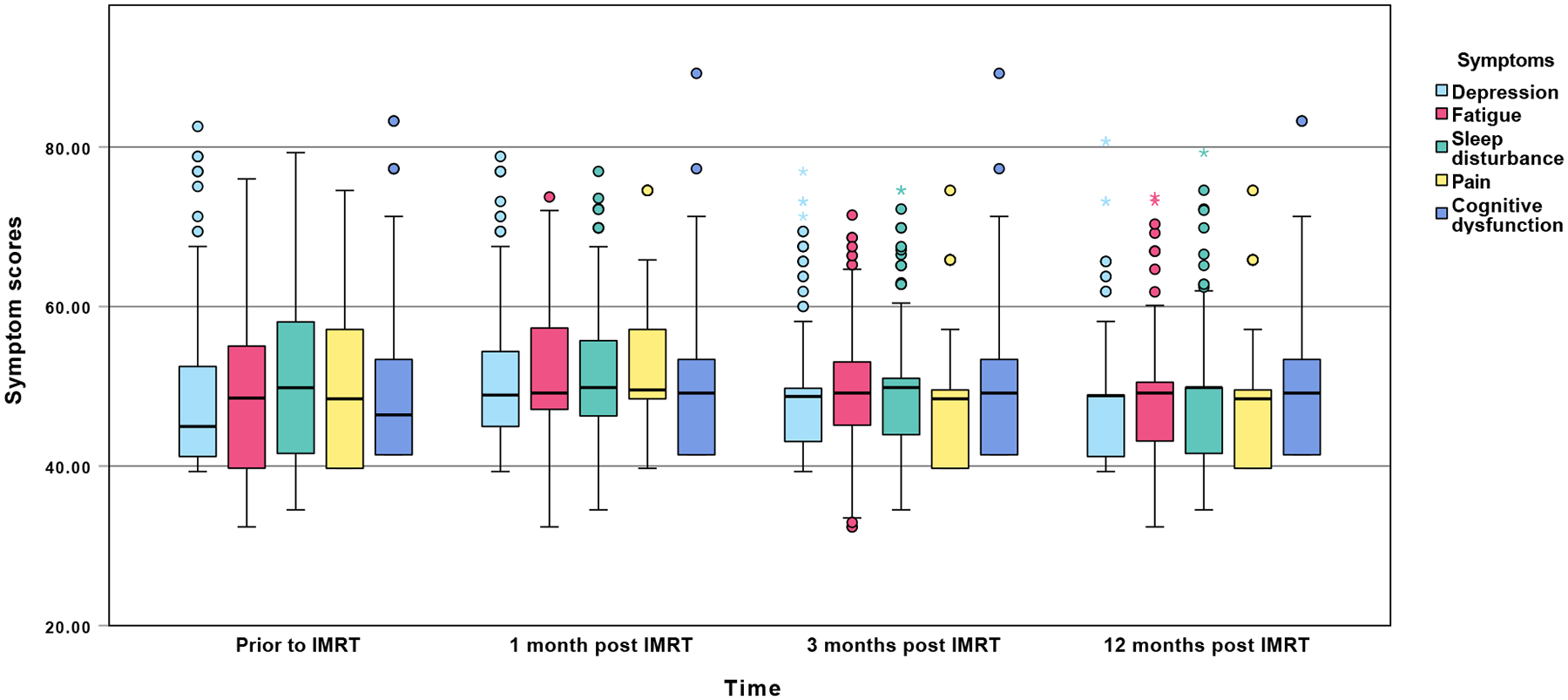
Patients with head and neck cancer experience psychoneurological symptoms (PNS) (i.e., depression, fatigue, sleep disturbance, pain, and cognitive dysfunction) during intensity-modulated radiotherapy (IMRT) that decrease their functional status, quality of life, and survival rates. The purpose of this study was to examine and visualize the relationships among PNS within networks over time and evaluate for demographic and clinical characteristics associated with symptom networks.
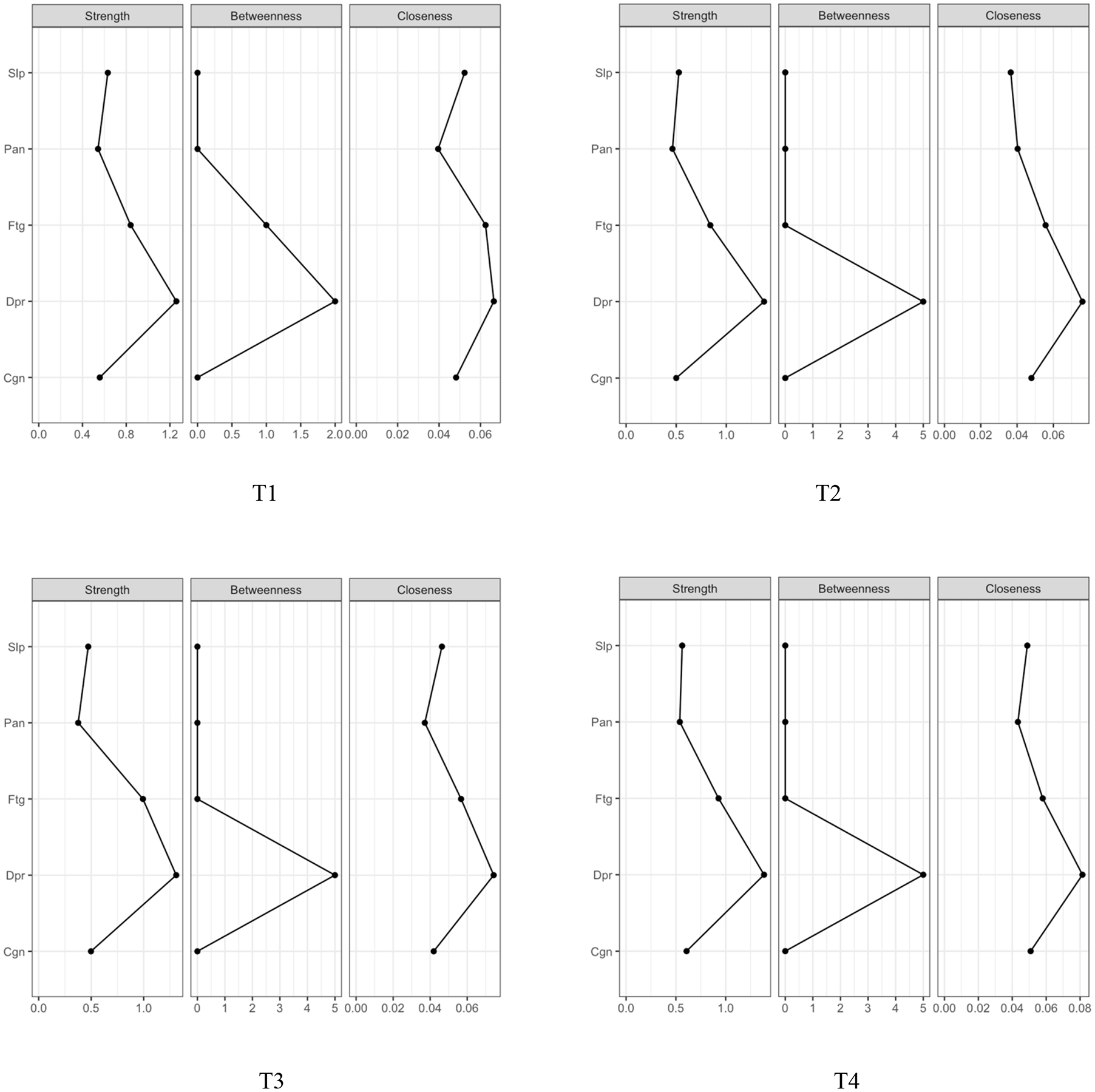
A total of 172 patients (mean age, 59.8 ± 9.9 years; 73.8%, male; 79.4%, White) completed symptom questionnaires four times, namely, before IMRT (T1), 1 month (T2), 3 months (T3), and 12 months (T4) post IMRT. Network analysis was used to examine the symptom-symptom relationships among PNS. Centrality indices, including strength, closeness, and betweenness, were used to describe the degrees of symptom network interconnections. Network comparison test was used to assess the differences between two symptom networks.
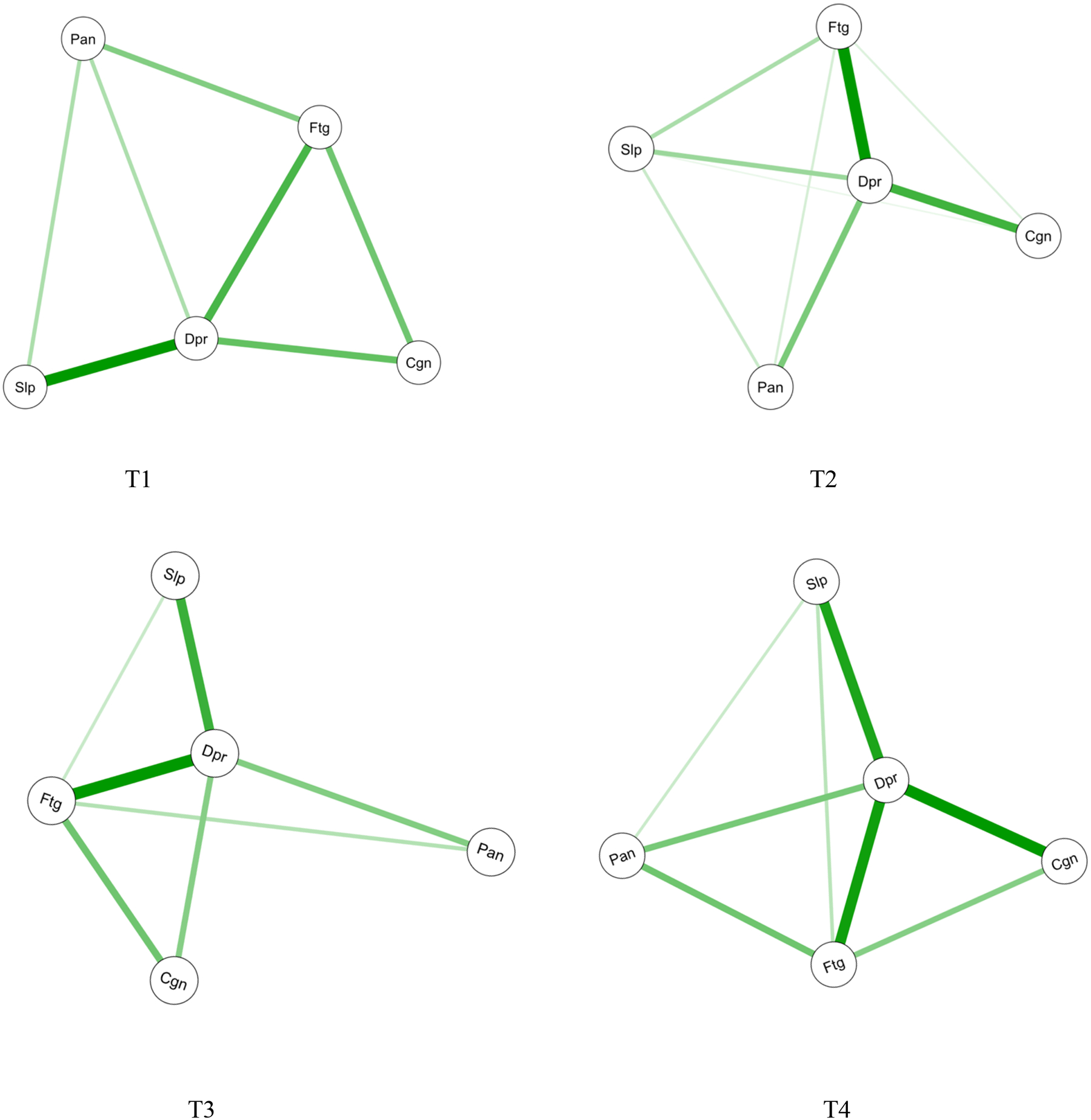
Depression was associated with the other four symptoms, and fatigue was associated with the other three symptoms across the four assessments. Based on the centrality indices, depression (r = 1.3-1.4, r = 0.06-0.08, r = 4-10) was the core symptom in all symptom networks, followed by fatigue. Female gender, higher levels of stress, and no alcohol use were associated with stronger symptom networks in network global strength before IMRT.
Network analysis provides a novel approach to gain insights into the relationships among self-reported PNS and identify the core symptoms and associated characteristics. Clinicians may use this information to develop symptom management interventions that target core symptoms and interconnections within a network.
This study describes the symptom-symptom relationships for five common symptoms in patients with head and neck cancer receiving radiotherapy. Depression and fatigue appeared to be two core symptoms that were connected with sleep disturbance, pain, and cognitive dysfunction within a network. Several characteristics (i.e., female, higher stress, no alcohol use) were associated with stronger symptom networks.
接受调强放疗(IMRT)的头颈部癌症患者会出现心理神经症状(PNS)(即抑郁、疲劳、睡眠障碍、疼痛和认知功能障碍),这些症状会降低他们的功能状态、生活质量和生存率。本研究的目的是检验和可视化 PNS 在网络中随时间的关系,并评估与症状网络相关的人口统计学和临床特征。
共 172 名患者(平均年龄 59.8±9.9 岁;73.8%为男性;79.4%为白人)在 IMRT 前(T1)、1 个月(T2)、3 个月(T3)和 12 个月(T4)后四次完成症状问卷。网络分析用于检验 PNS 之间的症状-症状关系。中心度指数,包括强度、紧密性和中间性,用于描述症状网络相互连接的程度。网络比较检验用于评估两个症状网络之间的差异。
抑郁与其他四个症状相关,疲劳与其他三个症状相关,且这四个评估都存在这种相关性。根据中心度指数,抑郁(r=1.3-1.4,r=0.06-0.08,r=4-10)在所有症状网络中都是核心症状,其次是疲劳。在 IMRT 前,女性、更高的压力水平和不饮酒与更强的症状网络的网络全局强度有关。
网络分析提供了一种新的方法来深入了解自我报告的 PNS 之间的关系,并确定核心症状和相关特征。临床医生可以利用这些信息制定针对核心症状和网络内相互连接的症状管理干预措施。
本研究描述了接受放疗的头颈部癌症患者五种常见症状之间的症状-症状关系。抑郁和疲劳似乎是两个核心症状,它们在网络内与睡眠障碍、疼痛和认知功能障碍相关。一些特征(如女性、更高的压力、不饮酒)与更强的症状网络有关。