College of Public Health, University of Iowa, Iowa City, Iowa, United States.
Independent consultant, Singapore.
Vaccine. 2022 Sep 2;40(37):5433-5444. doi: 10.1016/j.vaccine.2022.07.058. Epub 2022 Aug 13.
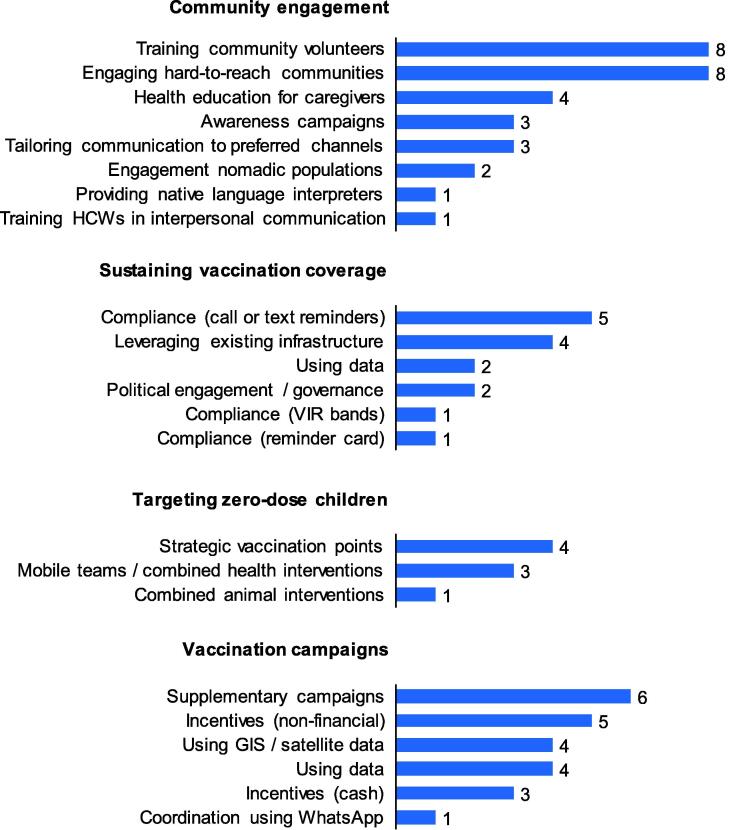
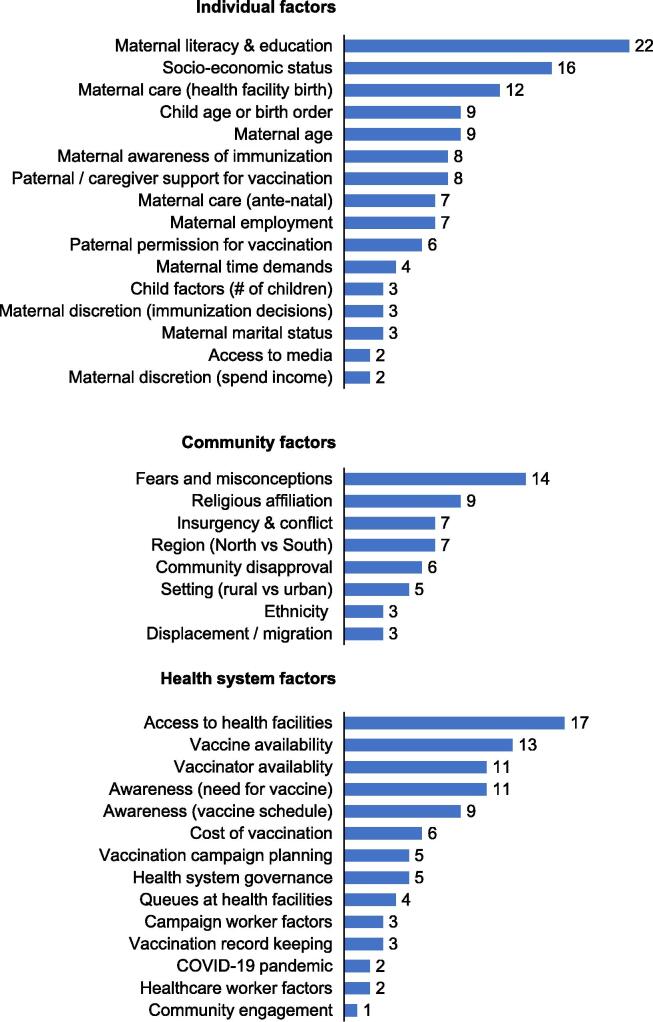
'Zero-dose' refers to a person who does not receive a single dose of any vaccine in the routine national immunization schedule, while 'missed dose' refers to a person who does not complete the schedule. These peopleremain vulnerable to vaccine-preventable diseases, and are often already disadvantaged due to poverty, conflict, and lack of access to basic health services. Globally, more 22.7 million children are estimated to be zero- or missed-dose, of which an estimated 3.1 million (∼14 %) reside in Nigeria.We conducted a scoping review tosynthesize recent literature on risk factors and interventions for zero- and missed-dosechildren in Nigeria. Our search identified 127 papers, including research into risk factors only (n = 66); interventions only (n = 34); both risk factors and interventions (n = 18); and publications that made recommendations only (n = 9). The most frequently reported factors influencing childhood vaccine uptake were maternal factors (n = 77), particularly maternal education (n = 22) and access to ante- and perinatal care (n = 19); heterogeneity between different types of communities - including location, region, wealth, religion, population composition, and other challenges (n = 50); access to vaccination, i.e., proximity of facilities with vaccines and vaccinators (n = 37); and awareness about immunization - including safety, efficacy, importance, and schedules (n = 18).Literature assessing implementation of interventions was more scattered, and heavily skewed towards vaccination campaigns and polio eradication efforts. Major evidence gaps exist in how to deliver effective and sustainable routine childhood immunization. Overall, further work is needed to operationalise the learnings from these studies, e.g. through applying findings to Nigeria's next review of vaccination plans, and using this summary as a basis for further investigation and specific recommendations on effective interventions.
“零剂量”是指一个人在常规国家免疫计划中没有接受任何一剂疫苗,而“漏剂量”是指一个人没有完成计划。这些人仍然容易感染疫苗可预防的疾病,而且往往由于贫困、冲突和缺乏基本卫生服务而处于不利地位。在全球范围内,估计有 2270 万儿童是零剂量或漏剂量,其中估计有 310 万(约 14%)居住在尼日利亚。我们进行了范围界定审查,以综合最近关于尼日利亚零剂量和漏剂量儿童的风险因素和干预措施的文献。我们的搜索确定了 127 篇论文,包括仅研究风险因素的论文(n=66);仅干预措施的论文(n=34);同时研究风险因素和干预措施的论文(n=18);以及仅提出建议的出版物(n=9)。影响儿童疫苗接种率的最常见因素是母亲因素(n=77),特别是母亲的教育程度(n=22)和获得产前和围产期保健的机会(n=19);不同类型社区之间的异质性-包括位置、区域、财富、宗教、人口构成和其他挑战(n=50);获得疫苗接种的机会,即疫苗和接种者所在设施的接近程度(n=37);以及对免疫接种的认识-包括安全性、有效性、重要性和时间表(n=18)。评估干预措施实施情况的文献更为分散,且严重偏向于疫苗接种运动和消灭脊髓灰质炎的努力。在如何提供有效和可持续的常规儿童免疫接种方面存在重大知识空白。总体而言,需要进一步开展工作,将这些研究的经验付诸实践,例如将研究结果应用于尼日利亚下一次疫苗接种计划审查,并将此摘要作为进一步调查和制定关于有效干预措施的具体建议的基础。