Francken Jolien C, Beerendonk Lola, Molenaar Dylan, Fahrenfort Johannes J, Kiverstein Julian D, Seth Anil K, van Gaal Simon
Department of Psychology, University of Amsterdam, Nieuwe Achtergracht 129-B, 1018 WS, Amsterdam, the Netherlands.
Academic Medical Centre, University of Amsterdam, Meibergdreef 9, 1105 AZ, Amsterdam, the Netherlands.
Neurosci Conscious. 2022 Aug 12;2022(1):niac011. doi: 10.1093/nc/niac011. eCollection 2022.
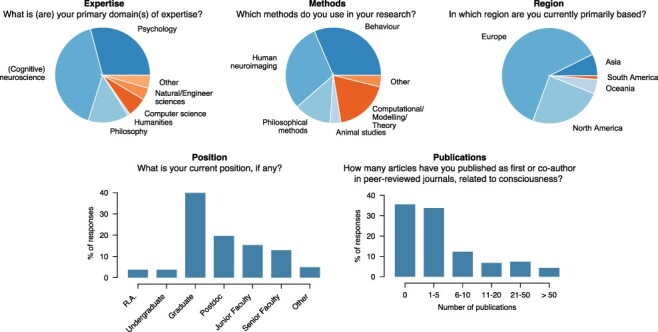
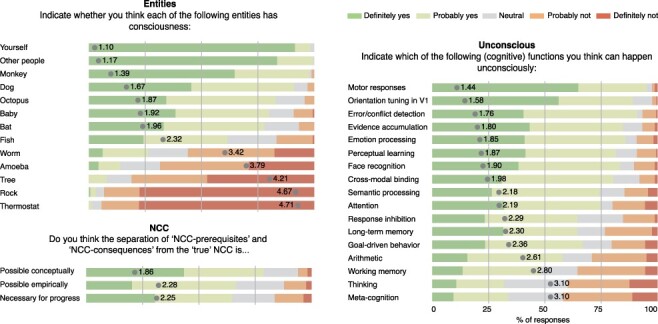
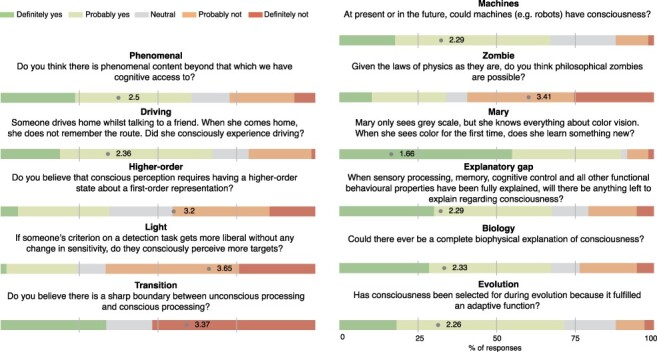
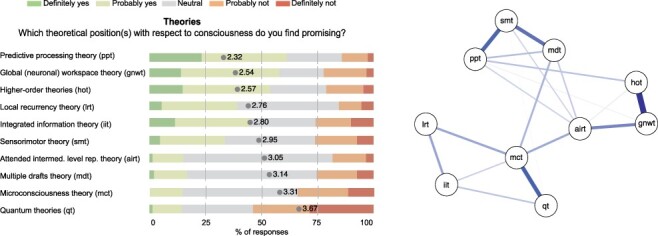
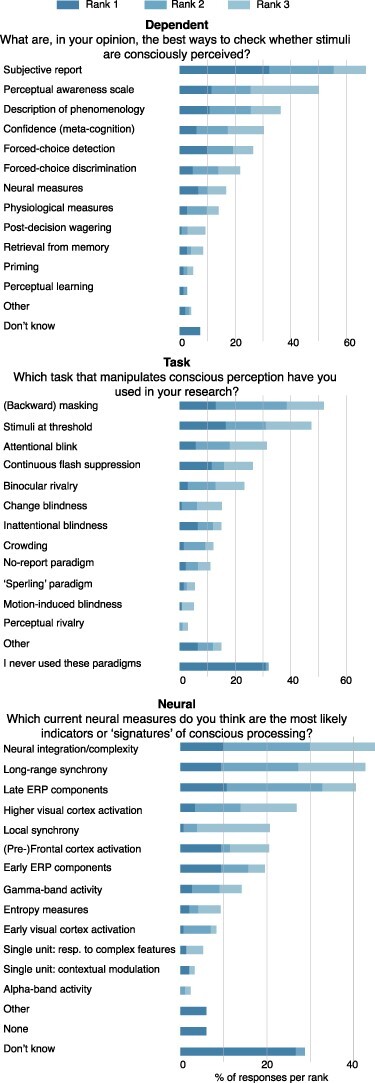
We report the results of an academic survey into the theoretical and methodological foundations, common assumptions, and the current state of the field of consciousness research. The survey consisted of 22 questions and was distributed on two different occasions of the annual meeting of the Association of the Scientific Study of Consciousness (2018 and 2019). We examined responses from 166 consciousness researchers with different backgrounds (e.g. philosophy, neuroscience, psychology, and computer science) and at various stages of their careers (e.g. junior/senior faculty and graduate/undergraduate students). The results reveal that there remains considerable discussion and debate between the surveyed researchers about the definition of consciousness and the way it should be studied. To highlight a few observations, a majority of respondents believe that machines could have consciousness, that consciousness is a gradual phenomenon in the animal kingdom, and that unconscious processing is extensive, encompassing both low-level and high-level cognitive functions. Further, we show which theories of consciousness are currently considered most promising by respondents and how supposedly different theories cluster together, which dependent measures are considered best to index the presence or absence of consciousness, and which neural measures are thought to be the most likely signatures of consciousness. These findings provide us with a snapshot of the current views of researchers in the field and may therefore help prioritize research and theoretical approaches to foster progress.
我们报告了一项关于意识研究领域的理论和方法论基础、共同假设以及该领域当前状况的学术调查结果。该调查由22个问题组成,在意识科学研究协会年会的两个不同场次(2018年和2019年)进行了分发。我们研究了166位具有不同背景(如哲学、神经科学、心理学和计算机科学)以及处于职业生涯不同阶段(如初级/高级教员、研究生/本科生)的意识研究人员的回复。结果显示,在接受调查的研究人员之间,关于意识的定义及其研究方式仍存在大量的讨论和争论。为突出一些观察结果,大多数受访者认为机器可能具有意识,意识在动物王国中是一种渐进现象,并且无意识加工广泛存在,涵盖了低层次和高层次的认知功能。此外,我们展示了受访者目前认为哪些意识理论最具前景,以及看似不同的理论是如何聚类的,哪些相关测量被认为是索引意识存在与否的最佳方式,以及哪些神经测量被认为最有可能是意识的特征。这些发现为我们提供了该领域研究人员当前观点的一个快照,因此可能有助于确定研究和理论方法的优先级以促进进展。