Faculty of Sport and Health Sciences, University of Jyväskylä, Jyväskylä, FINLAND.
Finnish Institute of High Performance Sport KIHU, Jyväskylä, FINLAND.
Med Sci Sports Exerc. 2022 Oct 1;54(10):1690-1701. doi: 10.1249/MSS.0000000000002968. Epub 2022 Aug 17.
Long-term development of endurance performance requires a proper balance between strain and recovery. Because responses and adaptations to training are highly individual, this study examined whether individually adjusted endurance training based on recovery and training status would lead to greater adaptations compared with a predefined program.
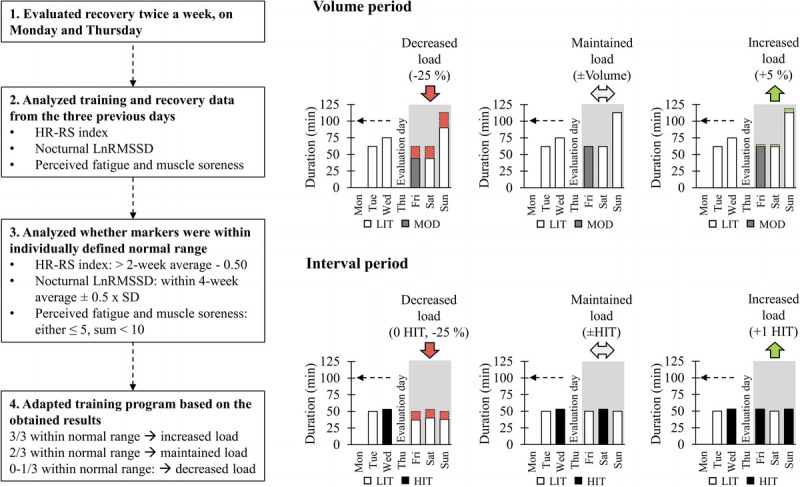
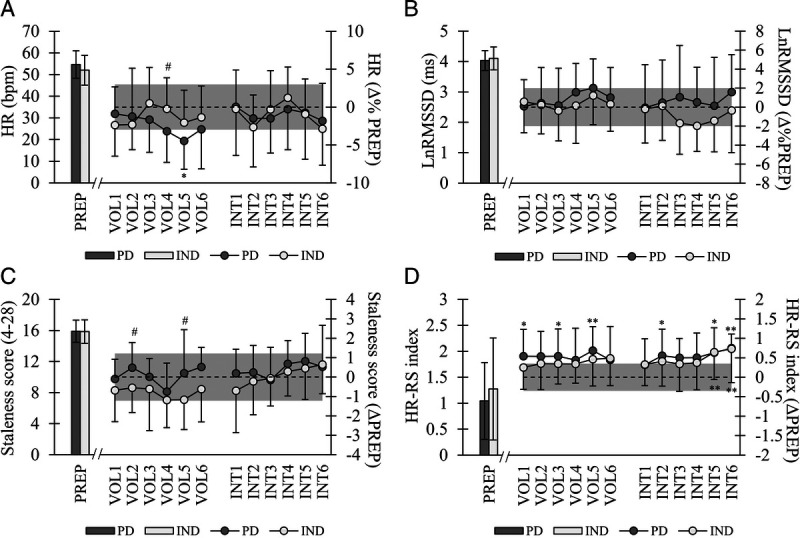
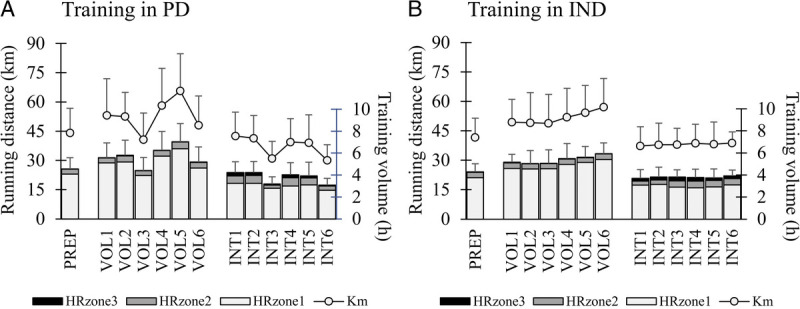
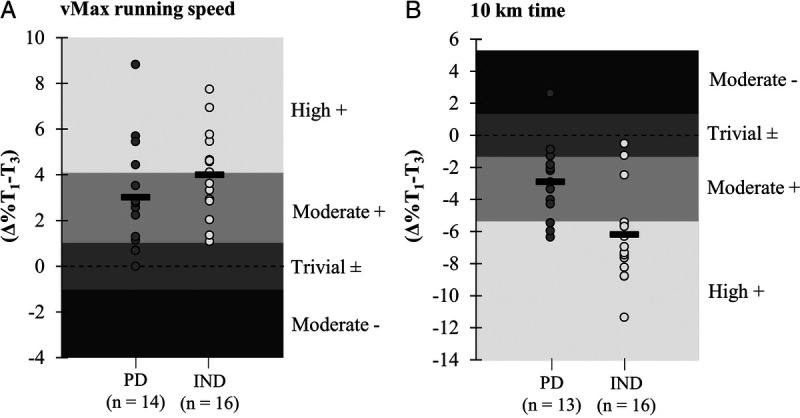
Recreational runners were divided into predefined (PD; n = 14) or individualized (IND; n = 16) training groups. In IND, the training load was decreased, maintained, or increased twice a week based on nocturnal heart rate variability, perceived recovery, and heart rate-running speed index. Both groups performed 3-wk preparatory, 6-wk volume, and 6-wk interval periods. Incremental treadmill tests and 10-km running tests were performed before the preparatory period ( T0 ) and after the preparatory ( T1 ), volume ( T2 ), and interval ( T3 ) periods. The magnitude of training adaptations was defined based on the coefficient of variation between T0 and T1 tests (high >2×, low <0.5×).
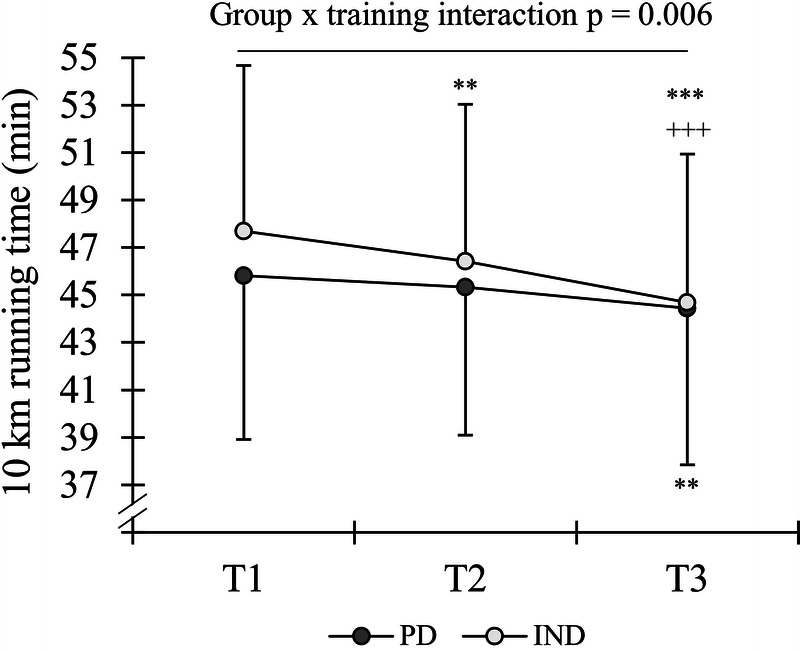
Both groups improved ( P < 0.01) their maximal treadmill speed and 10-km time from T1 to T3 . The change in the 10-km time was greater in IND compared with PD (-6.2% ± 2.8% vs -2.9% ± 2.4%, P = 0.002). In addition, IND had more high responders (50% vs 29%) and fewer low responders (0% vs 21%) compared with PD in the change of maximal treadmill speed and 10-km performance (81% vs 23% and 13% vs 23%), respectively.
PD and IND induced positive training adaptations, but the individualized training seemed more beneficial in endurance performance. Moreover, IND increased the likelihood of high response and decreased the occurrence of low response to endurance training.
耐力表现的长期发展需要在负荷和恢复之间取得适当的平衡。由于对训练的反应和适应具有高度的个体差异,因此本研究考察了基于恢复和训练状态的个体化耐力训练是否会比预定义的训练方案带来更大的适应。
将休闲跑者分为预定义(PD;n=14)或个体化(IND;n=16)训练组。在 IND 中,根据夜间心率变异性、感知恢复和心率-跑步速度指数,每周有两次减少、维持或增加训练负荷。两组均进行了 3 周的准备期、6 周的量期和 6 周的间歇期。在准备期之前(T0)和准备期后(T1)、量期(T2)和间歇期(T3)进行了递增式跑步机测试和 10km 跑步测试。基于 T0 和 T1 测试之间的变异系数(高>2×,低<0.5×)来定义训练适应的幅度。
两组在 T1 到 T3 期间均提高了(P<0.01)最大跑步机速度和 10km 时间。与 PD 相比,IND 组 10km 时间的变化更大(-6.2%±2.8% vs -2.9%±2.4%,P=0.002)。此外,与 PD 相比,IND 组在最大跑步机速度和 10km 成绩的变化中具有更多的高反应者(50% vs 29%)和更少的低反应者(0% vs 21%)(分别为 81% vs 23%和 13% vs 23%)。
PD 和 IND 均引起了积极的训练适应,但个体化训练似乎对耐力表现更有益。此外,IND 增加了对耐力训练的高反应可能性,并减少了低反应的发生。