
化学遗传学和光遗传学方法调控小胶质细胞在慢性痛中的作用。
Chemogenetic and Optogenetic Manipulations of Microglia in Chronic Pain.
机构信息
Department of Neurology, Mayo Clinic, Rochester, MN, 55905, USA.
Faculty of Psychology and Neuroscience, Maastricht University, Maastricht, MD, 6200, The Netherlands.
出版信息
Neurosci Bull. 2023 Mar;39(3):368-378. doi: 10.1007/s12264-022-00937-3. Epub 2022 Aug 17.
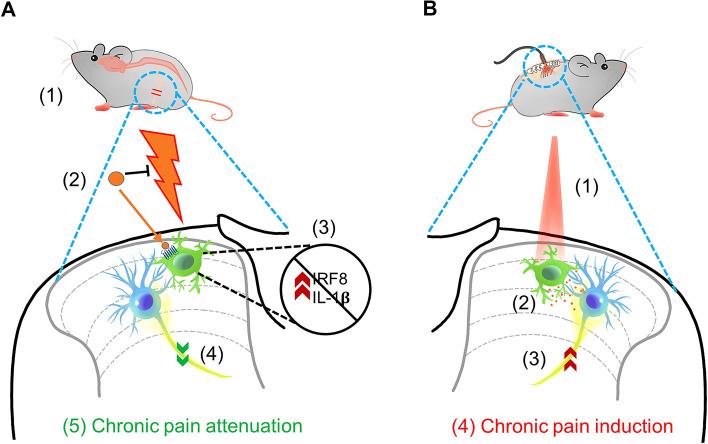
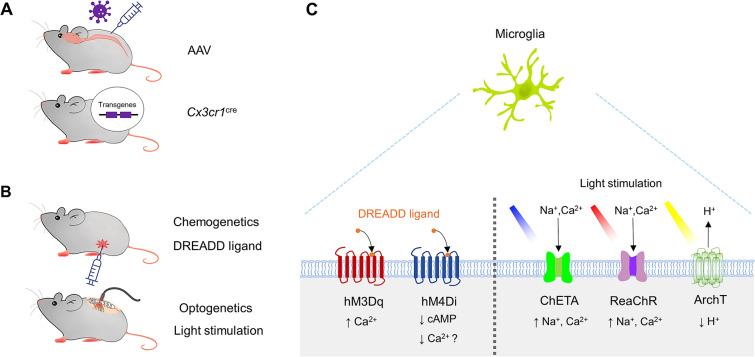
Chronic pain relief remains an unmet medical need. Current research points to a substantial contribution of glia-neuron interaction in its pathogenesis. Particularly, microglia play a crucial role in the development of chronic pain. To better understand the microglial contribution to chronic pain, specific regional and temporal manipulations of microglia are necessary. Recently, two new approaches have emerged that meet these demands. Chemogenetic tools allow the expression of designer receptors exclusively activated by designer drugs (DREADDs) specifically in microglia. Similarly, optogenetic tools allow for microglial manipulation via the activation of artificially expressed, light-sensitive proteins. Chemo- and optogenetic manipulations of microglia in vivo are powerful in interrogating microglial function in chronic pain. This review summarizes these emerging tools in studying the role of microglia in chronic pain and highlights their potential applications in microglia-related neurological disorders.
慢性疼痛缓解仍然是未满足的医学需求。目前的研究表明,胶质细胞-神经元相互作用在其发病机制中起着重要作用。特别是,小胶质细胞在慢性疼痛的发展中起着关键作用。为了更好地了解小胶质细胞对慢性疼痛的贡献,需要对小胶质细胞进行特定的区域和时间操作。最近,出现了两种新方法来满足这些需求。化学遗传工具允许专门在小胶质细胞中表达仅由设计药物(DREADD)激活的设计受体。同样,光遗传工具允许通过激活人工表达的、对光敏感的蛋白质来操纵小胶质细胞。体内的化学遗传和光遗传操纵小胶质细胞在研究小胶质细胞在慢性疼痛中的作用方面非常有效。这篇综述总结了这些新兴工具在研究小胶质细胞在慢性疼痛中的作用,并强调了它们在与小胶质细胞相关的神经紊乱中的潜在应用。
 Zotero 插件