INSERM U1016-Equipe "Génomique, Epigénétique et Physiologie de la Reproduction", Institut Cochin, Université Paris Descartes-Paris, Paris, France.
CECOS, Hôpitaux Universitaires Paris Seine-Saint-Denis, Hôpital Jean Verdier and Service de Biologie de la Reproduction, Hôpitaux Universitaires Paris Nord Val de Seine, Hôpital Bichat, Paris, France.
Nat Rev Urol. 2022 Oct;19(10):597-626. doi: 10.1038/s41585-022-00626-w. Epub 2022 Aug 17.
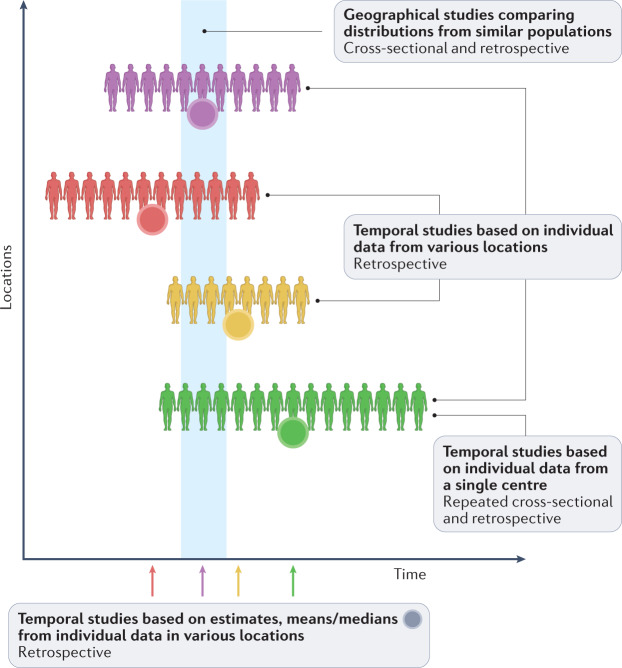
Over the past four decades, studies of various designs have reported spatial and temporal trends in human semen quality. Several standardized-methodology studies in homogeneous populations that compare specific cities within a country or a continent provide clear evidence of geographical differences in sperm production, even over short distances within the same country. Human sperm production is widely believed to be declining over time, but evidence from the scientific literature is less clear. Studies based on repeated cross-sectional data from a single centre have shown mixed results. Among the numerous retrospective studies conducted in a single centre, only some included homogeneous groups of men and appropriate methods, and most of them suggest a temporal decrease in human sperm production in the geographical areas considered. Conclusions reporting temporal trends in sperm production that came from existing retrospective multicentre studies based on individual semen data and those using means, medians or estimates of sperm production are questionable, owing to intrinsic limitations in the studies performed. Regardless of study design, studies on the percentage of motile or morphologically normal spermatozoa are still limited by the inherent variability in assessment. Overall, available data do not enable us to conclude that human semen quality is deteriorating worldwide or in the Western world, but that a trend is observed in some specific areas. To understand these trends and contrasts in sperm and semen quality, prospective studies should be encouraged and combined with assessment of the male exposome.
在过去的四十年中,各种设计的研究报告了人类精液质量的时空趋势。一些在同质人群中采用标准化方法的研究比较了一个国家或一个大陆内的特定城市,这些研究提供了明确的证据,表明即使在同一国家内的短距离范围内,精子产生也存在地理差异。人们普遍认为,人类的精子产生随着时间的推移而减少,但科学文献中的证据并不明确。基于单个中心的重复横断面数据的研究结果喜忧参半。在单个中心进行的众多回顾性研究中,只有一些研究包括了同质的男性群体和适当的方法,而且大多数研究表明,在所考虑的地理区域内,人类精子产生的时间呈下降趋势。由于所进行的研究存在内在局限性,因此,基于个体精液数据的现有回顾性多中心研究以及使用精子产生的平均值、中位数或估计值报告精子产生时间趋势的结论是值得怀疑的。无论研究设计如何,对运动或形态正常精子百分比的研究仍然受到评估中固有的可变性的限制。总的来说,现有数据并不能使我们得出结论,即全世界或西方世界的人类精液质量正在恶化,但在一些特定地区观察到了一种趋势。为了了解精子和精液质量的这些趋势和差异,应该鼓励前瞻性研究,并结合对男性外显子组的评估。