Institute of Marine Sciences, University of California Santa Cruz, Monterey, California, USA.
Environmental Research Division, Southwest Fisheries Science Center, National Marine Fisheries Service, National Oceanic and Atmospheric Administration, Monterey, California, USA.
Glob Chang Biol. 2022 Nov;28(22):6586-6601. doi: 10.1111/gcb.16371. Epub 2022 Aug 17.
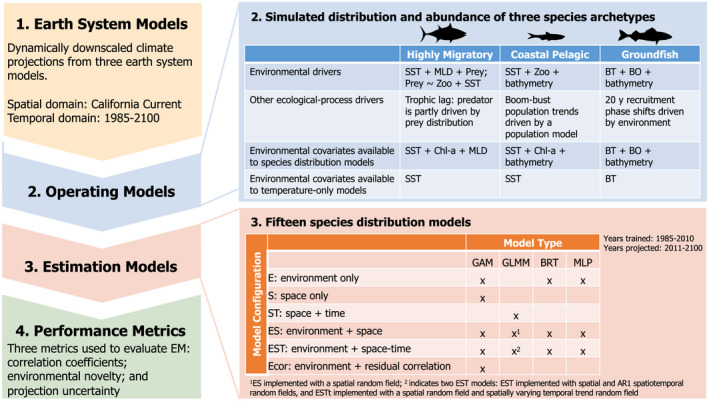
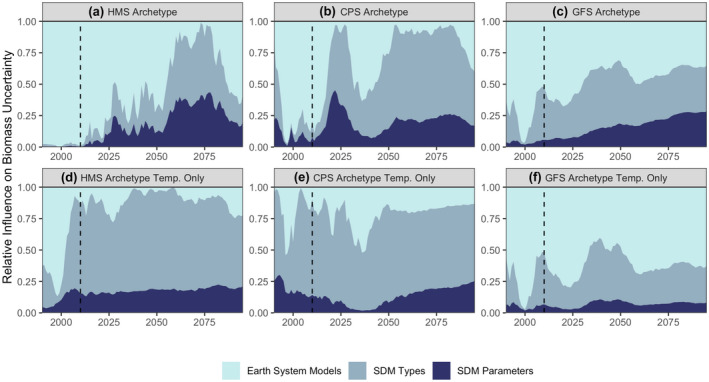
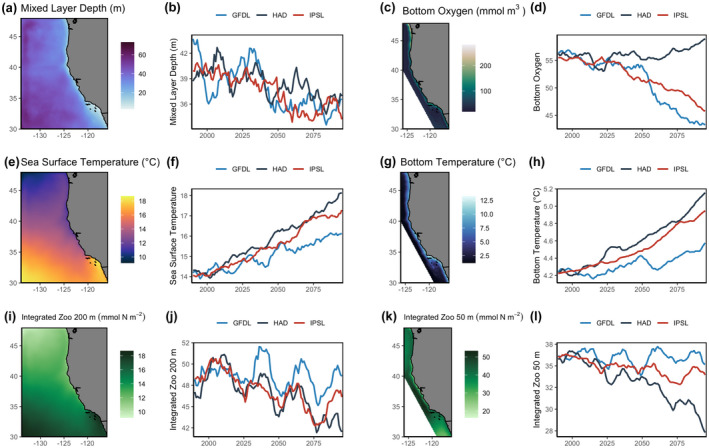
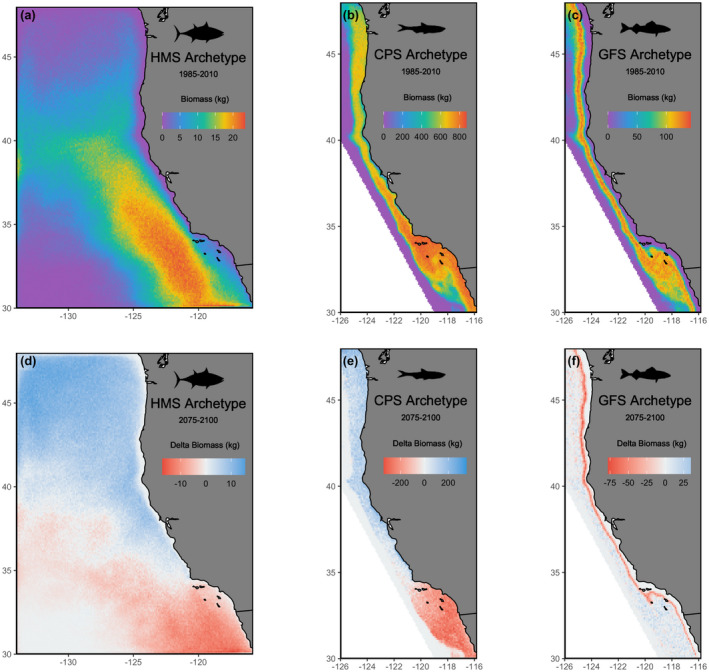
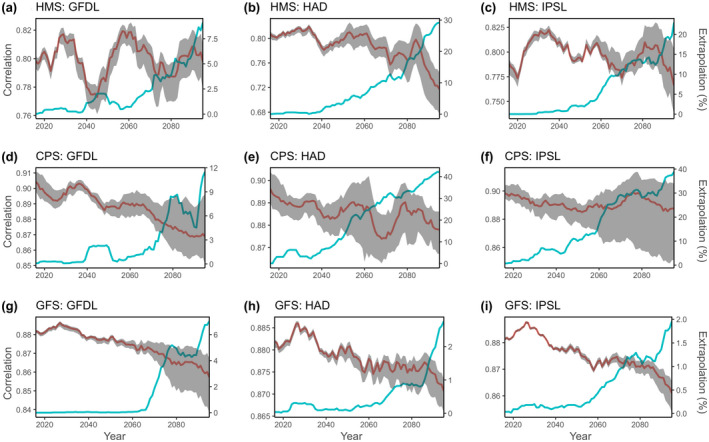
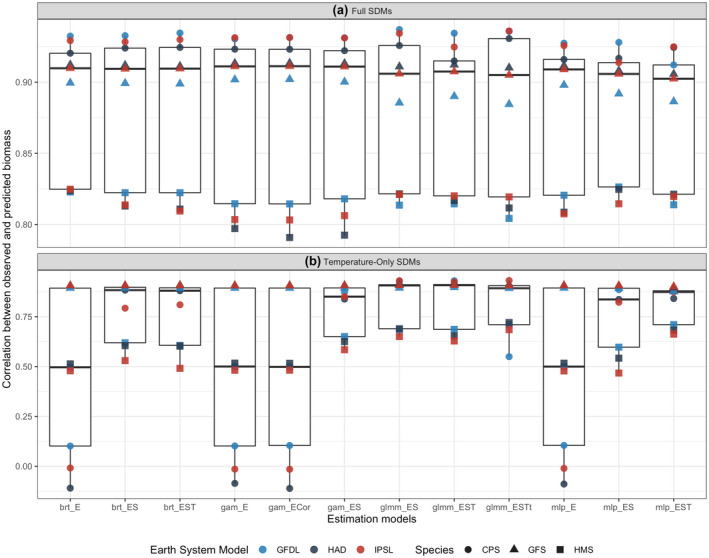
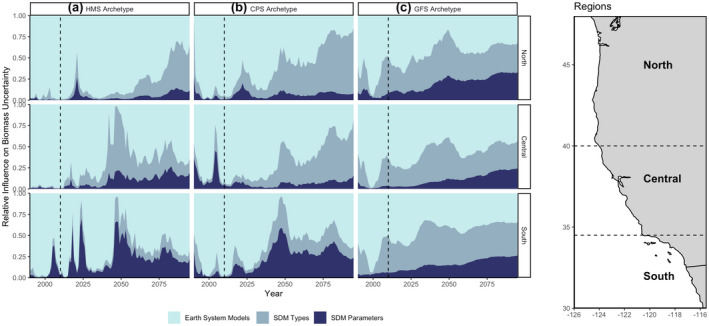
Projecting the future distributions of commercially and ecologically important species has become a critical approach for ecosystem managers to strategically anticipate change, but large uncertainties in projections limit climate adaptation planning. Although distribution projections are primarily used to understand the scope of potential change-rather than accurately predict specific outcomes-it is nonetheless essential to understand where and why projections can give implausible results and to identify which processes contribute to uncertainty. Here, we use a series of simulated species distributions, an ensemble of 252 species distribution models, and an ensemble of three regional ocean climate projections, to isolate the influences of uncertainty from earth system model spread and from ecological modeling. The simulations encompass marine species with different functional traits and ecological preferences to more broadly address resource manager and fishery stakeholder needs, and provide a simulated true state with which to evaluate projections. We present our results relative to the degree of environmental extrapolation from historical conditions, which helps facilitate interpretation by ecological modelers working in diverse systems. We found uncertainty associated with species distribution models can exceed uncertainty generated from diverging earth system models (up to 70% of total uncertainty by 2100), and that this result was consistent across species traits. Species distribution model uncertainty increased through time and was primarily related to the degree to which models extrapolated into novel environmental conditions but moderated by how well models captured the underlying dynamics driving species distributions. The predictive power of simulated species distribution models remained relatively high in the first 30 years of projections, in alignment with the time period in which stakeholders make strategic decisions based on climate information. By understanding sources of uncertainty, and how they change at different forecast horizons, we provide recommendations for projecting species distribution models under global climate change.
预测具有商业和生态重要性的物种的未来分布已经成为生态系统管理者进行战略预测的关键方法,但是预测中的巨大不确定性限制了气候适应规划。尽管分布预测主要用于了解潜在变化的范围,而不是准确预测特定结果,但了解预测可能产生不合理结果的原因以及确定哪些过程导致不确定性仍然至关重要。在这里,我们使用一系列模拟物种分布、252 个物种分布模型的集合和三个区域海洋气候预测的集合,来隔离来自地球系统模型扩散和生态建模的不确定性影响。这些模拟涵盖了具有不同功能特征和生态偏好的海洋物种,更广泛地满足资源管理者和渔业利益相关者的需求,并提供了一个模拟的真实状态,以便评估预测。我们根据与历史条件的环境外推程度来展示我们的结果,这有助于促进在不同系统中工作的生态模型人员进行解释。我们发现,物种分布模型的不确定性可能超过来自发散地球系统模型的不确定性(到 2100 年,高达总不确定性的 70%),并且这一结果在不同物种特征中是一致的。物种分布模型的不确定性随着时间的推移而增加,主要与模型在多大程度上外推到新的环境条件有关,但受模型在多大程度上捕捉到驱动物种分布的潜在动态的影响。在预测的前 30 年内,模拟物种分布模型的预测能力仍然相对较高,这与利益相关者根据气候信息做出战略决策的时间段一致。通过了解不确定性的来源以及它们在不同预测时间内的变化,我们为在全球气候变化下预测物种分布模型提供了建议。