Lymeus Freddie, White Mathew P, Lindberg Per, Hartig Terry
Institute for Housing and Urban Research, Uppsala University, Uppsala, Sweden.
Department of Psychology, Uppsala University, Uppsala, Sweden.
Front Psychol. 2022 Aug 1;13:763650. doi: 10.3389/fpsyg.2022.763650. eCollection 2022.
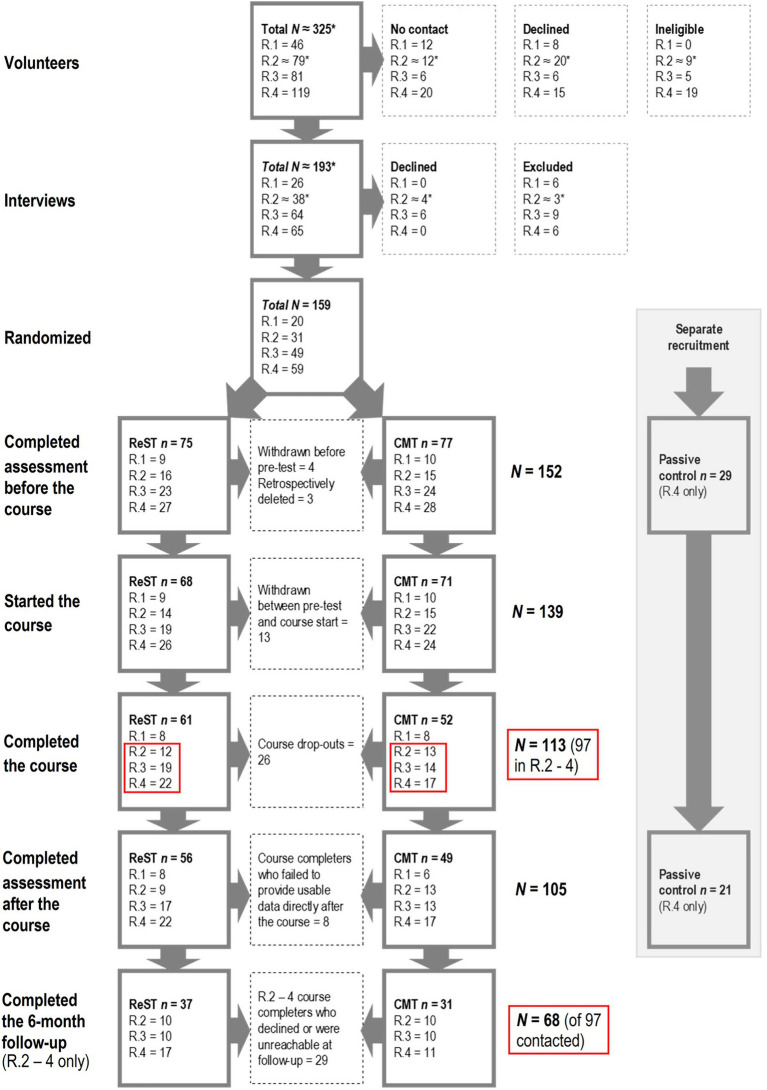
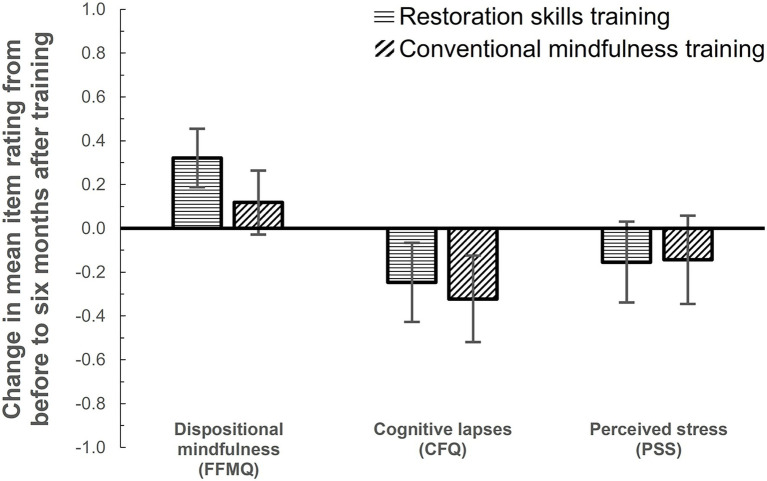
Restoration skills training (ReST) is a mindfulness-based course in which participants draw support from a natural practice setting while they learn to meditate. Well-established conventional mindfulness training (CMT) can improve psychological functioning but many perceive it as demanding and fail to sustain practice habits. Applying non-inferiority logic, previous research indicated that ReST overcomes compliance problems without compromising the benefits gained over 5 weeks' training. This article applies similar logic in a 6-month follow-up. Of 97 contacted ReST and CMT course completers, 68 responded and 29 were included with multiple imputation data. The online survey included questions about their psychological functioning in three domains (dispositional mindfulness, cognitive lapses, and perceived stress) and the forms and frequencies with which they had continued to practice mindfulness after the course. Former ReST participants continued, on average, to show higher dispositional mindfulness and fewer cognitive lapses compared to pre-course ratings. Improved psychological functioning in one or more domains was demonstrated by 35%, as determined by a reliable change index. Again, analyses detected no indications of any substantive disadvantages compared to the more demanding, established CMT approach. Compared to the CMT group, more ReST participants had also continued to practice at least occasionally (92 vs. 67%). Continued practice was linked to sustained improvements for ReST but not clearly so for CMT. ReST participants thus continued to use the skills and sustained the improvements in psychological functioning that they had gained in the course, further supporting the utility of ReST as a health intervention.
恢复技能训练(ReST)是一门基于正念的课程,参与者在学习冥想时从自然的练习环境中获得支持。成熟的传统正念训练(CMT)可以改善心理功能,但许多人认为它要求苛刻,难以维持练习习惯。先前的研究运用非劣效性逻辑表明,ReST克服了依从性问题,同时又不影响五周训练所带来的益处。本文在为期6个月的随访中运用了类似的逻辑。在联系的97名ReST和CMT课程结业者中,68人做出了回应,29人纳入了多重填补数据。在线调查包括有关他们在三个领域(特质正念、认知失误和感知压力)的心理功能问题,以及课程结束后他们继续练习正念的形式和频率。与课程前的评分相比,前ReST参与者平均而言继续表现出更高的特质正念和更少的认知失误。根据可靠变化指数确定,35%的人在一个或多个领域的心理功能得到改善。同样,分析未发现与要求更高的成熟CMT方法相比存在任何实质性劣势的迹象。与CMT组相比,更多的ReST参与者也至少偶尔继续练习(92%对67%)。持续练习与ReST的持续改善相关,但对CMT而言并非如此明显。因此,ReST参与者继续运用这些技能,并维持了他们在课程中所获得的心理功能改善,进一步支持了ReST作为一种健康干预措施的效用。