Marsaa Kristoffer, Mendahl Janni, Nielsen Steen, Mørk Lotte, Sjøgren Per, Kurita Geana Paula
Arresoedal Hospice, Denmark.
Palliative Unit, Department of Urology, Herlev and Gentofte hospital Copenhagen University Hospital, Denmark.
Eur Clin Respir J. 2022 Aug 12;9(1):2108195. doi: 10.1080/20018525.2022.2108195. eCollection 2022.
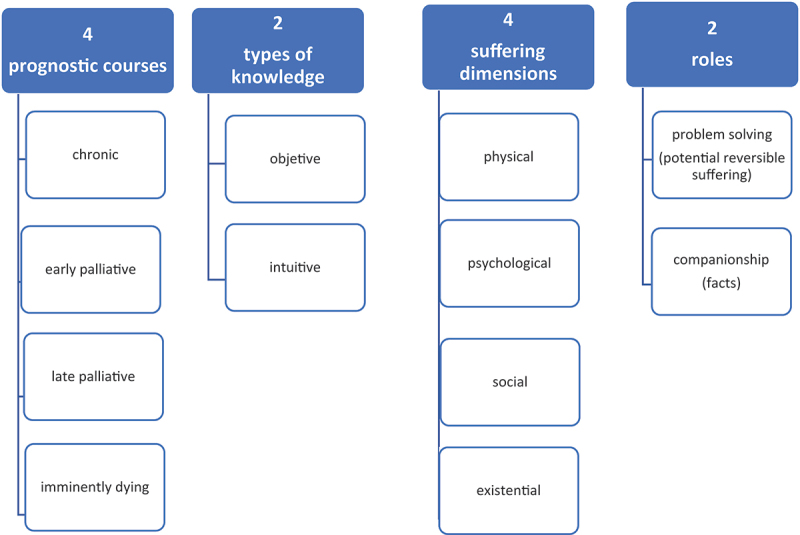
Palliative medicine has traditionally focused on people affected by cancer with rapidly advancing disease progression. However, as more people live longer time with serious illnesses, including lung diseases, the need of palliative care for these patients if also increasing. There is a lack of research and clinical knowledge about what palliative care is for people affected by chronic obstructive pulmonary disease and interstitial lung disease. The aim of this paper is to describe the development process of an easy to use and clinically relevant model for the palliative care approach in people affected by severe illnesses. The developed model consists of four components, which originated the title" 4,2,4,2 model". Each number has a specific meaning: the first 4 = the four disease trajectories that patients may experience; 2 = the two forms of knowledge, objective, and intuitive that must be achieved by the health professionals to gain an understanding of the situation; 4 = the four dimensions of suffering physically, mentally, socially and existentially/spiritually; and 2 = the two roles that health-care professionals must be able to take in when treating patients with serious illnesses. The 4-2-4-2 model proposes an easy-to-use and clinically relevant model for palliative approach and integration of PC and pulmonary medicine. Another important purpose of this model is to provide HPs with different educational backgrounds and from different medical fields with a 'golden standard approach' to enhance the focus of the palliative approach in both the clinic and teaching. The effect and consequences of the use of the 4-2-4-2 model should be explored in future clinical trials. Furthermore, it should be investigated whether teaching the model creates a change in clinical approach to patients with serious illnesses as well as whether these changes are long-lasting.
姑息医学传统上主要关注癌症患者,这些患者的疾病进展迅速。然而,随着越来越多的人患有包括肺部疾病在内的严重疾病并存活更长时间,这些患者对姑息治疗的需求也在增加。对于慢性阻塞性肺疾病和间质性肺疾病患者的姑息治疗,目前缺乏研究和临床知识。本文的目的是描述一种易于使用且与临床相关的模型的开发过程,该模型用于对重症患者的姑息治疗方法。所开发的模型由四个部分组成,由此产生了“4,2,4,2模型”这一名称。每个数字都有特定含义:第一个4表示患者可能经历的四种疾病轨迹;2表示健康专业人员为了解病情必须掌握的两种知识形式,即客观知识和直观知识;4表示身体、心理、社会和生存/精神层面的四种痛苦维度;2表示医疗保健专业人员在治疗重症患者时必须能够承担的两种角色。4-2-4-2模型提出了一种易于使用且与临床相关的姑息治疗方法模型,以及姑息治疗与肺病医学整合的模型。该模型的另一个重要目的是为具有不同教育背景和来自不同医学领域的医疗保健专业人员提供一种“黄金标准方法”,以加强临床和教学中对姑息治疗方法的关注。4-2-4-2模型的使用效果和后果应在未来的临床试验中进行探索。此外,还应研究教授该模型是否会改变对重症患者的临床治疗方法,以及这些改变是否持久。