Xiao Li, Totten Arthur H, Crabb Donna M, Atkinson Thomas Prescott, Waites Ken B
Department of Medicine, University of Alabama at Birmingham, Birmingham, AL, United States.
Department of Pediatrics, University of Alabama at Birmingham, Birmingham, AL, United States.
Front Microbiol. 2022 Aug 1;13:914464. doi: 10.3389/fmicb.2022.914464. eCollection 2022.
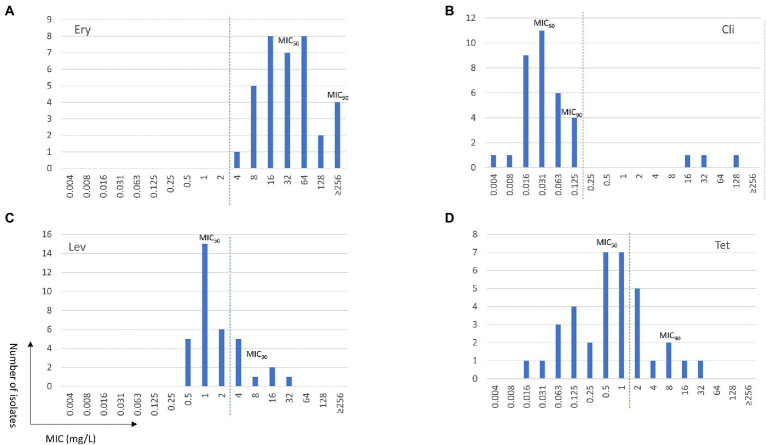
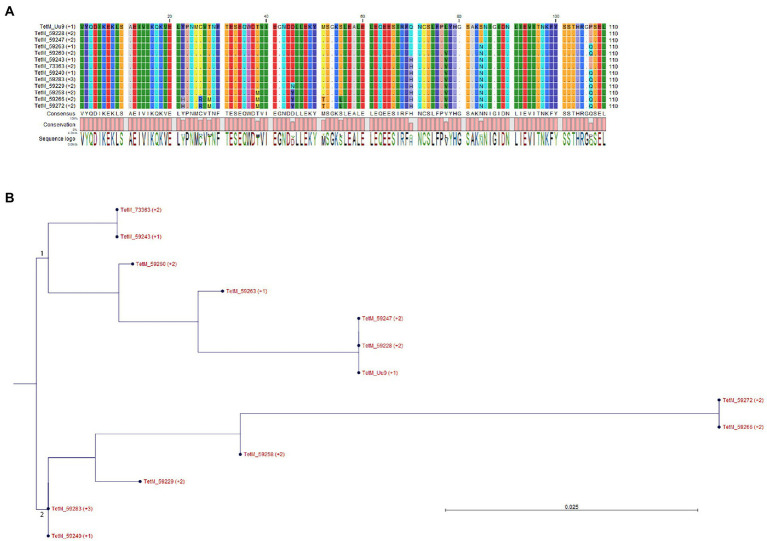
, an oral commensal organism, can cause severe invasive infections in immunocompromised individuals. Currently there is no treatment guidance for such infections. We performed antimicrobial susceptibility tests on 39 commensal and invasive isolates and investigated the mechanisms of antimicrobial resistance. Clindamycin was the most active agent [minimum inhibition concentration (MIC) range: 0.004-128 mg/L, MIC = 0.031 mg/L, MIC = 0.125 mg/ml], followed by tetracycline and levofloxacin. All isolates were resistant to erythromycin (MIC ≥4 mg/L) due to the presence of 2057A ( numbering) in 23S rRNA. Three isolates with elevated clindamycin MICs (≥8 mg/L) harbored A2058T/G mutations in gene; four sequential isolates from one patient developed C2611T and A2059G mutations accompanying the increase of clindamycin MICs. Five isolates with elevated tetracycline MICs (≥4 mg/L) had mutations in gene (A965G/T, G966T, or A967C/T) and one of them harbored . Nine isolates with elevated levofloxacin MICs (≥4 mg/L) had one or more mutations in , , , or . Susceptibility breakpoints for clindamycin, tetracycline and levofloxacin were suggested to be ≤0.125, ≤2, and ≤2 mg/L, respectively. Antimicrobial resistance to any of the three agents (clindamycin, tetracycline, or levofloxacin) was documented in 12 (34.3%) non-duplicate isolates, of which 10 were invasive. Levofloxacin resistance was most frequent (25.7%). Multi-drug resistance was also observed (14.3%). This study demonstrates the frequent occurrence of antimicrobial resistance in , emphasizing the need for culture and susceptibility testing to guide antimicrobial therapy.
作为一种口腔共生菌,可在免疫功能低下的个体中引起严重的侵袭性感染。目前对于此类感染尚无治疗指南。我们对39株共生菌和侵袭性分离株进行了药敏试验,并研究了耐药机制。克林霉素是最有效的药物[最低抑菌浓度(MIC)范围:0.004 - 128mg/L,MIC = 0.031mg/L,MIC = 0.125mg/ml],其次是四环素和左氧氟沙星。由于23S rRNA中存在2057A(编号),所有分离株对红霉素耐药(MIC≥4mg/L)。三株克林霉素MIC升高(≥8mg/L)的分离株在某基因中存在A2058T/G突变;来自一名患者的四个连续分离株随着克林霉素MIC的升高出现了C2611T和A2059G突变。五株四环素MIC升高(≥4mg/L)的分离株在某基因中存在突变(A965G/T、G966T或A967C/T),其中一株还存在某情况。九株左氧氟沙星MIC升高(≥4mg/L)的分离株在某几个基因中存在一个或多个突变。建议克林霉素、四环素和左氧氟沙星的药敏折点分别为≤0.125、≤2和≤2mg/L。在12株(34.3%)非重复分离株中记录到对这三种药物(克林霉素、四环素或左氧氟沙星)中任何一种的耐药情况,其中10株为侵袭性分离株。左氧氟沙星耐药最为常见(25.7%)。还观察到多药耐药(14.3%)。本研究表明某菌中耐药情况频繁发生,强调需要进行培养和药敏试验以指导抗菌治疗。 (注:原文中部分基因名称未明确写出,用“某基因”等表述代替)