Tang Minghua, Weaver Nicholas E, Frank Daniel N, Ir Diana, Robertson Charles E, Kemp Jennifer F, Westcott Jamie, Shankar Kartik, Garces Ana L, Figueroa Lester, Tshefu Antoinette K, Lokangaka Adrien L, Goudar Shivaprasad S, Somannavar Manjunath, Aziz Sumera, Saleem Sarah, McClure Elizabeth M, Hambidge K Michael, Hendricks Audrey E, Krebs Nancy F
Department of Pediatrics, Section of Nutrition, University of Colorado Anschutz Medical Campus, Aurora, CO, United States.
Department of Mathematical and Statistical Sciences, University of Colorado, Denver, Denver, CO, United States.
Front Microbiol. 2022 Aug 1;13:823757. doi: 10.3389/fmicb.2022.823757. eCollection 2022.
To characterize the changes in gut microbiota during pregnancy and determine the effects of nutritional intervention on gut microbiota in women from sub-Saharan Africa (the Democratic Republic of the Congo, DRC), South Asia (India and Pakistan), and Central America (Guatemala).
Pregnant women in the Women First (WF) Preconception Maternal Nutrition Trial were included in this analysis. Participants were randomized to receive a lipid-based micronutrient supplement either ≥3 months before pregnancy (Arm 1); started the same intervention late in the first trimester (Arm 2); or received no nutrition supplements besides those self-administered or prescribed through local health services (Arm 3). Stool and blood samples were collected during the first and third trimesters. Findings presented here include fecal 16S rRNA gene-based profiling and systemic and intestinal inflammatory biomarkers, including alpha (1)-acid glycoprotein (AGP), C-reactive protein (CRP), fecal myeloperoxidase (MPO), and calprotectin.
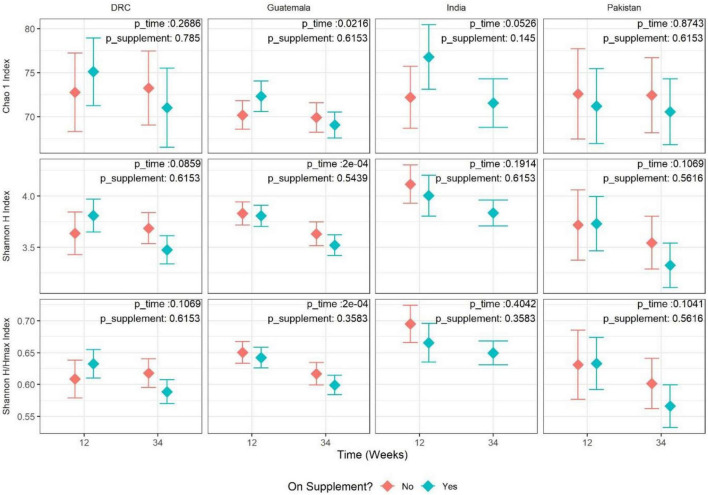
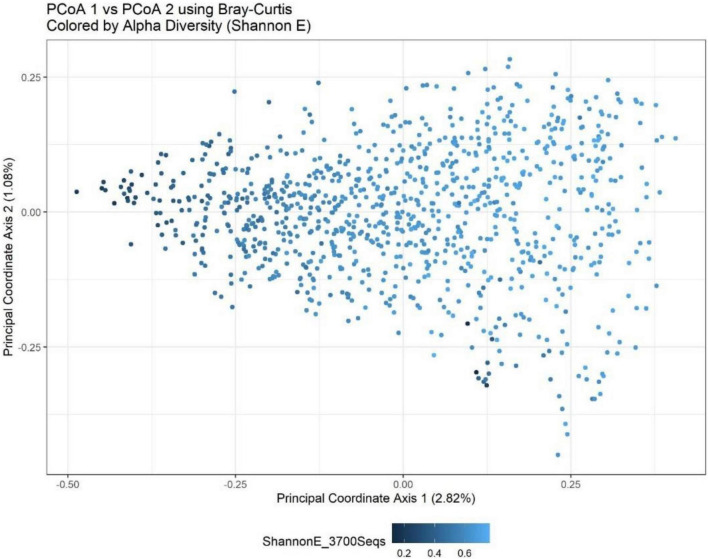
Stool samples were collected from 640 women (DRC, = 157; India, = 102; Guatemala, = 276; and Pakistan, = 105). Gut microbial community structure did not differ by intervention arm but changed significantly during pregnancy. Richness, a measure of alpha-diversity, decreased over pregnancy. Community composition (beta-diversity) also showed a significant change from first to third trimester in all four sites. Of the top 10 most abundant genera, unclassified significantly decreased in Guatemala and unclassified significantly decreased in Guatemala and DRC. The change in the overall community structure at the genus level was associated with a decrease in the abundances of certain genera with low heterogeneity among the four sites. Intervention arms were not significantly associated with inflammatory biomarkers at 12 or 34 weeks. AGP significantly decreased from 12 to 34 weeks of pregnancy, whereas CRP, MPO, and calprotectin did not significantly change over time. None of these biomarkers were significantly associated with the gut microbiota diversity.
The longitudinal reduction of individual genera (both commensals and potential pathogens) and alpha-diversity among all sites were consistent and suggested that the effect of pregnancy on the maternal microbiota overrides other influencing factors, such as nutrition intervention, geographical location, diet, race, and other demographical variables.
描述孕期肠道微生物群的变化,并确定营养干预对撒哈拉以南非洲(刚果民主共和国,DRC)、南亚(印度和巴基斯坦)及中美洲(危地马拉)女性肠道微生物群的影响。
纳入“女性优先”(WF)孕前孕产妇营养试验中的孕妇进行此项分析。参与者被随机分为三组:在怀孕前≥3个月接受基于脂质的微量营养素补充剂(组1);在孕早期晚期开始相同干预(组2);或除自行服用或通过当地卫生服务机构开具的补充剂外不接受任何营养补充剂(组3)。在孕早期和孕晚期采集粪便和血液样本。此处呈现的研究结果包括基于粪便16S rRNA基因的分析以及全身和肠道炎症生物标志物,包括α-1-酸性糖蛋白(AGP)、C反应蛋白(CRP)、粪便髓过氧化物酶(MPO)和钙卫蛋白。
收集了640名女性的粪便样本(DRC,n = 157;印度,n = 102;危地马拉,n = 276;巴基斯坦,n = 105)。肠道微生物群落结构在各干预组间无差异,但在孕期有显著变化。丰富度(一种α-多样性指标)在孕期降低。群落组成(β-多样性)在所有四个地点从孕早期到孕晚期也有显著变化。在最丰富的前10个属中,危地马拉未分类的属显著减少,危地马拉和DRC中未分类的属显著减少。属水平上总体群落结构的变化与四个地点间某些低异质性属的丰度降低有关。干预组与12周或34周时的炎症生物标志物无显著关联。AGP在怀孕12周到34周时显著降低,而CRP、MPO和钙卫蛋白随时间无显著变化。这些生物标志物均与肠道微生物群多样性无显著关联。
所有地点个体属(共生菌和潜在病原体)的纵向减少以及α-多样性是一致的,这表明怀孕对母体微生物群的影响超过了其他影响因素,如营养干预、地理位置、饮食、种族和其他人口统计学变量。