Huang Guoqing, Jin Qiankai, Tian Xiaoqing, Mao Yushan
Department of Endocrinology, The Affiliated Hospital of Medical School, Ningbo University, Ningbo, China.
School of Medicine, Ningbo University, Ningbo, China.
Front Cardiovasc Med. 2022 Aug 2;9:946063. doi: 10.3389/fcvm.2022.946063. eCollection 2022.
This study aimed to identify independent risk factors for carotid atherosclerosis (CAS) and construct and validate a CAS risk prediction model based on the Chinese population.
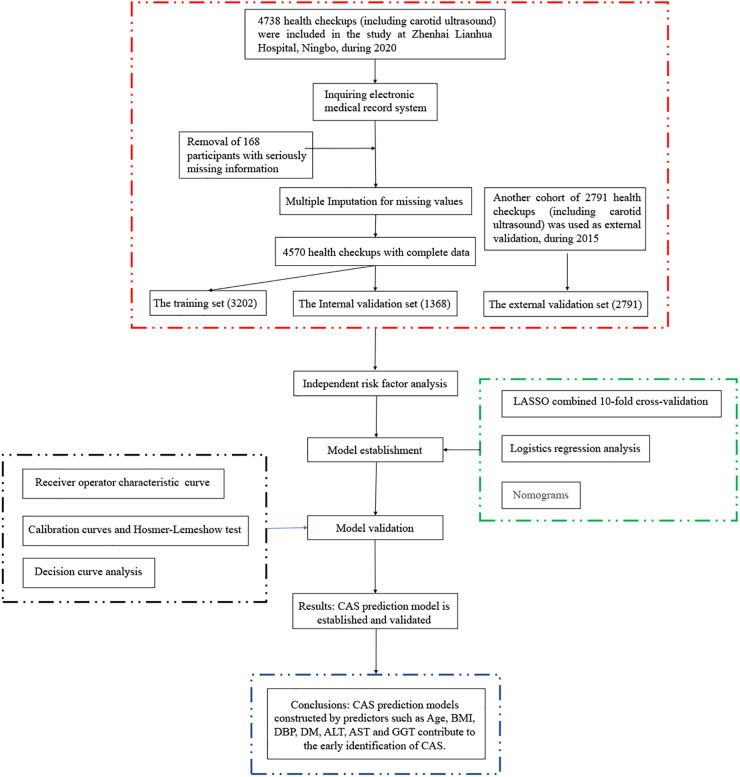
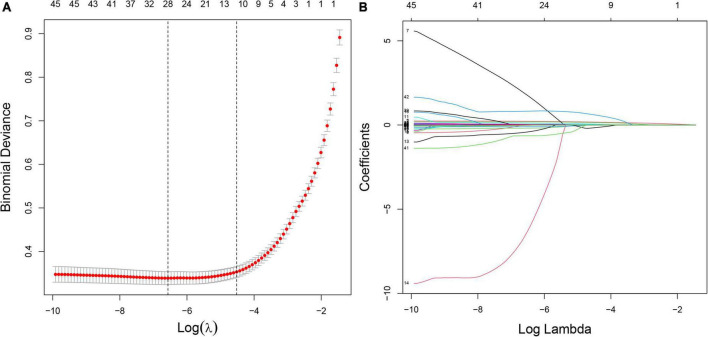
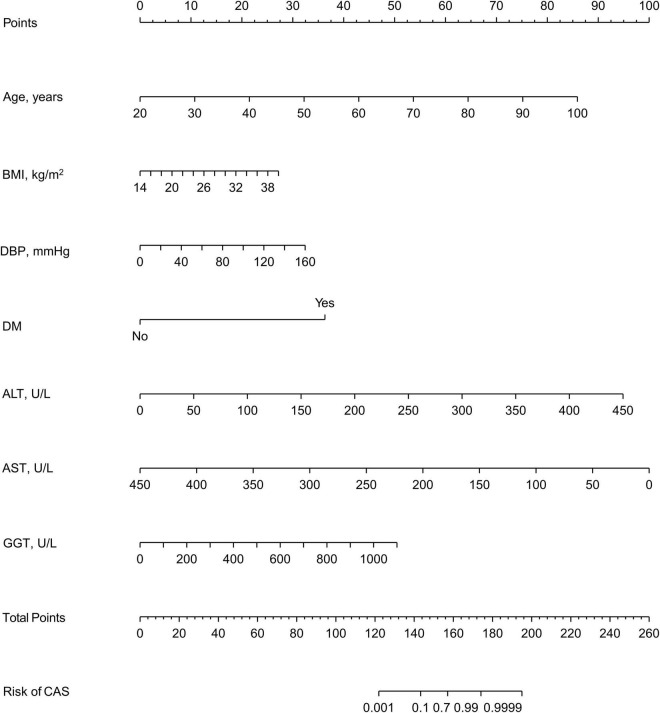
This retrospective study included 4,570 Chinese adults who underwent health checkups (including carotid ultrasound) at the Zhenhai Lianhua Hospital, Ningbo, China, in 2020. All the participants were randomly assigned to the training and validation sets at a ratio of 7:3. Independent risk factors associated with CAS were identified using multivariate logistic regression analysis. The least absolute shrinkage and selection operator combined with 10-fold cross-validation were screened for characteristic variables, and nomograms were plotted to demonstrate the risk prediction model. C-index and receiver operating characteristic curves, calibration plots, and decision curve analysis (DCA) were used to evaluate the risk model's discrimination, calibration, and clinical applicability.
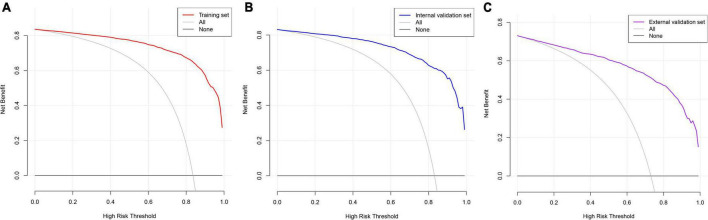
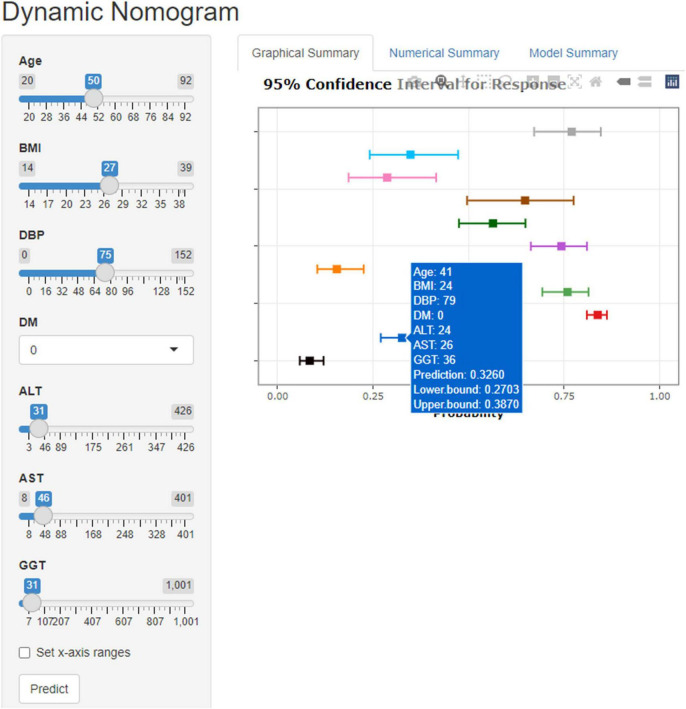
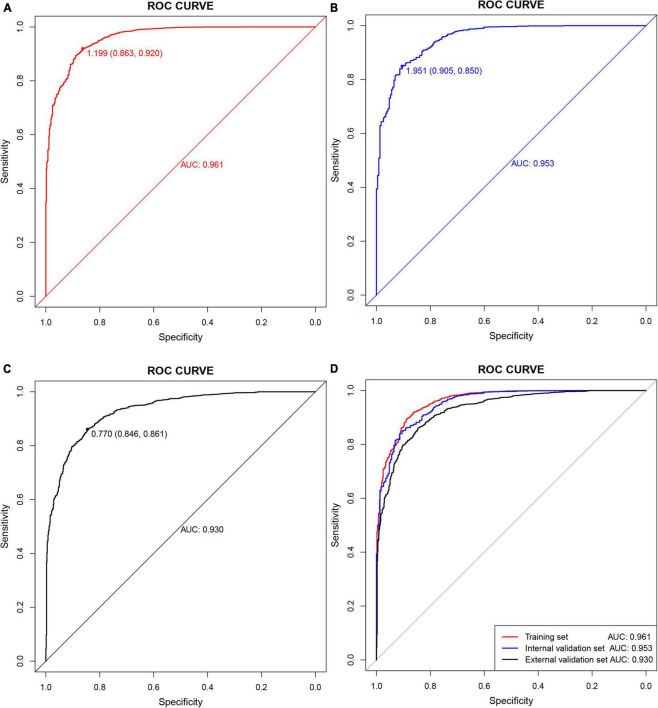
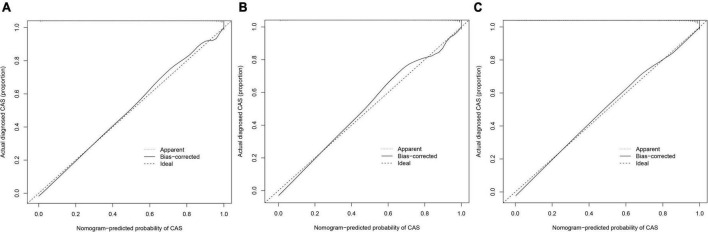
Age, body mass index, diastolic blood pressure, white blood cell count, mean platelet volume, alanine transaminase, aspartate transaminase, and gamma-glutamyl transferase were identified as independent risk factors for CAS. In the training, internal validation, and external validation sets, the risk model showed good discriminatory power with C-indices of 0.961 (0.953-0.969), 0.953 (0.939-0.967), and 0.930 (0.920-0.940), respectively, and excellent calibration. The results of DCA showed that the prediction model could be beneficial when the risk threshold probabilities were 1-100% in all sets. Finally, a network computer (dynamic nomogram) was developed to facilitate the physicians' clinical operations. The website is https://nbuhgq.shinyapps.io/DynNomapp/.
The development of risk models contributes to the early identification and prevention of CAS, which is important for preventing and reducing adverse cardiovascular and cerebrovascular events.
本研究旨在确定颈动脉粥样硬化(CAS)的独立危险因素,并构建和验证基于中国人群的CAS风险预测模型。
这项回顾性研究纳入了2020年在中国宁波镇海炼化医院接受健康检查(包括颈动脉超声检查)的4570名中国成年人。所有参与者按7:3的比例随机分配到训练集和验证集。使用多因素逻辑回归分析确定与CAS相关的独立危险因素。采用最小绝对收缩和选择算子结合10倍交叉验证筛选特征变量,并绘制列线图以展示风险预测模型。使用C指数、受试者工作特征曲线、校准图和决策曲线分析(DCA)来评估风险模型的区分度、校准度和临床适用性。
年龄、体重指数、舒张压、白细胞计数、平均血小板体积、丙氨酸转氨酶、天冬氨酸转氨酶和γ-谷氨酰转移酶被确定为CAS的独立危险因素。在训练集、内部验证集和外部验证集中,风险模型显示出良好的区分能力,C指数分别为0.961(0.953 - 0.969)、0.953(0.939 - 0.967)和0.930(0.920 - 0.940),并且校准良好。DCA结果表明,当风险阈值概率在所有数据集中为1 - 100%时,预测模型可能有益。最后,开发了一个网络计算机程序(动态列线图)以方便医生的临床操作。网站为https://nbuhgq.shinyapps.io/DynNomapp/。
风险模型的开发有助于早期识别和预防CAS,这对于预防和减少心血管和脑血管不良事件具有重要意义。