Penn Medicine Nudge Unit, University of Pennsylvania Health System, Philadelphia, PA, United States.
Department of Psychiatry, Perelman School of Medicine, University of Pennsylvania, Philadelphia, PA, United States.
Front Public Health. 2022 Aug 2;10:872746. doi: 10.3389/fpubh.2022.872746. eCollection 2022.
Implementation mapping is a systematic, collaborative, and contextually-attentive method for developing implementation strategies. As an exemplar, we applied this method to strategy development for Managed Problem Solving Plus (MAPS+), an adapted evidence-based intervention for HIV medication adherence and care retention that will be delivered by community health workers and tested in an upcoming trial.
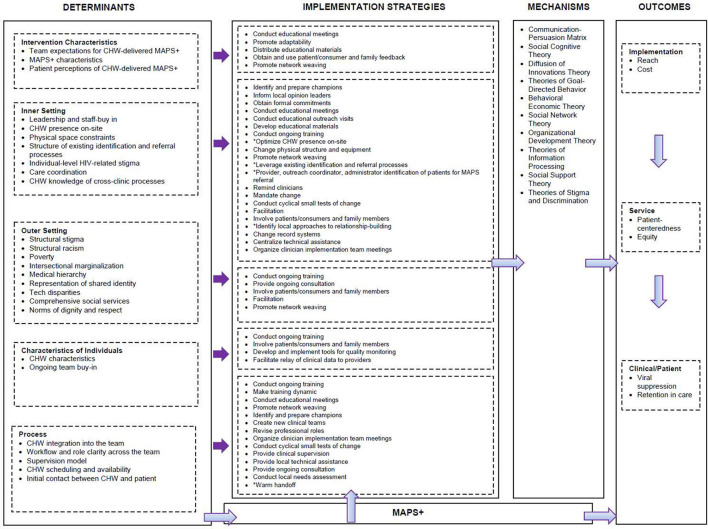
In Step 1: Conduct Needs Assessment, we interviewed 31 stakeholders to identify determinants of MAPS+ implementation in 13 clinics serving people with HIV in Philadelphia County. In Step 2: Develop Logic Model, we used these determinants as inputs for a working logic model guided by the Consolidated Framework for Implementation Research. In Step 3: Operationalize Implementation Strategies, our team held a virtual stakeholder meeting to confirm determinants. We synthesized stakeholder feedback, then identified implementation strategies that conceptually matched to determinants using the Expert Recommendations for Implementing Change taxonomy. Next, we operationalized implementation strategies with specific examples for clinic settings. We linked strategies to behavior change theories to allow for a mechanistic understanding. We then held a second virtual stakeholder meeting to present the implementation menu for feedback and glean generalizable insights for how these strategies could be operationalized in each stakeholder's clinic. In Step 4: Protocolize Strategies, we incorporated stakeholder feedback and finalized the implementation strategy menu.
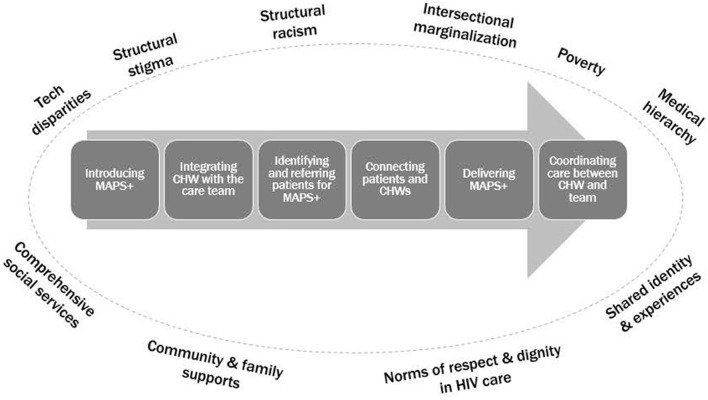
Implementation mapping produced a menu of 39 strategies including , and . The process of implementation mapping generated key challenges for implementation strategy development: lack of implementation strategies targeting the outer setting (i.e., sociopolitical context); tension between a one-size-fits-all and individualized approach for all clinics; conceptual confusion between facilitators and strategies; and challenges in translating the implementation science lexicon for partners.
This case exemplar advances both MAPS+ implementation and implementation science methods by furthering our understanding of the use of implementation mapping to develop strategies that enhance uptake of evidence-based interventions. The implementation menu will inform MAPS+ deployment across Philadelphia in an upcoming hybrid trial. We will carry out Step 5: Test Strategies to test the effectiveness and implementation of MAPS+.
实施映射是一种系统的、协作的、注重情境的方法,用于制定实施策略。作为一个范例,我们将这种方法应用于管理问题解决加(MAPS+)的策略制定中,MAPS+是一种经过改编的基于证据的干预措施,用于提高 HIV 药物依从性和护理保留率,将由社区卫生工作者提供,并在即将进行的试验中进行测试。
在步骤 1:进行需求评估中,我们采访了 31 位利益相关者,以确定在费城县为 HIV 感染者提供服务的 13 个诊所中实施 MAPS+的决定因素。在步骤 2:制定逻辑模型中,我们使用这些决定因素作为输入,为一个工作逻辑模型提供指导,该模型由实施研究的综合框架指导。在步骤 3:实施策略的实施中,我们的团队举行了一次虚拟利益相关者会议,以确认决定因素。我们综合了利益相关者的反馈意见,然后使用专家建议实施变革分类法,根据决定因素确定了在概念上与之匹配的实施策略。接下来,我们为诊所环境制定了具体的实施策略示例。我们将策略与行为改变理论联系起来,以允许进行机制理解。然后,我们举行了第二次虚拟利益相关者会议,展示实施菜单以征求反馈意见,并从中汲取这些策略如何在每个利益相关者的诊所中实施的可推广见解。在步骤 4:策略的制定中,我们纳入了利益相关者的反馈意见,并最终确定了实施策略菜单。
实施映射产生了一个包含 39 种策略的菜单,包括、、、。实施映射过程为实施策略的制定带来了关键挑战:缺乏针对外部环境(即社会政治背景)的实施策略;所有诊所采用一刀切和个性化方法之间的紧张关系;促进者和策略之间的概念混淆;以及为合作伙伴翻译实施科学词汇的挑战。
这个案例范例通过进一步了解使用实施映射来制定策略以增强对循证干预措施的采用,为 MAPS+的实施和实施科学方法的发展提供了支持。实施菜单将为即将进行的混合试验中在费城的 MAPS+部署提供信息。我们将进行步骤 5:测试策略,以测试 MAPS+的有效性和实施情况。