Macaulay Timothy R, Hegarty Amy, Yan Lirong, Duncan Dominique, Pa Judy, Kutch Jason J, La Rocca Marianna, Lane Christianne J, Schroeder E Todd
Division of Biokinesiology and Physical Therapy, Ostrow School of Dentistry, University of Southern California, Los Angeles, CA, USA.
Mark and Mary Stevens Neuroimaging and Informatics Institute, Department of Neurology, Keck School of Medicine, University of Southern California, Los Angeles, CA, USA.
Neurosci Insights. 2022 Aug 13;17:26331055221119441. doi: 10.1177/26331055221119441. eCollection 2022.
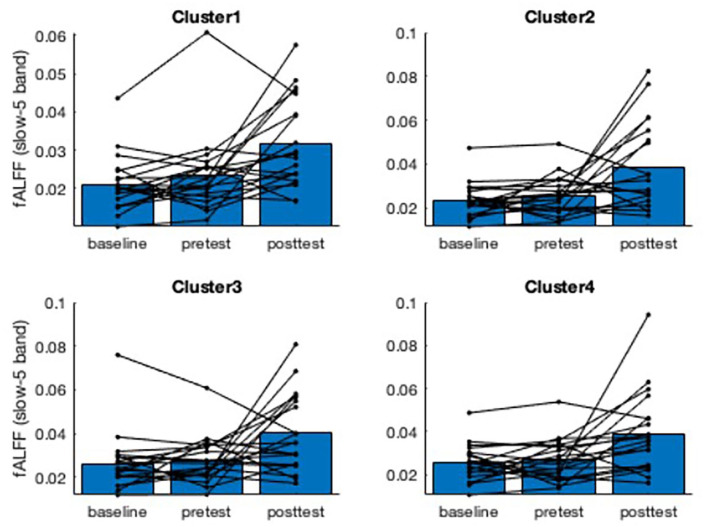
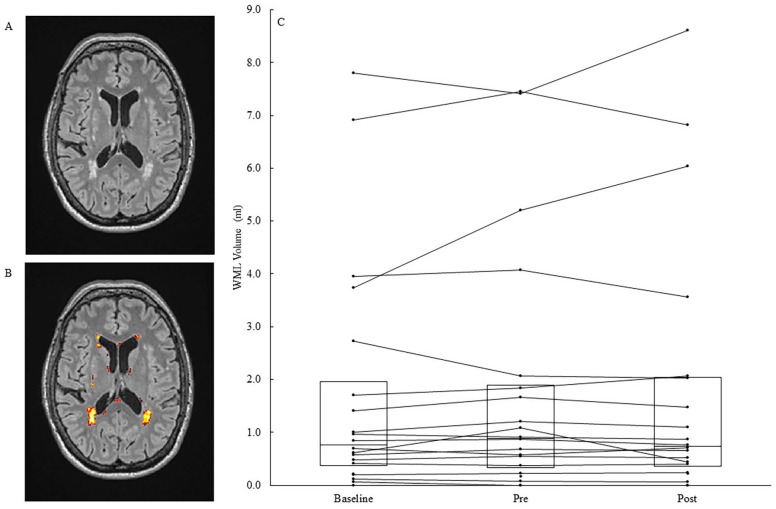
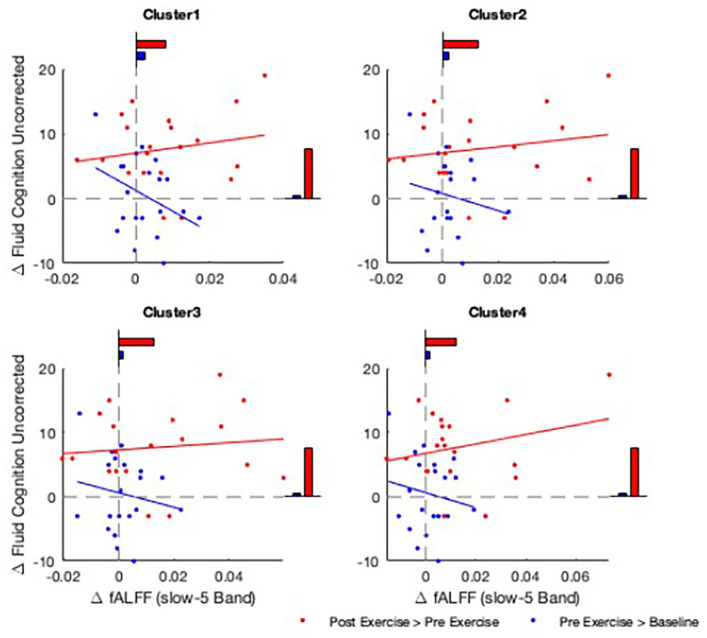
Resistance training is a promising strategy to promote healthy cognitive aging; however, the brain mechanisms by which resistance training benefits cognition have yet to be determined. Here, we examined the effects of a 12-week resistance training program on resting brain activity and cerebrovascular function in 20 healthy older adults (14 females, mean age 69.1 years). In this single group clinical trial, multimodal 3 T magnetic resonance imaging was performed at 3 time points: baseline (preceding a 12-week control period), pre-intervention, and post-intervention. Along with significant improvements in fluid cognition ( = 1.27), 4 significant voxelwise clusters were identified for decreases in resting brain activity after the intervention (Cerebellum, Right Middle Temporal Gyrus, Left Inferior Parietal Lobule, and Right Inferior Parietal Lobule), but none were identified for changes in resting cerebral blood flow. Using a separate region of interest approach, we provide estimates for improved cerebral blood flow, compared with declines over the initial control period, in regions associated with cognitive impairment, such as hippocampal blood flow ( = 0.40), and posterior cingulate blood flow ( = 0.61). Finally, resistance training had a small countermeasure effect on the age-related progression of white matter lesion volume (rank-biserial = -0.22), a biomarker of cerebrovascular disease. These proof-of-concept data support larger trials to determine whether resistance training can attenuate or even reverse salient neurodegenerative processes.
抗阻训练是促进健康认知老化的一种有前景的策略;然而,抗阻训练有益于认知的大脑机制尚未确定。在此,我们研究了一项为期12周的抗阻训练计划对20名健康老年人(14名女性,平均年龄69.1岁)静息脑活动和脑血管功能的影响。在这项单组临床试验中,在3个时间点进行了多模态3T磁共振成像:基线(在12周对照期之前)、干预前和干预后。随着流体认知能力显著改善(=1.27),干预后静息脑活动降低的4个显著体素簇被识别出来(小脑、右侧颞中回、左侧顶下小叶和右侧顶下小叶),但静息脑血流量的变化未识别出显著簇。使用单独的感兴趣区域方法,我们提供了与初始对照期下降相比,在与认知障碍相关区域(如海马血流量(=0.40)和后扣带回血流量(=0.61))改善脑血流量的估计值。最后,抗阻训练对作为脑血管疾病生物标志物的白质病变体积的年龄相关进展有较小的对抗作用(等级二列相关=-0.22)。这些概念验证数据支持进行更大规模的试验,以确定抗阻训练是否可以减弱甚至逆转显著的神经退行性过程。