Department of Neurology, Washington University School of Medicine, 660 S. Euclid Avenue, Box 8111, St. Louis, MO, 63110, USA.
Department of Radiology, Washington University School of Medicine, St. Louis, MO, 63110, USA.
Acta Neuropathol Commun. 2022 Aug 19;10(1):120. doi: 10.1186/s40478-022-01428-2.
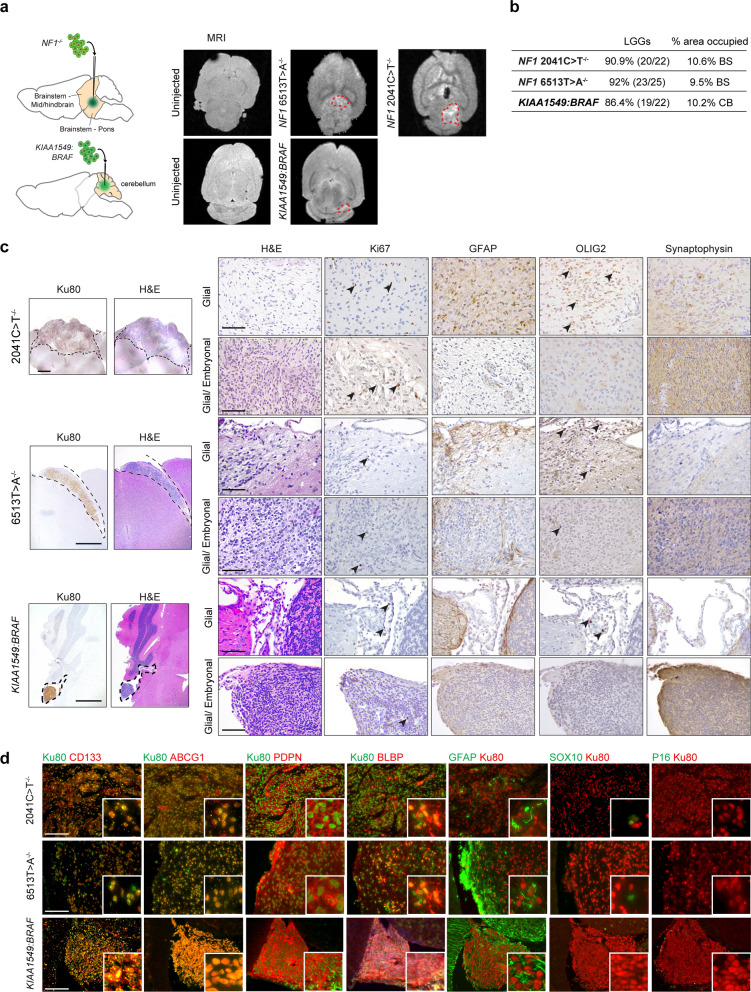
A major obstacle to identifying improved treatments for pediatric low-grade brain tumors (gliomas) is the inability to reproducibly generate human xenografts. To surmount this barrier, we leveraged human induced pluripotent stem cell (hiPSC) engineering to generate low-grade gliomas (LGGs) harboring the two most common pediatric pilocytic astrocytoma-associated molecular alterations, NF1 loss and KIAA1549:BRAF fusion. Herein, we identified that hiPSC-derived neuroglial progenitor populations (neural progenitors, glial restricted progenitors and oligodendrocyte progenitors), but not terminally differentiated astrocytes, give rise to tumors retaining LGG histologic features for at least 6 months in vivo. Additionally, we demonstrated that hiPSC-LGG xenograft formation requires the absence of CD4 T cell-mediated induction of astrocytic Cxcl10 expression. Genetic Cxcl10 ablation is both necessary and sufficient for human LGG xenograft development, which additionally enables the successful long-term growth of patient-derived pediatric LGGs in vivo. Lastly, MEK inhibitor (PD0325901) treatment increased hiPSC-LGG cell apoptosis and reduced proliferation both in vitro and in vivo. Collectively, this study establishes a tractable experimental humanized platform to elucidate the pathogenesis of and potential therapeutic opportunities for childhood brain tumors.
鉴定改善小儿低级别脑肿瘤(神经胶质瘤)治疗方法的主要障碍是无法重复生成人源异种移植物。为了克服这一障碍,我们利用人类诱导多能干细胞(hiPSC)工程技术生成携带两种最常见的小儿毛细胞星形细胞瘤相关分子改变(NF1 缺失和 KIAA1549:BRAF 融合)的低级别神经胶质瘤(LGG)。在此,我们发现 hiPSC 来源的神经胶质前体细胞群体(神经祖细胞、胶质限制定殖细胞和少突胶质前体细胞),而不是终末分化的星形细胞,至少在体内 6 个月内产生保留 LGG 组织学特征的肿瘤。此外,我们证明 hiPSC-LGG 异种移植物的形成需要不存在 CD4 T 细胞介导的星形细胞 Cxcl10 表达诱导。Cxcl10 的遗传缺失对于人类 LGG 异种移植物的发育是必要且充分的,这还使得患者来源的小儿 LGG 在体内能够成功长期生长。最后,MEK 抑制剂(PD0325901)治疗在体外和体内均增加了 hiPSC-LGG 细胞的凋亡并减少了增殖。总的来说,这项研究建立了一种可行的实验性人类化平台,以阐明儿童脑肿瘤的发病机制和潜在的治疗机会。