Luo Hanpeng, Hu Lirong, Brito Luiz F, Dou Jinhuan, Sammad Abdul, Chang Yao, Ma Longgang, Guo Gang, Liu Lin, Zhai Liwei, Xu Qing, Wang Yachun
Laboratory of Animal Genetics, Breeding and Reproduction, Ministry of Agriculture of China, National Engineering Laboratory of Animal Breeding, College of Animal Science and Technology, China Agricultural University, No.2, Yuanmingyuanxi Road, Haidian District, Beijing, 100193, China.
Department of Animal Sciences, Purdue University, West Lafayette, IN, 47907, USA.
J Anim Sci Biotechnol. 2022 Aug 20;13(1):108. doi: 10.1186/s40104-022-00748-6.
The study of molecular processes regulating heat stress response in dairy cattle is paramount for developing mitigation strategies to improve heat tolerance and animal welfare. Therefore, we aimed to identify quantitative trait loci (QTL) regions associated with three physiological indicators of heat stress response in Holstein cattle, including rectal temperature (RT), respiration rate score (RS), and drooling score (DS). We estimated genetic parameters for all three traits. Subsequently, a weighted single-step genome-wide association study (WssGWAS) was performed based on 3200 genotypes, 151,486 phenotypic records, and 38,101 animals in the pedigree file. The candidate genes located within the identified QTL regions were further investigated through RNA sequencing (RNA-seq) analyses of blood samples for four cows collected in April (non-heat stress group) and four cows collected in July (heat stress group).
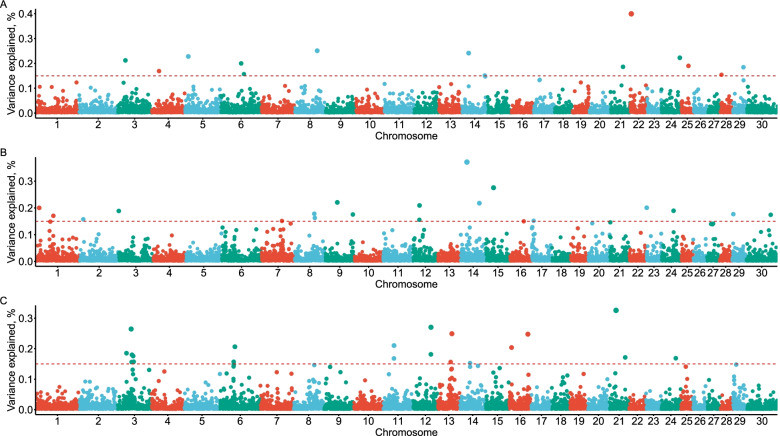
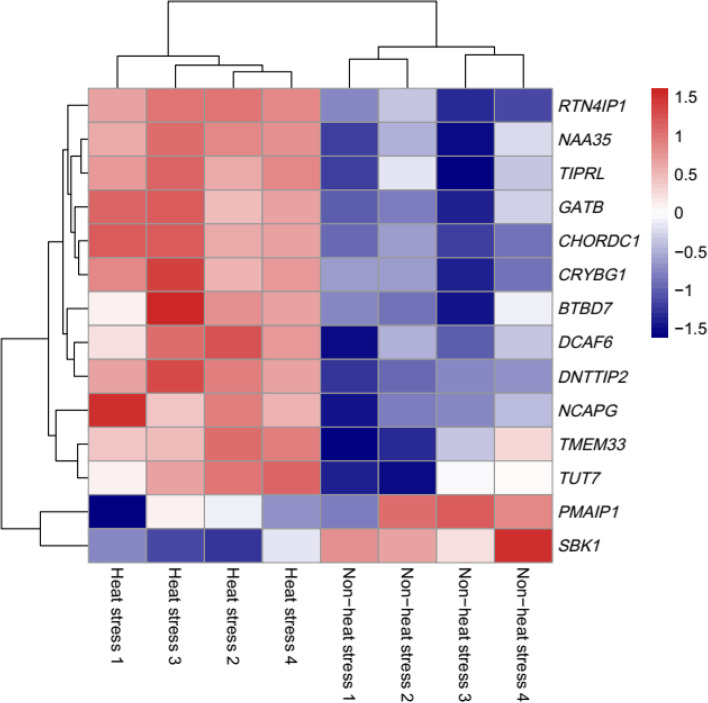
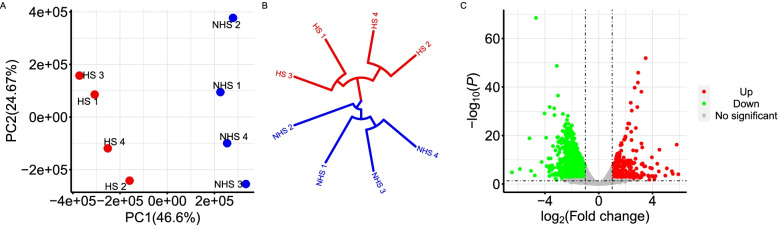
The heritability estimates for RT, RS, and DS were 0.06, 0.04, and 0.03, respectively. Fourteen, 19, and 20 genomic regions explained 2.94%, 3.74%, and 4.01% of the total additive genetic variance of RT, RS, and DS, respectively. Most of these genomic regions are located in the Bos taurus autosome (BTA) BTA3, BTA6, BTA8, BTA12, BTA14, BTA21, and BTA24. No genomic regions overlapped between the three indicators of heat stress, indicating the polygenic nature of heat tolerance and the complementary mechanisms involved in heat stress response. For the RNA-seq analyses, 2627 genes were significantly upregulated and 369 downregulated in the heat stress group in comparison to the control group. When integrating the WssGWAS, RNA-seq results, and existing literature, the key candidate genes associated with physiological indicators of heat stress in Holstein cattle are: PMAIP1, SBK1, TMEM33, GATB, CHORDC1, RTN4IP1, and BTBD7.
Physiological indicators of heat stress are heritable and can be improved through direct selection. Fifty-three QTL regions associated with heat stress indicators confirm the polygenic nature and complex genetic determinism of heat tolerance in dairy cattle. The identified candidate genes will contribute for optimizing genomic evaluation models by assigning higher weights to genetic markers located in these regions as well as to the design of SNP panels containing polymorphisms located within these candidate genes.
研究调节奶牛热应激反应的分子过程对于制定缓解策略以提高耐热性和动物福利至关重要。因此,我们旨在鉴定与荷斯坦奶牛热应激反应的三个生理指标相关的数量性状位点(QTL)区域,包括直肠温度(RT)、呼吸频率评分(RS)和流涎评分(DS)。我们估计了这三个性状的遗传参数。随后,基于3200个基因型、151486个表型记录和系谱文件中的38101头动物进行了加权单步全基因组关联研究(WssGWAS)。通过对4头4月采集的奶牛(非热应激组)和4头7月采集的奶牛(热应激组)的血液样本进行RNA测序(RNA-seq)分析,进一步研究了位于鉴定出的QTL区域内的候选基因。
RT、RS和DS的遗传力估计值分别为0.06、0.04和0.03。14个、19个和20个基因组区域分别解释了RT、RS和DS总加性遗传方差的2.94%、3.74%和4.01%。这些基因组区域大多位于牛的常染色体(BTA)BTA3、BTA6、BTA8、BTA12、BTA14、BTA21和BTA24上。热应激的三个指标之间没有重叠的基因组区域,这表明耐热性的多基因性质以及热应激反应中涉及的互补机制。对于RNA-seq分析,与对照组相比,热应激组中有2627个基因显著上调,369个基因下调。综合WssGWAS、RNA-seq结果和现有文献,与荷斯坦奶牛热应激生理指标相关的关键候选基因有:PMAIP1、SBK1、TMEM33、GATB、CHORDC1、RTN4IP1和BTBD7。
热应激的生理指标是可遗传的,可以通过直接选择来改善。与热应激指标相关的53个QTL区域证实了奶牛耐热性的多基因性质和复杂的遗传决定机制。鉴定出的候选基因将有助于优化基因组评估模型,方法是对位于这些区域的遗传标记赋予更高的权重,以及设计包含这些候选基因内多态性的SNP面板。