Department of Psychology, Utrecht University, Utrecht, The Netherlands.
Human-Technology Interaction Group at Eindhoven University of Technology, Eindhoven, The Netherlands.
BMC Public Health. 2022 Aug 20;22(1):1588. doi: 10.1186/s12889-022-13977-1.
Since the outbreak of the COVID-19 pandemic, physical distancing and hand washing have been used as effective means to reduce virus transmission in the Netherlands. However, these measures pose a societal challenge as they require people to change their customary behaviours in various contexts. The science of habit formation is potentially useful for informing policy-making in public health, but the current literature largely overlooked the role of habit in predicting and explaining these preventive behaviours. Our research aimed to describe habit formation processes of physical distancing and hand washing and to estimate the influences of habit strength and intention on behavioural adherence.
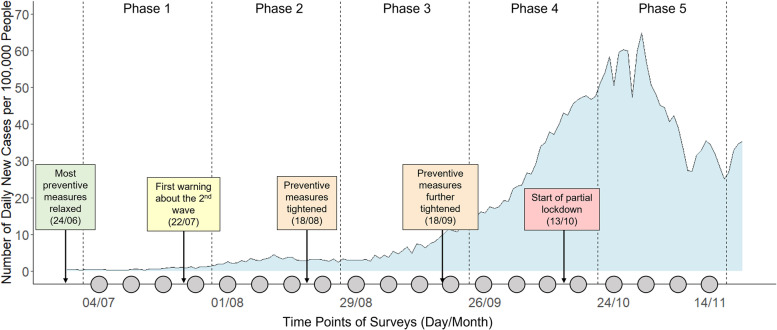
A longitudinal survey was conducted between July and November 2020 on a representative Dutch sample (n = 800). Respondents reported their intentions, habit strengths, and adherence regarding six context-specific preventive behaviours on a weekly basis. Temporal developments of the measured variables were visualized, quantified, and mapped onto five distinct phases of the pandemic. Regression models were used to test the effects of intention, habit strength, and their interaction on behavioural adherence.
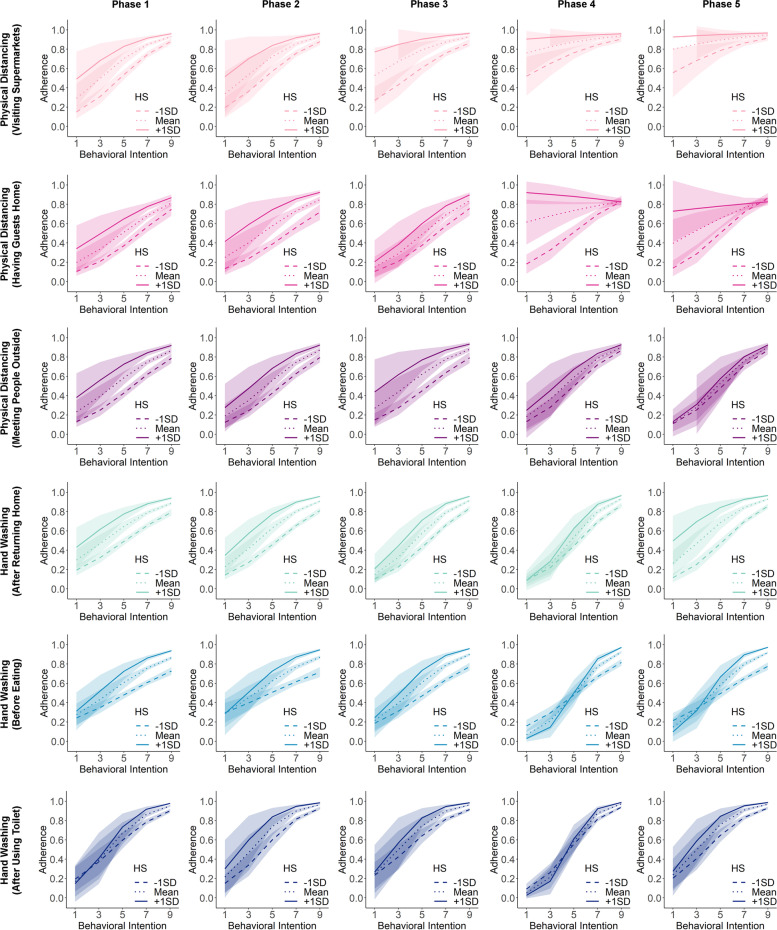
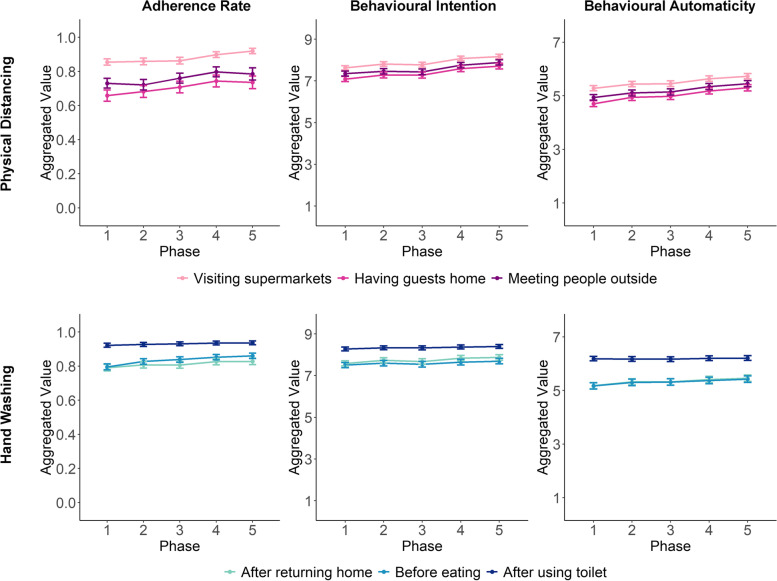
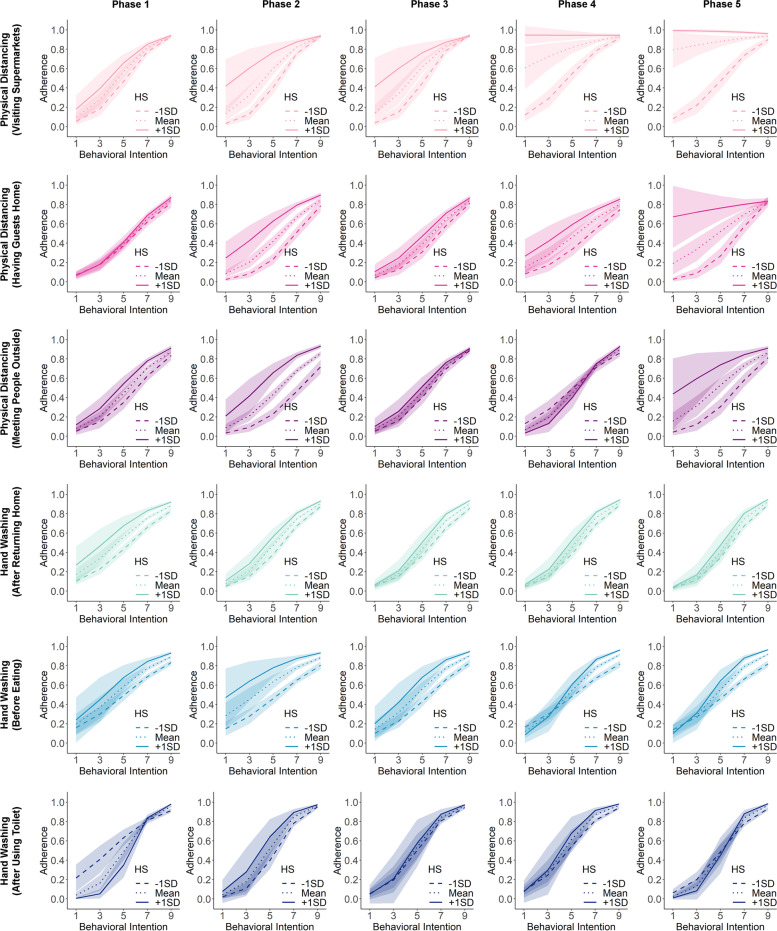
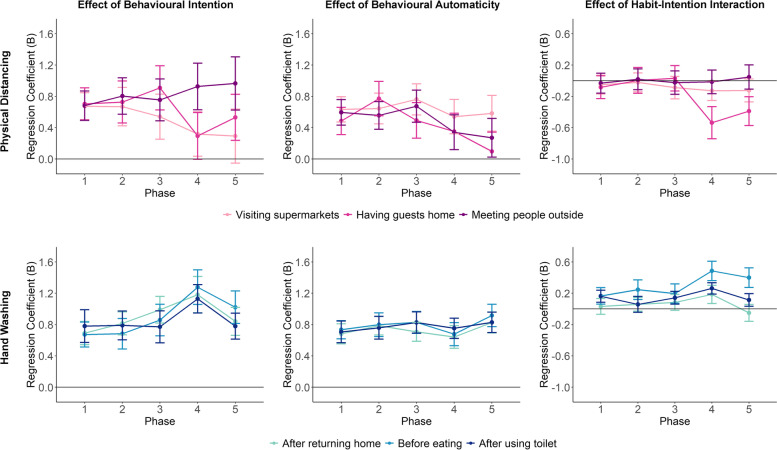
Dutch respondents generally had strong intentions to adhere to all preventive measures and their adherence rates were between 70% and 90%. They also self-reported to experience their behaviours as more automatic over time, and this increasing trend in habit strength was more evident for physical-distancing than for hand washing behaviours. For all six behaviours, both intention and habit strength predicted subsequent adherence (all ps < 2e-16). In addition, the predictive power of intention decreased over time and was weaker for respondents with strong habits for physical distancing when visiting supermarkets (B = -0.63, p <.0001) and having guests at home (B = -0.54, p <.0001) in the later phases of the study, but not for hand washing.
People's adaptations to physical-distancing and hand washing measures involve both intentional and habitual processes. For public health management, our findings highlight the importance of using contextual cues to promote habit formation, especially for maintaining physical-distancing practices. For habit theories, our study provides a unique dataset that covers multiple health behaviours in a critical real-world setting.
自 COVID-19 大流行爆发以来,保持身体距离和勤洗手已被用作减少荷兰病毒传播的有效手段。然而,这些措施给社会带来了挑战,因为它们要求人们在各种情况下改变他们的习惯行为。习惯形成科学对于为公共卫生政策制定提供信息可能是有用的,但当前的文献在很大程度上忽略了习惯在预测和解释这些预防行为方面的作用。我们的研究旨在描述保持身体距离和勤洗手的习惯形成过程,并估计习惯强度和意图对行为坚持的影响。
2020 年 7 月至 11 月期间,我们对一个具有代表性的荷兰样本(n = 800)进行了纵向调查。受访者每周报告他们在六个特定于情境的预防行为方面的意图、习惯强度和遵守情况。可视化、量化了测量变量的时间发展,并将其映射到大流行的五个不同阶段。使用回归模型来检验意图、习惯强度及其相互作用对行为坚持的影响。
荷兰受访者普遍强烈希望遵守所有预防措施,他们的遵守率在 70%到 90%之间。他们还自我报告说,随着时间的推移,他们的行为变得更加自动,而这种习惯强度的上升趋势在保持身体距离方面比在勤洗手方面更为明显。对于所有六种行为,意图和习惯强度都预测了随后的遵守情况(所有 p 值均<2e-16)。此外,意图的预测力随时间减弱,对于在研究后期访问超市(B = -0.63,p <.0001)和在家中接待客人(B = -0.54,p <.0001)时具有强烈习惯的受访者来说,意图的预测力更弱,而不是在勤洗手方面。
人们对保持身体距离和勤洗手措施的适应既涉及有意识的过程,也涉及习惯性的过程。对于公共卫生管理,我们的研究结果强调了利用情境线索促进习惯形成的重要性,特别是对于保持保持身体距离的做法。对于习惯理论,我们的研究提供了一个独特的数据集,涵盖了在关键现实环境中的多种健康行为。