Department of Psychology, Northumbria University, Newcastle upon Tyne, UK.
Department of Arts, Northumbria University, Newcastle upon Tyne, UK.
J Glob Health. 2022 Jul 22;12:05018. doi: 10.7189/jogh.12.05018.
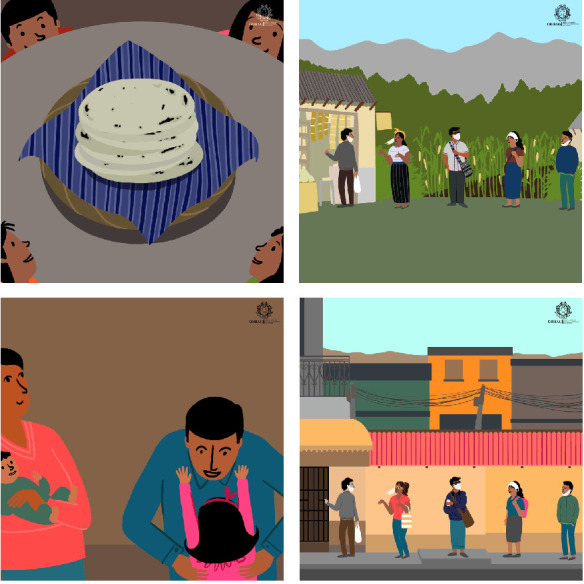
Effective health communication to encourage participation in COVID-19 preventive behaviours is crucial in helping mitigate viral spread. Intentions and beliefs are known determinants of adherence to these behaviours, therefore, health communication interventions based on these constructs may be effective. Visual languageless messages can be particularly useful in multilingual countries, where text-based communications can limit message exposure. This pre- and post-intervention study sought to identify the effect of exposure to languageless animated messages, presented in the Graphic Interchange Format (GIF), communicating COVID-19 preventive behaviours (physical distancing, handwashing, and mask-wearing) on behavioural intentions and beliefs.
Between February and March 2021, a nationally representative sample of 308 Guatemalan adults completed this online survey experiment. Self-reported performance of preventive behaviours, understanding of COVID-19 transmission risk, as well as intentions, self-efficacy, and outcome expectancy beliefs about preventive behaviours were assessed at baseline. Participants were then exposed to a random combination of three of four possible GIFs in random presentation order. Following exposure to each GIF, intentions, self-efficacy, and outcome expectancy beliefs were reassessed.
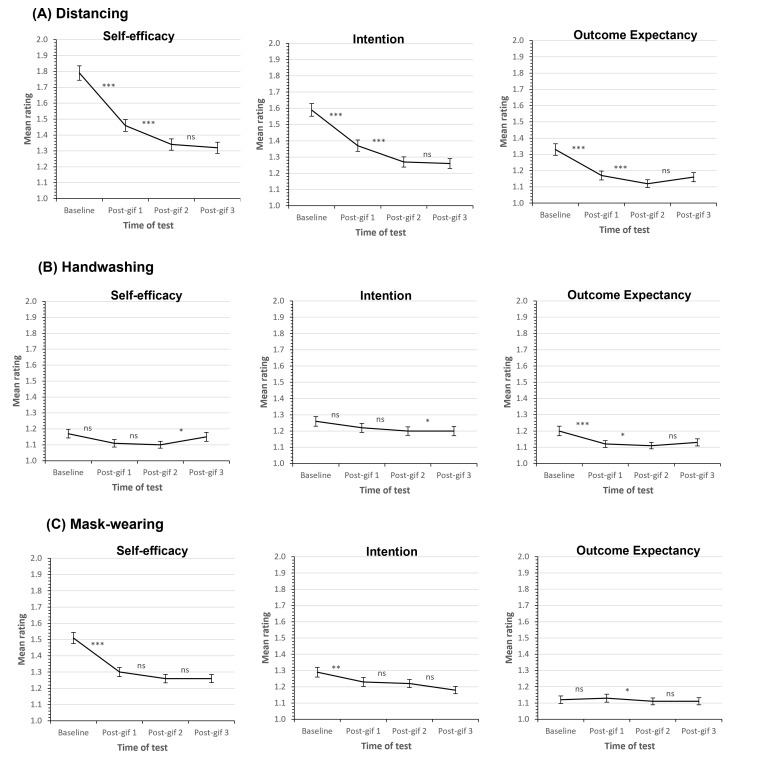
In terms of main effects, GIF exposure was significantly associated with improved intentions, self-efficacy, and outcome expectancy beliefs in relation to physical distancing; intentions and outcome expectancy beliefs in relation to handwashing; and intentions and self-efficacy in relation to mask-wearing. These associations were not dependent on the combination of the three of four possible GIFs presented. Pairwise comparisons revealed that observed improvements in scores were most pronounced from baseline to the first GIF exposure and reduced thereafter.
Exposure to languageless GIFs communicating COVID-19 preventive behaviours is associated with improvements in key social-cognitive determinants of those behaviours. Dosage of GIF exposure and durability of effects are issues that warrant further attention so we can better understand the conditions and point at which benefits are maximised. Moreover, the effect on behavioural adherence is yet to be determined. GIFs provide a valuable means to widely disseminate health messages via social media during public health crises, such as COVID-19. When these messages are languageless, the potential reach of dissemination can be maximised.
有效的健康传播对于鼓励人们参与 COVID-19 预防行为至关重要,这有助于减轻病毒传播。意图和信念是决定人们是否遵守这些行为的已知因素,因此,基于这些结构的健康传播干预可能是有效的。无语言的视觉信息在多语言国家可能特别有用,因为基于文本的交流可能会限制信息的传播。这项预-后干预研究旨在确定接触无语言动画信息(以图形交换格式 (GIF) 呈现)对 COVID-19 预防行为(身体距离、洗手和戴口罩)的行为意图和信念的影响。
在 2021 年 2 月至 3 月期间,一项全国代表性的 308 名危地马拉成年人的在线调查实验完成了这项研究。在基线时评估了预防行为的自我报告表现、对 COVID-19 传播风险的理解,以及对预防行为的意图、自我效能和结果预期信念。然后,参与者随机接触四个可能的 GIF 中的三个,以随机呈现顺序。在接触每个 GIF 之后,重新评估意图、自我效能和结果预期信念。
就主要影响而言,与身体距离相关的 GIF 接触与改善意图、自我效能和结果预期信念显著相关;与洗手相关的意图和结果预期信念;与戴口罩相关的意图和自我效能。这些关联不依赖于呈现的四个可能的 GIF 中的三个的组合。成对比较显示,与基线相比,从第一次 GIF 接触到观察到的评分提高最为显著,此后有所降低。
接触传达 COVID-19 预防行为的无语言 GIF 与这些行为的关键社会认知决定因素的改善有关。GIF 接触的剂量和效果的持久性是需要进一步关注的问题,以便我们更好地了解条件和最大限度提高效益的点。此外,行为依从性的影响仍有待确定。GIF 为在 COVID-19 等公共卫生危机期间通过社交媒体广泛传播健康信息提供了有价值的手段。当这些信息是无语言时,传播的潜在范围可以最大化。