Department of Science and Education, 47862Affiliated People's Hospital of Ningbo University, Ningbo, China.
Department of Preventive Medicine, School of Medicine, 47862Ningbo University, Ningbo, China.
Diab Vasc Dis Res. 2022 Jul-Aug;19(4):14791641221122918. doi: 10.1177/14791641221122918.
We aimed to explore the shared and specific signalling pathways involved in diabetic retinopathy (DR), diabetic peripheral neuropathy (DPN) and diabetic nephropathy (DN).
Differentially expressed mRNAs and lncRNAs were identified by high-throughput sequencing. Subsequently, functional enrichment analysis, protein-protein interaction (PPI) analysis and lncRNAs-mRNAs networks were conducted to determine the pathogenic mechanisms underlying DR, DPN and DN.
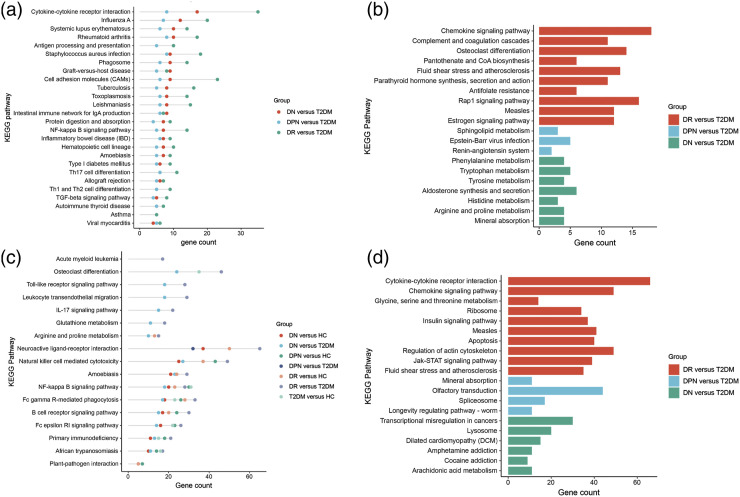
Twenty-six biological pathways were shared among DR, DPN and DN groups compared to the type 2 diabetes mellitus (T2DM) group without complications, and most of the shared pathways and core proteins were involved in immune and inflammatory responses of microvascular damage. Cytokine‒cytokine receptor interactions and chemokine signalling pathway were the most significant and specific pathways for DR, and the lncRNA‒mRNA regulatory networks affected DR by targeting these pathways. Sphingolipid metabolism and neuroactive ligand-receptor pathways were found to be specific for the pathogenesis of DPN. Moreover, multiple amino acid metabolic pathways were involved in the occurrence and progression of DN.
Diabetic retinopathy, DPN and DN exhibited commonality and heterogeneity simultaneously. The shared pathologic mechanisms underlying these diabetic complications are involved in diabetic microvascular damage via immune and inflammatory pathways. Our findings predict several biomarkers and therapeutic targets for these diabetic complications.
探讨糖尿病视网膜病变(DR)、糖尿病周围神经病变(DPN)和糖尿病肾病(DN)共有的和特异的信号通路。
通过高通量测序鉴定差异表达的 mRNAs 和 lncRNAs。随后,进行功能富集分析、蛋白质-蛋白质相互作用(PPI)分析和 lncRNAs-mRNAs 网络分析,以确定 DR、DPN 和 DN 的发病机制。
与无并发症的 2 型糖尿病(T2DM)组相比,DR、DPN 和 DN 组共有 26 个生物学途径,大多数共有途径和核心蛋白参与微血管损伤的免疫和炎症反应。细胞因子-细胞因子受体相互作用和趋化因子信号通路是 DR 最显著和特异的途径,lncRNA-mRNA 调控网络通过靶向这些途径影响 DR。鞘脂代谢和神经活性配体-受体途径是 DPN 发病机制的特异性途径。此外,多种氨基酸代谢途径参与了 DN 的发生和发展。
DR、DPN 和 DN 同时表现出共性和异质性。这些糖尿病并发症的共同发病机制涉及通过免疫和炎症途径导致的糖尿病微血管损伤。我们的研究结果预测了这些糖尿病并发症的一些生物标志物和治疗靶点。