Department of Infectious Diseases, Cairns Hospital, Cairns, QLD, 4870, Australia.
Department of Infectious Diseases, Central Clinical School, Monash University, Melbourne, VIC, 3004, Australia.
BMC Infect Dis. 2022 Aug 24;22(1):704. doi: 10.1186/s12879-022-07687-7.
Infections caused by Klebsiella oxytoca are the second most common cause of Klebsiella infections in humans. Most studies have focused on K. oxytoca outbreaks and few have examined the broader clinical context of K. oxytoca.
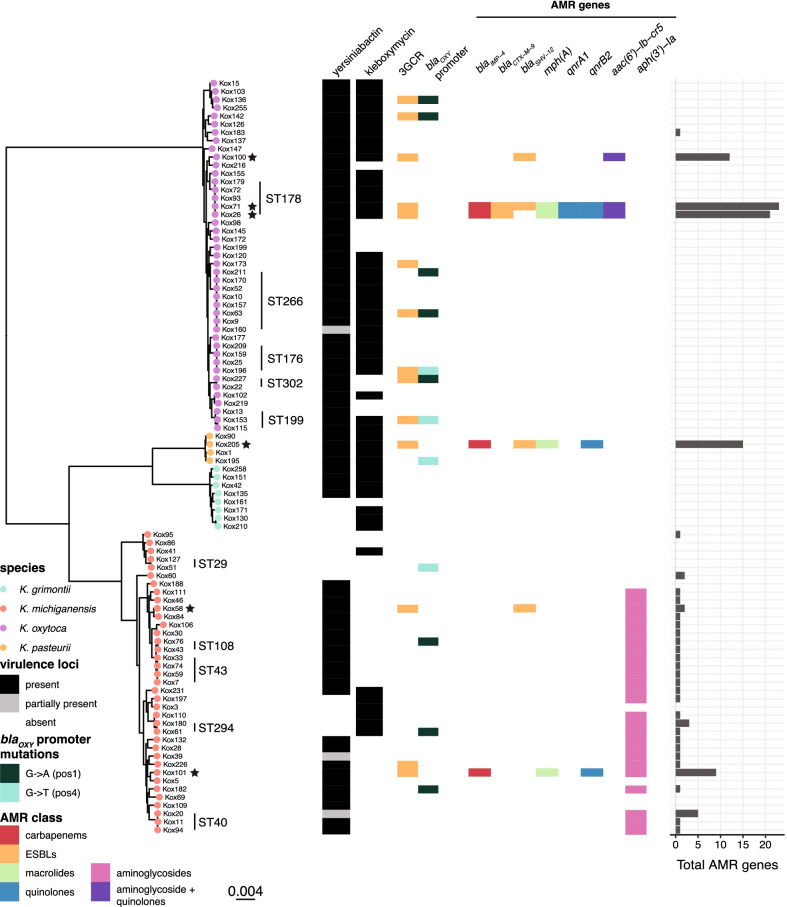
Here, we collected all clinical isolates identified as K. oxytoca in a hospital microbiological diagnostic lab across a 15-month period (n = 239). Whole genome sequencing was performed on a subset of 92 isolates (all invasive, third-generation cephalosporin resistant (3GCR) and non-urinary isolates collected > 48 h after admission), including long-read sequencing on a further six isolates with extended-spectrum beta-lactamase or carbapenemase genes.
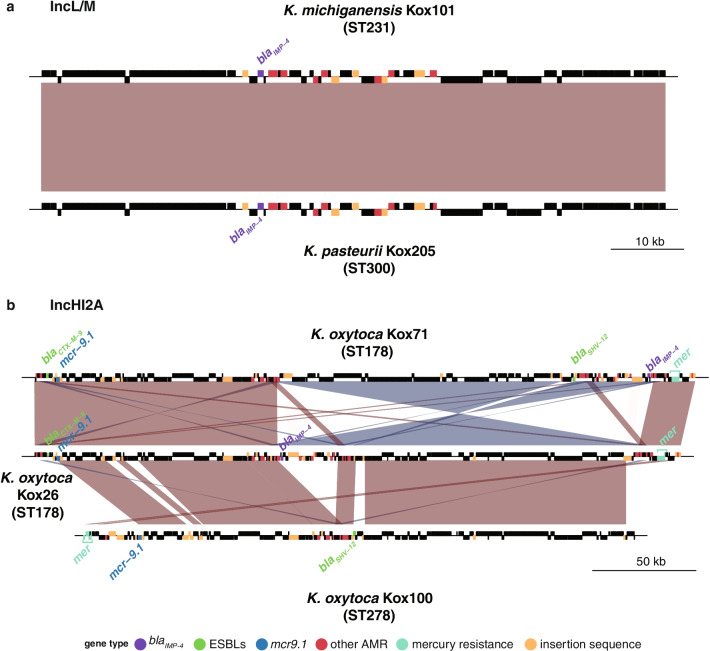
The majority of isolates were sensitive to antimicrobials, however 22 isolates were 3GCR, of which five were also carbapenem resistant. Genomic analyses showed those identified as K. oxytoca by the clinical laboratory actually encompassed four distinct species (K. oxytoca, Klebsiella michiganensis, Klebsiella grimontii and Klebsiella pasteurii), referred to as the K. oxytoca species complex (KoSC). There was significant diversity within the population, with only 10/67 multi-locus sequence types (STs) represented by more than one isolate. Strain transmission was rare, with only one likely event identified. Six isolates had extended spectrum beta-lactamase (bla and/or bla) or carbapenemase (bla) genes. One pair of K. michiganensis and K. pasteurii genomes carried identical bla IncL/M plasmids, indicative of plasmid transmission.
Whilst antimicrobial resistance was rare, the resistance plasmids were similar to those found in other Enterobacterales, demonstrating that KoSC has access to the same plasmid reservoir and thus there is potential for multi-drug resistance. Further genomic studies are required to improve our understanding of the KoSC population and facilitate investigation into the attributes of successful nosocomial isolates.
产酸克雷伯菌引起的感染是人类克雷伯菌感染的第二大常见原因。大多数研究都集中在产酸克雷伯菌的爆发上,很少有研究检查产酸克雷伯菌更广泛的临床背景。
在这里,我们收集了在医院微生物诊断实验室在 15 个月期间鉴定为产酸克雷伯菌的所有临床分离株(n=239)。对 92 株分离株的亚组进行全基因组测序(所有侵袭性、第三代头孢菌素耐药(3GCR)和非尿分离株均在入院后>48 小时收集),包括对 6 株具有扩展谱β-内酰胺酶或碳青霉烯酶基因的分离株进行长读测序。
大多数分离株对抗菌药物敏感,但 22 株为 3GCR,其中 5 株也对碳青霉烯类耐药。基因组分析表明,临床实验室鉴定为产酸克雷伯菌的实际上包含四个不同的种(产酸克雷伯菌、密歇根克雷伯菌、格里蒙氏克雷伯菌和粘质沙雷氏菌),称为产酸克雷伯菌种复合体(KoSC)。该群体内存在显著的多样性,只有 10/67 个多位点序列型(ST)由超过一个分离株代表。菌株传播很少,仅鉴定出一个可能的事件。6 株分离株具有扩展谱β-内酰胺酶(bla 和/或 bla)或碳青霉烯酶(bla)基因。一对密歇根克雷伯菌和粘质沙雷氏菌基因组携带相同的 bla IncL/M 质粒,表明质粒的传播。
虽然抗药性罕见,但耐药质粒与其他肠杆菌科中发现的质粒相似,表明 KoSC 可以利用相同的质粒库,因此存在多药耐药的潜力。需要进一步的基因组研究来提高我们对 KoSC 群体的理解,并促进对成功医院分离株的属性的研究。