Australian Centre for Health Services Innovation, Centre for Healthcare Transformation, School of Public Health and Social Work, Faculty of Health, Queensland University of Technology, Kelvin Grove, 4059, QLD, Australia.
BMC Health Serv Res. 2022 Aug 24;22(1):1079. doi: 10.1186/s12913-022-08464-7.
While involving users in healthcare decision-making has become increasingly common and important, there is a lack of knowledge about how to best design community-based health screening programs. Reviews of methods that incorporate discrete choice experiments (DCEs) are scarce, particularly for non-cancer illnesses like cardiovascular disease, diabetes and liver disease. We provide an overview of currently available applications and methods available by using DCEs in health screening programs, for chronic conditions.
A scoping review was undertaken, where four electronic databases were searched for key terms to identify eligible DCE studies related to community health screening. We included studies that met a pre-determined criteria, including being published between 2011 and 2021, in English and reported findings on human participants. Data were systematically extracted, tabulated, and summarised in a narrative review.
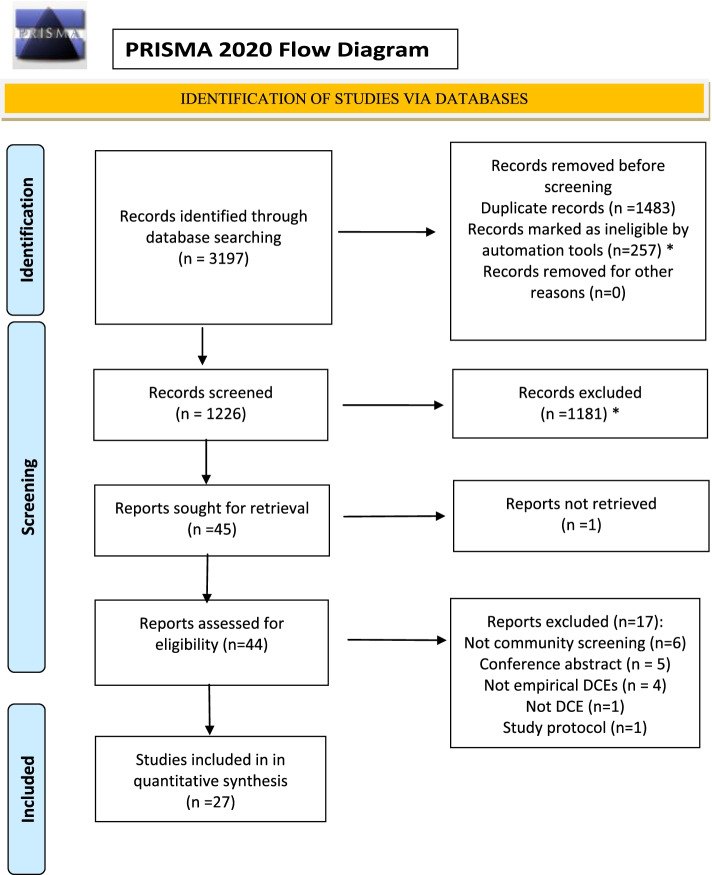
A total of 27 studies that used a DCE to elicit preferences for cancer (n = 26) and cardiovascular disease screening (n = 1) programmes were included in the final analysis. All studies were assessed for quality, against a list of 13 criteria, with the median score being 9/13 (range 5-12). Across the 27 studies, the majority (80%) had the same overall scores. Two-thirds of included studies reported a sample size calculation, approximately half (13/27) administered the survey completely online and over 75% used the general public as the participating population.
Our review has led to highlighting several areas of current practice that can be improved, particularly greater use of sample size calculations, increased use of qualitative methods, better explanation of the chosen experimental design including how choice sets are generated, and methods for analysis.
虽然让用户参与医疗决策变得越来越普遍和重要,但对于如何最好地设计基于社区的健康筛查项目,人们的了解还很有限。关于纳入离散选择实验(DCE)的方法的综述很少,特别是对于心血管疾病、糖尿病和肝病等非癌症疾病。我们提供了目前可用于健康筛查计划中慢性疾病的 DCE 应用和方法的概述。
进行了范围界定审查,其中四个电子数据库中搜索了关键词,以确定与社区健康筛查相关的合格 DCE 研究。我们纳入了符合预先确定标准的研究,包括发表时间在 2011 年至 2021 年之间,使用英语并报告了人类参与者的研究结果。数据以叙述性综述的形式进行系统提取、制表和总结。
共有 27 项使用 DCE 来引出对癌症(n=26)和心血管疾病筛查(n=1)计划偏好的研究纳入最终分析。所有研究均根据 13 项标准进行了质量评估,中位数得分为 9/13(范围为 5-12)。在 27 项研究中,大多数(80%)的总体得分相同。三分之二的纳入研究报告了样本量计算,大约一半(13/27)完全在线进行调查,超过 75%的研究使用公众作为参与人群。
我们的综述突出了当前实践中可以改进的几个方面,特别是更广泛地使用样本量计算、增加定性方法的使用、更好地解释所选择的实验设计,包括如何生成选择集,以及分析方法。