Erasmus School of Health Policy & Management, Erasmus University Rotterdam, P.O. Box 1738, 3000 DR, Rotterdam, The Netherlands.
Erasmus Choice Modelling Centre, Erasmus University, Rotterdam, The Netherlands.
Patient. 2021 Mar;14(2):269-281. doi: 10.1007/s40271-020-00477-w. Epub 2020 Nov 5.
Non-participation in colorectal cancer (CRC) screening needs to be decreased to achieve its full potential as a public health strategy. To facilitate successful implementation of CRC screening towards unscreened individuals, this study aimed to quantify the impact of screening and individual characteristics on non-participation in CRC screening.
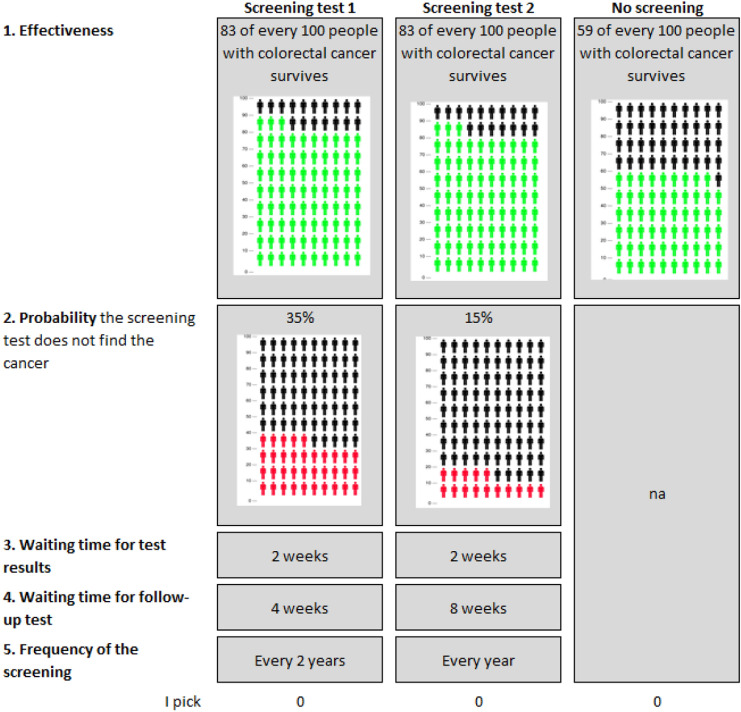
An online discrete choice experiment partly based on qualitative research was used among 406 representatives of the Dutch general population aged 55-75 years. In the discrete choice experiment, respondents were offered a series of choices between CRC screening scenarios that differed on five characteristics: effectiveness of the faecal immunochemical screening test, risk of a false-negative outcome, test frequency, waiting time for faecal immunochemical screening test results and waiting time for a colonoscopy follow-up test. The discrete choice experiment data were analysed in a systematic manner using random-utility-maximisation choice processes with scale and/or preference heterogeneity (based on 15 individual characteristics) and/or random intercepts.
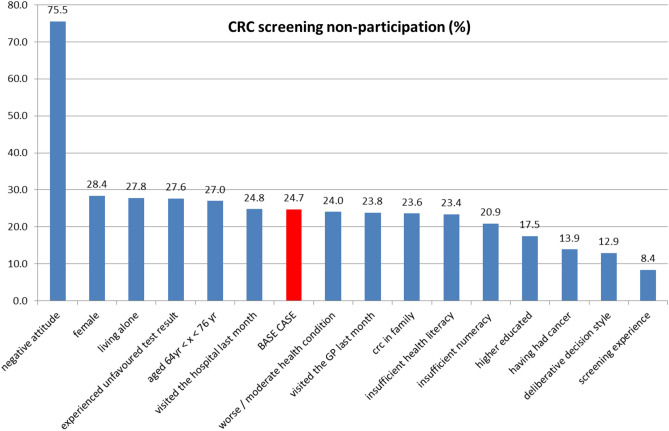
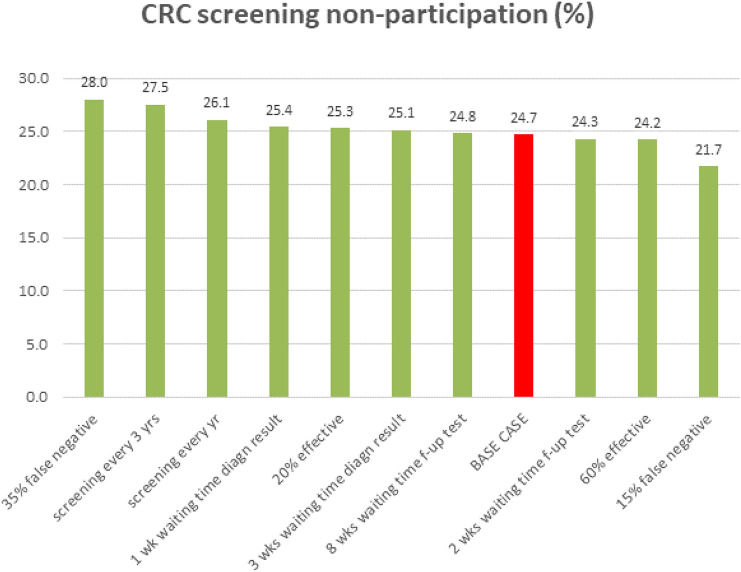
Screening characteristics proved to influence non-participation in CRC screening (21.7-28.0% non-participation rate), but an individual's characteristics had an even higher impact on CRC screening non-participation (8.4-75.5% non-participation rate); particularly the individual's attitude towards CRC screening followed by whether the individual had participated in a cancer screening programme before, the decision style of the individual and the educational level of the individual. Our findings provided a high degree of confidence in the internal-external validity.
This study showed that although screening characteristics proved to influence non-participation in CRC screening, a respondent's characteristics had a much higher impact on CRC screening non-participation. Policy makers and physicians can use our study insights to improve and tailor their communication plans regarding (CRC) screening for unscreened individuals.
为充分发挥结直肠癌(CRC)筛查的公共卫生策略潜力,需要降低其不参与率。为促进向未筛查者成功实施 CRC 筛查,本研究旨在定量评估筛查特征和个体特征对 CRC 筛查不参与的影响。
采用基于定性研究的部分在线离散选择实验,对 406 名年龄在 55-75 岁的荷兰一般人群代表进行调查。在离散选择实验中,受访者在一系列 CRC 筛查方案中进行选择,这些方案在五个特征上有所不同:粪便免疫化学检测的有效性、假阴性结果的风险、检测频率、粪便免疫化学检测结果的等待时间和结肠镜随访检测的等待时间。使用随机效用最大化选择过程(基于 15 个个体特征)和/或随机截距对离散选择实验数据进行系统分析,这些过程具有规模和/或偏好异质性。
筛查特征被证明会影响 CRC 筛查的不参与率(21.7-28.0%的不参与率),但个体特征对 CRC 筛查的不参与率有更高的影响(8.4-75.5%的不参与率);特别是个体对 CRC 筛查的态度,其次是个体之前是否参加过癌症筛查计划、个体的决策风格和个体的教育水平。我们的研究结果对内部和外部有效性提供了高度的置信度。
本研究表明,尽管筛查特征被证明会影响 CRC 筛查的不参与率,但受访者的特征对 CRC 筛查的不参与率有更高的影响。政策制定者和医生可以利用我们的研究结果来改进和定制针对未筛查者的(CRC)筛查沟通计划。