School of Business, Accounting and Law, CQUniversity, Brisbane, Australia.
Centre for Health Policy and Management, School of Medicine, Trinity College Dublin, The University of Dublin, Dublin, Ireland.
Eur J Health Econ. 2023 Aug;24(6):987-998. doi: 10.1007/s10198-022-01528-9. Epub 2022 Sep 28.
Understanding young people's preferences for healthcare is critical for reducing the negative effect of undesirable choices. This review aims to synthesise the evidence obtained from discrete choice experiments (DCEs) eliciting young people's preferences for healthcare interventions and service deliveries, specifically, to (1) examine the methodology, including a selection of attributes and levels, experimental design, estimation procedure and validity; (2) evaluate similarities, differences and rigour of designs to the general population DCEs; and, (3) compare the DCEs' application to the seven health priority areas defined by the World Health Organisation (WHO).
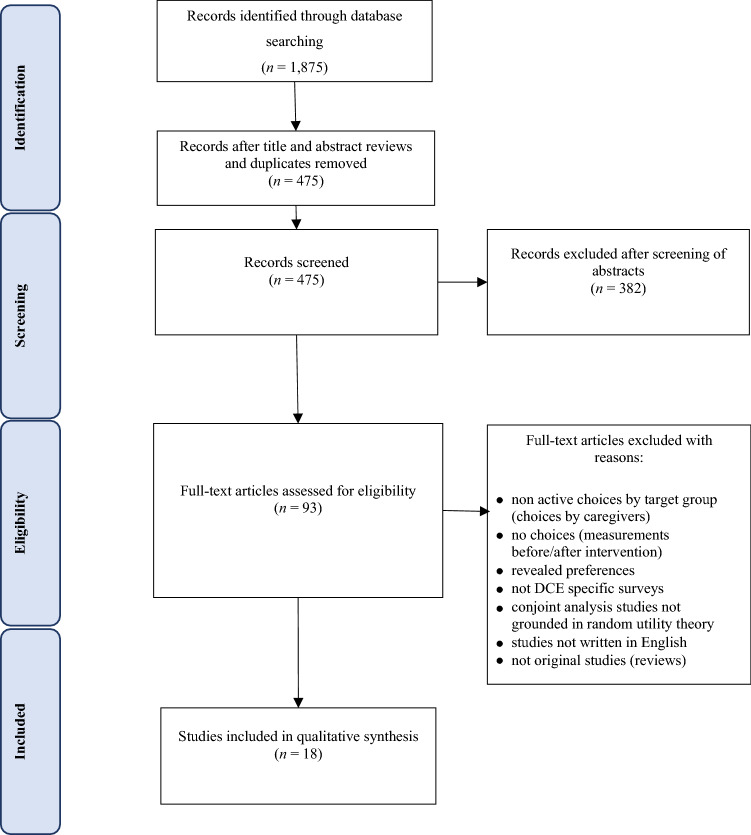
A systematic review searching Medline, EconLIT, PsychINFO, Scopus, and Web of Science was performed up until May 2021.
a DCE, eliciting young peoples' preferences (10-24 years of age), on a healthcare-related topic defined by WHO, peer-reviewed, full-text available in English. A bespoke checklist was used to assess the methodological quality of the included studies.
Eighteen DCE studies were included in the review, exploring interventions and service in sexual and reproductive health (n = 9; 50%), smoking cessation (n = 4; 22%), mental health (n = 1), nutrition (n = 1), unintentional injuries (n = 1), vaccination against severe but rare diseases (n = 1); and diabetes (n = 1). Compared to the general population, DCEs eliciting young people's preferences had a high proportion of monetary measures and a smaller number of choices per respondent with the overwhelming number of surveys using fractional factorial design. The majority of studies were of moderate quality (50-75% of the criteria met).
While identified DCEs touched on most health priority areas, the scope was limited. The conduct and reporting of DCEs with young people could be improved by including the state-of-the-art design, estimation procedures and analysis.
了解年轻人对医疗保健的偏好对于降低不良选择的负面影响至关重要。本综述旨在综合从离散选择实验(DCE)中获得的证据,这些实验旨在了解年轻人对医疗保健干预措施和服务提供的偏好,具体来说:(1)检查方法学,包括属性和水平的选择、实验设计、估计程序和有效性;(2)评估与一般人群 DCE 的设计的相似性、差异和严谨性;(3)比较 DCE 在世界卫生组织(WHO)确定的七个卫生优先领域的应用。
对截至 2021 年 5 月的 Medline、EconLIT、PsychINFO、Scopus 和 Web of Science 进行了系统检索。
DCE,调查年轻人对 WHO 定义的与医疗保健相关主题的偏好(10-24 岁),经同行评审,全文为英文。使用定制清单评估纳入研究的方法学质量。
本综述纳入了 18 项 DCE 研究,探讨了性与生殖健康(n=9;50%)、戒烟(n=4;22%)、心理健康(n=1)、营养(n=1)、意外伤害(n=1)、针对严重但罕见疾病的疫苗接种(n=1)和糖尿病(n=1)方面的干预措施和服务。与一般人群相比,调查年轻人偏好的 DCE 中有很高比例的货币措施,每个受访者的选择数量较少,绝大多数调查使用分阶因子设计。大多数研究的质量为中等(符合标准的 50-75%)。
虽然确定的 DCE 涉及了大多数卫生优先领域,但范围有限。通过纳入最新的设计、估计程序和分析,DCE 与年轻人的实施和报告可以得到改善。